

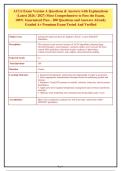
ACLS Exam Version A Questions & Answers with Explanations
(Latest ) Most Comprehensive to Pass the Exam,
100% Guaranteed Pass - 200 Questions and Answers Already
Graded A+ Premium Exam Tested And Verified
Subject Area Advanced Cardiovascular Life Support (ACLS) - Latest 2026/2027
Guidelines
Description This rigorous exam assesses mastery of ACLS algorithms, pharmacology,
electrical therapies, team dynamics, and post-cardiac arrest care per the most
current AHA guidelines. Questions require synthesis of physiology,
evidence-based interventions, and complex clinical decision-making.
Expected Grade A+
Total Questions 200
Duration 3 hours
Learning Outcomes 1. Integrate hemodynamic monitoring and capnography to guide resuscitation
2. Select appropriate antiarrhythmic therapies based on underlying rhythm and
etiology
3. Interpret 12-lead ECG patterns to identify ischemia, infarction, and electrolyte
disturbances
4. Apply post-arrest targeted temperature management and coronary reperfusion
strategies
5. Optimize team leadership and communication during high-acuity events
Accreditation Meets US accreditation standards for ACLS provider certification (AHA
2026/2027 guidelines)
Page 1
,1. A patient with suspected acute coronary syndrome develops a wide-complex
tachycardia with hemodynamic instability. Synchronized cardioversion is attempted
at 100 J biphasic, but the rhythm persists. Which of the following should be
performed next?
A. Increase energy to 200 J biphasic and repeat synchronized cardioversion
B. Administer amiodarone 300 mg IV push and repeat cardioversion at same energy
C. Switch to defibrillation (unsynchronized) at 200 J biphasic
D. Initiate transcutaneous pacing at 80 bpm with sedation
Answer: C. Switch to defibrillation (unsynchronized) at 200 J biphasic
Synchronized cardioversion is preferred for stable wide-complex tachycardia, but if the
patient is unstable and the rhythm persists after an initial shock, immediate
defibrillation (unsynchronized) is indicated because synchronization may fail to deliver
a shock if the device does not detect a suitable QRS complex. Increasing energy or
adding antiarrhythmics delays definitive therapy. Pacing is ineffective for
tachyarrhythmias.
2. During a cardiac arrest, a waveform capnography reading suddenly drops from
35 mmHg to 10 mmHg despite ongoing high-quality CPR. The rhythm on the
monitor is pulseless electrical activity (PEA). Which of the following is the most
likely cause?
A. Return of spontaneous circulation (ROSC)
B. Tension pneumothorax
C. Hyperventilation by the rescuer
D. Electrode displacement
Answer: B. Tension pneumothorax
A sudden drop in end-tidal CO2 (ETCO2) during CPR, especially in PEA, suggests a
critical reduction in cardiac output. Tension pneumothorax impairs venous return and
can cause abrupt ETCO2 decline. ROSC would typically show a rapid rise in ETCO2.
Hyperventilation reduces ETCO2 but is less acute. Electrode displacement would not
selectively lower ETCO2.
Page 2
,3. Which of the following ECG findings is most consistent with hyperkalemia and
warrants immediate intervention before it degenerates into ventricular fibrillation?
A. Prolonged QT interval with T-wave inversion
B. Wide QRS complex with tall, peaked T waves and loss of P wave
C. ST-segment elevation in leads II, III, and aVF with reciprocal depression
D. Sinus bradycardia with first-degree AV block
Answer: B. Wide QRS complex with tall, peaked T waves and loss of P wave
Hyperkalemia classically presents with tall, peaked T waves, widening of the QRS, and
eventual loss of P wave as potassium rises. This pattern indicates severe cardiotoxicity
and requires emergent calcium administration to prevent VF. Prolonged QT with T
inversion is seen in hypokalemia. ST elevation suggests ischemia. Sinus bradycardia
with first-degree block is not specific for hyperkalemia.
4. A patient in cardiac arrest due to ventricular fibrillation has received one shock
and 2 minutes of CPR. The rhythm check reveals persistent VF. Which of the
following is the most appropriate next step?
A. Administer amiodarone 300 mg IV/IO and resume CPR
B. Deliver a second shock at the same or higher energy and immediately resume CPR
C. Place an advanced airway and administer epinephrine 1 mg IV/IO
D. Administer lidocaine 1.5 mg/kg IV/IO and resume CPR
Answer: B. Deliver a second shock at the same or higher energy and immediately
resume CPR
For refractory VF, the priority is to continue the defibrillation-CPR cycle. After the
first shock and 2 minutes of CPR, if VF persists, a second shock should be delivered
immediately, then CPR resumed. Epinephrine is given after the second shock, and
antiarrhythmics (amiodarone or lidocaine) are typically given after the third shock.
Delaying defibrillation for medications worsens outcomes.
Page 3
, 5. Which of the following clinical scenarios is most appropriate for the use of
adenosine in a tachyarrhythmia?
A. A wide-complex tachycardia of uncertain origin with a rate of 180 bpm and blood
pressure 85/50 mmHg
B. A narrow-complex tachycardia with irregularly irregular rhythm and no P waves
C. A narrow-complex tachycardia with regular rhythm and rate 200 bpm, stable blood
pressure
D. A wide-complex tachycardia with a history of myocardial infarction and ejection fraction
30%
Answer: C. A narrow-complex tachycardia with regular rhythm and rate 200 bpm,
stable blood pressure
Adenosine is indicated for stable, regular, narrow-complex tachycardias, typically
supraventricular tachycardia (SVT) involving AV nodal reentry. It terminates the
rhythm by transiently blocking AV conduction. Option A is unstable and warrants
cardioversion. Option B describes atrial fibrillation (irregular), which is not terminated
by adenosine. Option D may be ventricular tachycardia, where adenosine is ineffective
and potentially harmful.
6. After ROSC, a patient remains unconscious with a Glasgow Coma Scale of 5. The
initial ECG shows ST-segment elevation in leads V1-V4. Which of the following is
the most appropriate immediate intervention?
A. Initiate targeted temperature management at 32-36°C for 24 hours
B. Proceed to emergent coronary angiography with percutaneous coronary intervention
C. Administer fibrinolytic therapy for presumed STEMI
D. Obtain a non-contrast head CT to rule out intracranial hemorrhage
Answer: B. Proceed to emergent coronary angiography with percutaneous
coronary intervention
In post-arrest patients with ST-elevation on ECG, emergent coronary angiography and
PCI are indicated regardless of neurologic status, as early revascularization improves
survival. Targeted temperature management should be initiated simultaneously but
does not take precedence over revascularization. Fibrinolysis is not first-line if PCI is
available. Head CT may be considered but should not delay angiography.
Page 4
(Latest ) Most Comprehensive to Pass the Exam,
100% Guaranteed Pass - 200 Questions and Answers Already
Graded A+ Premium Exam Tested And Verified
Subject Area Advanced Cardiovascular Life Support (ACLS) - Latest 2026/2027
Guidelines
Description This rigorous exam assesses mastery of ACLS algorithms, pharmacology,
electrical therapies, team dynamics, and post-cardiac arrest care per the most
current AHA guidelines. Questions require synthesis of physiology,
evidence-based interventions, and complex clinical decision-making.
Expected Grade A+
Total Questions 200
Duration 3 hours
Learning Outcomes 1. Integrate hemodynamic monitoring and capnography to guide resuscitation
2. Select appropriate antiarrhythmic therapies based on underlying rhythm and
etiology
3. Interpret 12-lead ECG patterns to identify ischemia, infarction, and electrolyte
disturbances
4. Apply post-arrest targeted temperature management and coronary reperfusion
strategies
5. Optimize team leadership and communication during high-acuity events
Accreditation Meets US accreditation standards for ACLS provider certification (AHA
2026/2027 guidelines)
Page 1
,1. A patient with suspected acute coronary syndrome develops a wide-complex
tachycardia with hemodynamic instability. Synchronized cardioversion is attempted
at 100 J biphasic, but the rhythm persists. Which of the following should be
performed next?
A. Increase energy to 200 J biphasic and repeat synchronized cardioversion
B. Administer amiodarone 300 mg IV push and repeat cardioversion at same energy
C. Switch to defibrillation (unsynchronized) at 200 J biphasic
D. Initiate transcutaneous pacing at 80 bpm with sedation
Answer: C. Switch to defibrillation (unsynchronized) at 200 J biphasic
Synchronized cardioversion is preferred for stable wide-complex tachycardia, but if the
patient is unstable and the rhythm persists after an initial shock, immediate
defibrillation (unsynchronized) is indicated because synchronization may fail to deliver
a shock if the device does not detect a suitable QRS complex. Increasing energy or
adding antiarrhythmics delays definitive therapy. Pacing is ineffective for
tachyarrhythmias.
2. During a cardiac arrest, a waveform capnography reading suddenly drops from
35 mmHg to 10 mmHg despite ongoing high-quality CPR. The rhythm on the
monitor is pulseless electrical activity (PEA). Which of the following is the most
likely cause?
A. Return of spontaneous circulation (ROSC)
B. Tension pneumothorax
C. Hyperventilation by the rescuer
D. Electrode displacement
Answer: B. Tension pneumothorax
A sudden drop in end-tidal CO2 (ETCO2) during CPR, especially in PEA, suggests a
critical reduction in cardiac output. Tension pneumothorax impairs venous return and
can cause abrupt ETCO2 decline. ROSC would typically show a rapid rise in ETCO2.
Hyperventilation reduces ETCO2 but is less acute. Electrode displacement would not
selectively lower ETCO2.
Page 2
,3. Which of the following ECG findings is most consistent with hyperkalemia and
warrants immediate intervention before it degenerates into ventricular fibrillation?
A. Prolonged QT interval with T-wave inversion
B. Wide QRS complex with tall, peaked T waves and loss of P wave
C. ST-segment elevation in leads II, III, and aVF with reciprocal depression
D. Sinus bradycardia with first-degree AV block
Answer: B. Wide QRS complex with tall, peaked T waves and loss of P wave
Hyperkalemia classically presents with tall, peaked T waves, widening of the QRS, and
eventual loss of P wave as potassium rises. This pattern indicates severe cardiotoxicity
and requires emergent calcium administration to prevent VF. Prolonged QT with T
inversion is seen in hypokalemia. ST elevation suggests ischemia. Sinus bradycardia
with first-degree block is not specific for hyperkalemia.
4. A patient in cardiac arrest due to ventricular fibrillation has received one shock
and 2 minutes of CPR. The rhythm check reveals persistent VF. Which of the
following is the most appropriate next step?
A. Administer amiodarone 300 mg IV/IO and resume CPR
B. Deliver a second shock at the same or higher energy and immediately resume CPR
C. Place an advanced airway and administer epinephrine 1 mg IV/IO
D. Administer lidocaine 1.5 mg/kg IV/IO and resume CPR
Answer: B. Deliver a second shock at the same or higher energy and immediately
resume CPR
For refractory VF, the priority is to continue the defibrillation-CPR cycle. After the
first shock and 2 minutes of CPR, if VF persists, a second shock should be delivered
immediately, then CPR resumed. Epinephrine is given after the second shock, and
antiarrhythmics (amiodarone or lidocaine) are typically given after the third shock.
Delaying defibrillation for medications worsens outcomes.
Page 3
, 5. Which of the following clinical scenarios is most appropriate for the use of
adenosine in a tachyarrhythmia?
A. A wide-complex tachycardia of uncertain origin with a rate of 180 bpm and blood
pressure 85/50 mmHg
B. A narrow-complex tachycardia with irregularly irregular rhythm and no P waves
C. A narrow-complex tachycardia with regular rhythm and rate 200 bpm, stable blood
pressure
D. A wide-complex tachycardia with a history of myocardial infarction and ejection fraction
30%
Answer: C. A narrow-complex tachycardia with regular rhythm and rate 200 bpm,
stable blood pressure
Adenosine is indicated for stable, regular, narrow-complex tachycardias, typically
supraventricular tachycardia (SVT) involving AV nodal reentry. It terminates the
rhythm by transiently blocking AV conduction. Option A is unstable and warrants
cardioversion. Option B describes atrial fibrillation (irregular), which is not terminated
by adenosine. Option D may be ventricular tachycardia, where adenosine is ineffective
and potentially harmful.
6. After ROSC, a patient remains unconscious with a Glasgow Coma Scale of 5. The
initial ECG shows ST-segment elevation in leads V1-V4. Which of the following is
the most appropriate immediate intervention?
A. Initiate targeted temperature management at 32-36°C for 24 hours
B. Proceed to emergent coronary angiography with percutaneous coronary intervention
C. Administer fibrinolytic therapy for presumed STEMI
D. Obtain a non-contrast head CT to rule out intracranial hemorrhage
Answer: B. Proceed to emergent coronary angiography with percutaneous
coronary intervention
In post-arrest patients with ST-elevation on ECG, emergent coronary angiography and
PCI are indicated regardless of neurologic status, as early revascularization improves
survival. Targeted temperature management should be initiated simultaneously but
does not take precedence over revascularization. Fibrinolysis is not first-line if PCI is
available. Head CT may be considered but should not delay angiography.
Page 4


