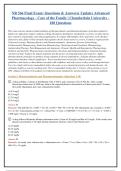
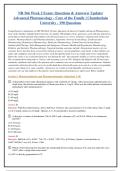
NR 566 Midterm & Final Exam: Questions & Answers( Update)
Advanced Pharmacology - Care of the Family | Chamberlain
University - 190 Questions
Comprehensive examination on NR 566 Midterm & Final Exam: Questions & Answers( Update) Advanced
Pharmacology - Care of the Family | Chamberlain University. It contains 190 multiple-choice questions, each
with four distractors and a fully worked rationale that explains why the keyed answer is correct. Content is
organized into 10 focused sections: Pharmacokinetics and Pharmacodynamics, Autonomic Nervous System
Drugs, Cardiovascular Pharmacology, Respiratory Pharmacology, Endocrine Pharmacology, Central Nervous
System Drugs, Antimicrobial Therapy, Pain Management and Analgesics, Women's Health and Reproductive
Pharmacology, Pediatric and Geriatric Pharmacology Considerations. Targeted learning outcomes include:
Demonstrate mastery of core concepts. Every item has been reviewed for clinical accuracy, current guidelines,
and clarity so that students can study with confidence and self-correct as they work through the bank. Use it as a
high-yield review immediately before the exam, or as a structured practice tool during the unit - the rationales
double as concise teaching notes. The recommended writing time is 3 hours, with a passing score of 70%. Aligned
with Aligned with US university standards. standards and reflects the question style commonly seen on accredited
program examinations. Students consistently achieving above the cut score on this bank have historically gone on
to earn A+ on the corresponding course exam. Read every stem carefully - distractors are written to look
plausible, and the best answer is sometimes the one that addresses the patient's most immediate physiological or
Section 1: Pharmacokinetics and Pharmacodynamics (Questions 1-10)
1 A drug follows first-order elimination kinetics and has a half-life of 4 hours. After a single intravenous bolus
dose, the plasma concentration at 8 hours is 25 mg/L. What was the initial plasma concentration?
A) 50 mg/L
B) 100 mg/L
C) 200 mg/L
D) 400 mg/L
Answer: B
Rationale: With first-order kinetics, after two half-lives (8 hours), the concentration decreases to 25% of the initial.
25 mg/L is 25% of 100 mg/L. Option A would be after one half-life; options C and D are too high.
2 Which of the following best describes the change in volume of distribution (Vd) when a drug is highly protein
bound and there is a decrease in plasma albumin concentration?
A) Vd decreases due to increased free drug concentration in plasma
B) Vd increases because more free drug is available to distribute into tissues
C) Vd remains unchanged because total drug concentration is unaffected
D) Vd increases only if the drug is also a weak base
Answer: B
Rationale: A decrease in albumin reduces protein binding, increasing the free fraction. More free drug can leave the
vascular space, increasing Vd. Option A is incorrect because Vd increases. Option C ignores the effect of binding
changes. Option D adds an irrelevant condition.
3 A drug is administered as a continuous intravenous infusion at a rate of 10 mg/h. The steady-state concentration
(Css) is 5 mg/L. If the infusion rate is doubled, what will be the new Css after a new steady state is achieved?
A) 5 mg/L
,B) 7.5 mg/L
C) 10 mg/L
D) 20 mg/L
Answer: C
Rationale: For a linear drug, Css is directly proportional to infusion rate: Css = rate / clearance. Doubling the rate
from 10 to 20 mg/h doubles Css from 5 to 10 mg/L. Option A would require no change; options B and D are
incorrect multiples.
4 A drug has a partition coefficient (log P) of 3.5 and is a weak acid with pKa 4.5. At a physiological pH of 7.4,
which statement best describes its absorption across the gastric mucosa (pH 2)?
A) Absorption is poor because the drug is mostly ionized in the stomach
B) Absorption is rapid because the drug is mostly nonionized and highly lipophilic
C) Absorption is slow because the drug is hydrophilic
D) Absorption is negligible due to first-pass metabolism
Answer: B
Rationale: At pH 2, a weak acid (pKa 4.5) is predominantly nonionized (Henderson-Hasselbalch). A high log P (3.5)
indicates lipophilicity, favoring passive diffusion. Option A is false; ionization is low. Option C is false; log P
indicates lipophilicity. Option D is about metabolism, not absorption.
5 Which of the following scenarios would most likely result in a drug exhibiting flip-flop kinetics?
A) Intravenous administration of a drug with a very short half-life
B) Oral administration of a drug whose absorption rate constant is smaller than its elimination rate constant
C) Topical application of a drug with high first-pass metabolism
D) Subcutaneous injection of a drug that is rapidly eliminated
Answer: B
Rationale: Flip-flop kinetics occurs when absorption is slower than elimination, so the terminal phase reflects
absorption. Option B describes that scenario. Option A (IV) has no absorption. Option C mentions first-pass, not
flip-flop. Option D: rapid elimination would not produce flip-flop if absorption is faster.
6 A drug is 90% bound to plasma proteins. Its clearance is 20 L/h and hepatic blood flow is 80 L/h. Which best
describes the extraction ratio and the effect of protein binding on clearance?
A) Low extraction ratio; clearance is sensitive to changes in protein binding
B) Low extraction ratio; clearance is insensitive to changes in protein binding
C) High extraction ratio; clearance is sensitive to changes in protein binding
D) High extraction ratio; clearance is insensitive to changes in protein binding
Answer: A
Rationale: Extraction ratio (E) = clearance / hepatic blood flow = 20/80 = 0.25, which is low (E < 0.3). For low E
drugs, clearance depends on intrinsic clearance and free fraction; thus, changes in protein binding affect clearance.
Option B is incorrect; option C and D are wrong because E is low.
7 A patient with chronic kidney disease (GFR 30 mL/min) is started on a drug that is primarily eliminated by
renal excretion. The drug's half-life in normal renal function (GFR 120 mL/min) is 6 hours. Assuming a linear
relationship between GFR and clearance, what is the expected half-life in this patient?
A) 12 hours
B) 24 hours
C) 48 hours
D) 6 hours
,Answer: B
Rationale: Clearance is proportional to GFR. Reduced to 30/120 = 1/4 of normal. Half-life is inversely proportional
to clearance, so half-life becomes 6 hours * (120/30) = 24 hours. Option A (12h) would be if GFR was 60; option C
(48h) for GFR 15; option D is normal.
8 Which of the following drugs would be most affected by a drug-drug interaction that inhibits cytochrome P450
3A4?
A) A drug that undergoes conjugation with glucuronic acid
B) A drug that is a substrate for P-glycoprotein but not metabolized
C) A drug that is metabolized primarily by CYP3A4 and has a high first-pass effect
D) A drug that is renally excreted unchanged
Answer: C
Rationale: Inhibition of CYP3A4 will increase the bioavailability and half-life of drugs metabolized by this enzyme,
especially those with high first-pass metabolism. Option A: conjugation is phase II, not directly affected. Option B:
P-gp is a transporter, not a metabolizing enzyme. Option D: renal excretion is not affected by CYP inhibition.
9 A drug displays nonlinear pharmacokinetics due to saturable metabolism. Which of the following is expected as
the dose is increased from a low to a high dose?
A) The area under the curve (AUC) increases proportionally with dose
B) The half-life decreases with increasing dose
C) The clearance decreases with increasing dose
D) The volume of distribution increases with dose
Answer: C
Rationale: With saturable metabolism, as dose increases, metabolic enzymes become saturated, leading to a decrease
in clearance. AUC increases more than proportionally. Option A would be linear; option B: half-life increases
(clearance decreases); option D: Vd is generally dose-independent.
10 A drug follows a two-compartment model after intravenous bolus. The initial rapid decline in plasma
concentration is primarily due to:
A) Metabolism and excretion
B) Distribution from central to peripheral compartment
C) Redistribution from peripheral back to central compartment
D) Saturation of protein binding sites
Answer: B
Rationale: In a two-compartment model, the initial rapid phase (alpha phase) reflects distribution of drug from the
central compartment to peripheral tissues. Option A describes elimination, which dominates the slower terminal
phase. Option C describes redistribution but that is not the primary cause of the initial decline. Option D is not
typical for a bolus.
Section 2: Autonomic Nervous System Drugs (Questions 11-30)
11 A patient with bradycardia and hypotension secondary to excessive vagal tone is being considered for
pharmacological intervention. Which agent would most selectively increase heart rate without causing
significant peripheral vasoconstriction?
A) Atropine
B) Isoproterenol
C) Epinephrine
, D) Dobutamine
Answer: A
Rationale: Atropine is a muscarinic antagonist that blocks vagal tone on the sinoatrial node, increasing heart rate
with minimal direct vascular effects. Isoproterenol is a non-selective beta agonist that also causes vasodilation and
tachycardia. Epinephrine and dobutamine have significant alpha or beta-1 effects leading to vasoconstriction or
inotropy, respectively.
12 A patient with asthma develops significant bronchospasm after inadvertent administration of a non-selective
beta-blocker. Which agent would be most appropriate to reverse this bronchospasm while minimizing cardiac
side effects?
A) Salbutamol (albuterol)
B) Terbutaline
C) Isoproterenol
D) Epinephrine
Answer: A
Rationale: Salbutamol is a selective beta-2 agonist that effectively reverses bronchospasm with minimal beta-1
cardiac stimulation. Terbutaline is also beta-2 selective but less commonly used. Isoproterenol and epinephrine are
non-selective and would cause significant tachycardia and potential arrhythmias.
13 A patient on long-term treatment for glaucoma using a topical beta-blocker develops bradycardia and exercise
intolerance. Which mechanism best explains these systemic effects?
A) Partial agonist activity at beta-1 receptors
B) Blockade of beta-2 receptors in the heart
C) Inhibition of adenylyl cyclase in cardiac myocytes
D) Antagonism of muscarinic receptors in the sinoatrial node
Answer: C
Rationale: Topical beta-blockers (e.g., timolol) are absorbed systemically and block beta-1 receptors in the heart,
inhibiting adenylyl cyclase and reducing cAMP, leading to decreased heart rate and contractility. Beta-2 blockade is
not primarily responsible for bradycardia. Partial agonist activity would increase heart rate. Muscarinic antagonism
would increase heart rate, not decrease it.
14 A patient with neurogenic orthostatic hypotension fails to respond to non-pharmacologic measures. Which
agent would be most appropriate to increase standing blood pressure by enhancing sympathetic outflow?
A) Midodrine
B) Fludrocortisone
C) Pyridostigmine
D) Phenylephrine
Answer: C
Rationale: Pyridostigmine, a cholinesterase inhibitor, increases acetylcholine at autonomic ganglia, enhancing
sympathetic outflow to the vasculature. Midodrine is a direct alpha-1 agonist. Fludrocortisone is a
mineralocorticoid that increases blood volume. Phenylephrine is a direct alpha-1 agonist that does not enhance
sympathetic outflow.
15 A patient with Alzheimer's disease is started on a centrally acting cholinesterase inhibitor. Which receptor
subtype is primarily responsible for the cognitive improvement observed?
A) Nicotinic alpha-7 receptors
B) Muscarinic M1 receptors
Advanced Pharmacology - Care of the Family | Chamberlain
University - 190 Questions
Comprehensive examination on NR 566 Midterm & Final Exam: Questions & Answers( Update) Advanced
Pharmacology - Care of the Family | Chamberlain University. It contains 190 multiple-choice questions, each
with four distractors and a fully worked rationale that explains why the keyed answer is correct. Content is
organized into 10 focused sections: Pharmacokinetics and Pharmacodynamics, Autonomic Nervous System
Drugs, Cardiovascular Pharmacology, Respiratory Pharmacology, Endocrine Pharmacology, Central Nervous
System Drugs, Antimicrobial Therapy, Pain Management and Analgesics, Women's Health and Reproductive
Pharmacology, Pediatric and Geriatric Pharmacology Considerations. Targeted learning outcomes include:
Demonstrate mastery of core concepts. Every item has been reviewed for clinical accuracy, current guidelines,
and clarity so that students can study with confidence and self-correct as they work through the bank. Use it as a
high-yield review immediately before the exam, or as a structured practice tool during the unit - the rationales
double as concise teaching notes. The recommended writing time is 3 hours, with a passing score of 70%. Aligned
with Aligned with US university standards. standards and reflects the question style commonly seen on accredited
program examinations. Students consistently achieving above the cut score on this bank have historically gone on
to earn A+ on the corresponding course exam. Read every stem carefully - distractors are written to look
plausible, and the best answer is sometimes the one that addresses the patient's most immediate physiological or
Section 1: Pharmacokinetics and Pharmacodynamics (Questions 1-10)
1 A drug follows first-order elimination kinetics and has a half-life of 4 hours. After a single intravenous bolus
dose, the plasma concentration at 8 hours is 25 mg/L. What was the initial plasma concentration?
A) 50 mg/L
B) 100 mg/L
C) 200 mg/L
D) 400 mg/L
Answer: B
Rationale: With first-order kinetics, after two half-lives (8 hours), the concentration decreases to 25% of the initial.
25 mg/L is 25% of 100 mg/L. Option A would be after one half-life; options C and D are too high.
2 Which of the following best describes the change in volume of distribution (Vd) when a drug is highly protein
bound and there is a decrease in plasma albumin concentration?
A) Vd decreases due to increased free drug concentration in plasma
B) Vd increases because more free drug is available to distribute into tissues
C) Vd remains unchanged because total drug concentration is unaffected
D) Vd increases only if the drug is also a weak base
Answer: B
Rationale: A decrease in albumin reduces protein binding, increasing the free fraction. More free drug can leave the
vascular space, increasing Vd. Option A is incorrect because Vd increases. Option C ignores the effect of binding
changes. Option D adds an irrelevant condition.
3 A drug is administered as a continuous intravenous infusion at a rate of 10 mg/h. The steady-state concentration
(Css) is 5 mg/L. If the infusion rate is doubled, what will be the new Css after a new steady state is achieved?
A) 5 mg/L
,B) 7.5 mg/L
C) 10 mg/L
D) 20 mg/L
Answer: C
Rationale: For a linear drug, Css is directly proportional to infusion rate: Css = rate / clearance. Doubling the rate
from 10 to 20 mg/h doubles Css from 5 to 10 mg/L. Option A would require no change; options B and D are
incorrect multiples.
4 A drug has a partition coefficient (log P) of 3.5 and is a weak acid with pKa 4.5. At a physiological pH of 7.4,
which statement best describes its absorption across the gastric mucosa (pH 2)?
A) Absorption is poor because the drug is mostly ionized in the stomach
B) Absorption is rapid because the drug is mostly nonionized and highly lipophilic
C) Absorption is slow because the drug is hydrophilic
D) Absorption is negligible due to first-pass metabolism
Answer: B
Rationale: At pH 2, a weak acid (pKa 4.5) is predominantly nonionized (Henderson-Hasselbalch). A high log P (3.5)
indicates lipophilicity, favoring passive diffusion. Option A is false; ionization is low. Option C is false; log P
indicates lipophilicity. Option D is about metabolism, not absorption.
5 Which of the following scenarios would most likely result in a drug exhibiting flip-flop kinetics?
A) Intravenous administration of a drug with a very short half-life
B) Oral administration of a drug whose absorption rate constant is smaller than its elimination rate constant
C) Topical application of a drug with high first-pass metabolism
D) Subcutaneous injection of a drug that is rapidly eliminated
Answer: B
Rationale: Flip-flop kinetics occurs when absorption is slower than elimination, so the terminal phase reflects
absorption. Option B describes that scenario. Option A (IV) has no absorption. Option C mentions first-pass, not
flip-flop. Option D: rapid elimination would not produce flip-flop if absorption is faster.
6 A drug is 90% bound to plasma proteins. Its clearance is 20 L/h and hepatic blood flow is 80 L/h. Which best
describes the extraction ratio and the effect of protein binding on clearance?
A) Low extraction ratio; clearance is sensitive to changes in protein binding
B) Low extraction ratio; clearance is insensitive to changes in protein binding
C) High extraction ratio; clearance is sensitive to changes in protein binding
D) High extraction ratio; clearance is insensitive to changes in protein binding
Answer: A
Rationale: Extraction ratio (E) = clearance / hepatic blood flow = 20/80 = 0.25, which is low (E < 0.3). For low E
drugs, clearance depends on intrinsic clearance and free fraction; thus, changes in protein binding affect clearance.
Option B is incorrect; option C and D are wrong because E is low.
7 A patient with chronic kidney disease (GFR 30 mL/min) is started on a drug that is primarily eliminated by
renal excretion. The drug's half-life in normal renal function (GFR 120 mL/min) is 6 hours. Assuming a linear
relationship between GFR and clearance, what is the expected half-life in this patient?
A) 12 hours
B) 24 hours
C) 48 hours
D) 6 hours
,Answer: B
Rationale: Clearance is proportional to GFR. Reduced to 30/120 = 1/4 of normal. Half-life is inversely proportional
to clearance, so half-life becomes 6 hours * (120/30) = 24 hours. Option A (12h) would be if GFR was 60; option C
(48h) for GFR 15; option D is normal.
8 Which of the following drugs would be most affected by a drug-drug interaction that inhibits cytochrome P450
3A4?
A) A drug that undergoes conjugation with glucuronic acid
B) A drug that is a substrate for P-glycoprotein but not metabolized
C) A drug that is metabolized primarily by CYP3A4 and has a high first-pass effect
D) A drug that is renally excreted unchanged
Answer: C
Rationale: Inhibition of CYP3A4 will increase the bioavailability and half-life of drugs metabolized by this enzyme,
especially those with high first-pass metabolism. Option A: conjugation is phase II, not directly affected. Option B:
P-gp is a transporter, not a metabolizing enzyme. Option D: renal excretion is not affected by CYP inhibition.
9 A drug displays nonlinear pharmacokinetics due to saturable metabolism. Which of the following is expected as
the dose is increased from a low to a high dose?
A) The area under the curve (AUC) increases proportionally with dose
B) The half-life decreases with increasing dose
C) The clearance decreases with increasing dose
D) The volume of distribution increases with dose
Answer: C
Rationale: With saturable metabolism, as dose increases, metabolic enzymes become saturated, leading to a decrease
in clearance. AUC increases more than proportionally. Option A would be linear; option B: half-life increases
(clearance decreases); option D: Vd is generally dose-independent.
10 A drug follows a two-compartment model after intravenous bolus. The initial rapid decline in plasma
concentration is primarily due to:
A) Metabolism and excretion
B) Distribution from central to peripheral compartment
C) Redistribution from peripheral back to central compartment
D) Saturation of protein binding sites
Answer: B
Rationale: In a two-compartment model, the initial rapid phase (alpha phase) reflects distribution of drug from the
central compartment to peripheral tissues. Option A describes elimination, which dominates the slower terminal
phase. Option C describes redistribution but that is not the primary cause of the initial decline. Option D is not
typical for a bolus.
Section 2: Autonomic Nervous System Drugs (Questions 11-30)
11 A patient with bradycardia and hypotension secondary to excessive vagal tone is being considered for
pharmacological intervention. Which agent would most selectively increase heart rate without causing
significant peripheral vasoconstriction?
A) Atropine
B) Isoproterenol
C) Epinephrine
, D) Dobutamine
Answer: A
Rationale: Atropine is a muscarinic antagonist that blocks vagal tone on the sinoatrial node, increasing heart rate
with minimal direct vascular effects. Isoproterenol is a non-selective beta agonist that also causes vasodilation and
tachycardia. Epinephrine and dobutamine have significant alpha or beta-1 effects leading to vasoconstriction or
inotropy, respectively.
12 A patient with asthma develops significant bronchospasm after inadvertent administration of a non-selective
beta-blocker. Which agent would be most appropriate to reverse this bronchospasm while minimizing cardiac
side effects?
A) Salbutamol (albuterol)
B) Terbutaline
C) Isoproterenol
D) Epinephrine
Answer: A
Rationale: Salbutamol is a selective beta-2 agonist that effectively reverses bronchospasm with minimal beta-1
cardiac stimulation. Terbutaline is also beta-2 selective but less commonly used. Isoproterenol and epinephrine are
non-selective and would cause significant tachycardia and potential arrhythmias.
13 A patient on long-term treatment for glaucoma using a topical beta-blocker develops bradycardia and exercise
intolerance. Which mechanism best explains these systemic effects?
A) Partial agonist activity at beta-1 receptors
B) Blockade of beta-2 receptors in the heart
C) Inhibition of adenylyl cyclase in cardiac myocytes
D) Antagonism of muscarinic receptors in the sinoatrial node
Answer: C
Rationale: Topical beta-blockers (e.g., timolol) are absorbed systemically and block beta-1 receptors in the heart,
inhibiting adenylyl cyclase and reducing cAMP, leading to decreased heart rate and contractility. Beta-2 blockade is
not primarily responsible for bradycardia. Partial agonist activity would increase heart rate. Muscarinic antagonism
would increase heart rate, not decrease it.
14 A patient with neurogenic orthostatic hypotension fails to respond to non-pharmacologic measures. Which
agent would be most appropriate to increase standing blood pressure by enhancing sympathetic outflow?
A) Midodrine
B) Fludrocortisone
C) Pyridostigmine
D) Phenylephrine
Answer: C
Rationale: Pyridostigmine, a cholinesterase inhibitor, increases acetylcholine at autonomic ganglia, enhancing
sympathetic outflow to the vasculature. Midodrine is a direct alpha-1 agonist. Fludrocortisone is a
mineralocorticoid that increases blood volume. Phenylephrine is a direct alpha-1 agonist that does not enhance
sympathetic outflow.
15 A patient with Alzheimer's disease is started on a centrally acting cholinesterase inhibitor. Which receptor
subtype is primarily responsible for the cognitive improvement observed?
A) Nicotinic alpha-7 receptors
B) Muscarinic M1 receptors