
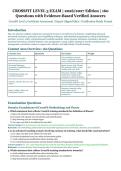
CROSSFIT LEVEL 3 EXAM | 2026/2027 Edition | 160
Questions with Evidence-Based Verified Answers
CrossFit Level 3 Certificate Assessment | Expert-Aligned Q&A | Certification-Ready Format
Introduction
This 160-question original competency assessment focuses on CrossFit Level 3 domains, emphasizing advanced
movement mechanics, gymnastics and weightlifting techniques, individualized programming, scaling methodologies,
nutrition, recovery, safety, and professional coaching standards. Items integrate mechanics-consistency-intensity,
functional movement, intended stimulus, class management, cueing, athlete adaptation, nutrition fundamentals, risk
management, and ethical conduct to support safe, effective, and high-fidelity CrossFit training.
Content Area Overview: 160 Questions
Content Area Questions Key Topics Weight
Fitness definition, intensity,
Foundations of CrossFit
32 variance, functional movement, 20%
Methodology and Theory
power, scaling, data, virtuosity
Movement Mechanics: Squats, presses, pulls, Olympic
Gymnastics, Weightlifting, and 48 lifts, gymnastics skills, rowing, 30%
Monostructural running, jump rope, faults
Class plans, stimulus, scaling,
Programming, Scaling, and
40 progressions, cueing, group 25%
Coaching Techniques
management, athlete adaptation
Nutrition fundamentals,
Nutrition, Lifestyle, Recovery, and
24 macronutrients, hydration, sleep, 15%
Fitness
recovery, behavior change, scope
Emergency planning, facility
Safety, Liability, Ethics, and safety, scope, privacy,
16 10%
Professional Conduct documentation, boundaries, risk
management
Examination Questions
Domain: Foundations of CrossFit Methodology and Theory
1. Which statement best reflects CrossFit training standards for definition of fitness?
A. Ignore the intended stimulus and use the same prescription for everyone
B. Increased work capacity across broad time and modal domains
C. Stop observing once the workout begins
D. Use vague cues that do not address the main fault
Correct Answer: B. Increased work capacity across broad time and modal domains
Rationale: The methodology defines fitness by measurable capacity across varied tasks, durations, and modalities.
2. In an advanced coaching scenario involving variance in training, what should the coach prioritize?
A. Use vague cues that do not address the main fault
B. Prioritize leaderboard score over safety and movement quality
C. Avoid scaling because modification reduces training value
D. Use varied functional movements and time domains while preserving purposeful stimulus
Correct Answer: D. Use varied functional movements and time domains while preserving purposeful stimulus
Rationale: Variance develops broad capacity when it is intentional rather than random.
3. Which statement best reflects CrossFit training standards for intensity?
A. Avoid scaling because modification reduces training value
B. Prioritize relative intensity after mechanics and consistency are established
C. Skip documentation and athlete communication
, D. Replace coaching judgment with random workout selection
Correct Answer: B. Prioritize relative intensity after mechanics and consistency are established
Rationale: Intensity drives adaptation, but it must be appropriate to the athlete and quality of movement.
4. In an advanced coaching scenario involving mechanics consistency intensity hierarchy, what should
the coach prioritize?
A. Replace coaching judgment with random workout selection
B. Increase load before the athlete can demonstrate sound mechanics
C. Ignore the intended stimulus and use the same prescription for everyone
D. Develop sound mechanics, then consistency, then intensity
Correct Answer: D. Develop sound mechanics, then consistency, then intensity
Rationale: This sequence protects safety and preserves long-term progress.
5. Which statement best reflects CrossFit training standards for threshold training?
A. Ignore the intended stimulus and use the same prescription for everyone
B. Train near the edge of current capacity while preserving movement quality
C. Stop observing once the workout begins
D. Use vague cues that do not address the main fault
Correct Answer: B. Train near the edge of current capacity while preserving movement quality
Rationale: Threshold training helps athletes improve without allowing technique to collapse.
6. In an advanced coaching scenario involving functional movement, what should the coach prioritize?
A. Use vague cues that do not address the main fault
B. Prioritize leaderboard score over safety and movement quality
C. Avoid scaling because modification reduces training value
D. Emphasize movements that are natural, essential, compound, and capable of moving large loads long distances quickly
Correct Answer: D. Emphasize movements that are natural, essential, compound, and capable of moving large
loads long distances quickly
Rationale: Functional movements are central because they produce high power and transfer to life and sport.
7. Which statement best reflects CrossFit training standards for power output?
A. Avoid scaling because modification reduces training value
B. Measure work divided by time to quantify intensity
C. Skip documentation and athlete communication
D. Replace coaching judgment with random workout selection
Correct Answer: B. Measure work divided by time to quantify intensity
Rationale: Power provides an objective way to compare output and adaptation.
8. In an advanced coaching scenario involving general physical preparedness, what should the coach
prioritize?
A. Replace coaching judgment with random workout selection
B. Increase load before the athlete can demonstrate sound mechanics
C. Ignore the intended stimulus and use the same prescription for everyone
D. Develop broad capacity rather than specializing narrowly
Correct Answer: D. Develop broad capacity rather than specializing narrowly
Rationale: General preparation supports readiness for unknown and varied demands.
9. Which statement best reflects CrossFit training standards for relative intensity?
A. Ignore the intended stimulus and use the same prescription for everyone
B. Scale loading, volume, and complexity so the athlete experiences the intended stimulus safely
C. Stop observing once the workout begins
D. Use vague cues that do not address the main fault
Correct Answer: B. Scale loading, volume, and complexity so the athlete experiences the intended stimulus safely
Rationale: Relative intensity allows different athletes to train productively in the same session.
10. In an advanced coaching scenario involving training stimulus, what should the coach prioritize?
A. Use vague cues that do not address the main fault
B. Prioritize leaderboard score over safety and movement quality
C. Avoid scaling because modification reduces training value
D. Identify the intended metabolic, strength, skill, and psychological demand before coaching the workout
Correct Answer: D. Identify the intended metabolic, strength, skill, and psychological demand before coaching the
workout
, Rationale: Coaching choices should preserve the intended response rather than simply copying written loads.
11. Which statement best reflects CrossFit training standards for measurable observable repeatable
data?
A. Avoid scaling because modification reduces training value
B. Use objective scores, times, loads, ranges, and movement standards to track progress
C. Skip documentation and athlete communication
D. Replace coaching judgment with random workout selection
Correct Answer: B. Use objective scores, times, loads, ranges, and movement standards to track progress
Rationale: Objective measurement supports accountability and program evaluation.
12. In an advanced coaching scenario involving modal domain balance, what should the coach
prioritize?
A. Replace coaching judgment with random workout selection
B. Increase load before the athlete can demonstrate sound mechanics
C. Ignore the intended stimulus and use the same prescription for everyone
D. Include gymnastics, weightlifting, monostructural work, and combinations over time
Correct Answer: D. Include gymnastics, weightlifting, monostructural work, and combinations over time
Rationale: Broad exposure develops balanced capacity.
13. Which statement best reflects CrossFit training standards for metabolic pathways?
A. Ignore the intended stimulus and use the same prescription for everyone
B. Program phosphagen, glycolytic, and oxidative demands across varied durations
C. Stop observing once the workout begins
D. Use vague cues that do not address the main fault
Correct Answer: B. Program phosphagen, glycolytic, and oxidative demands across varied durations
Rationale: Different durations and intensities stress different energy systems.
14. In an advanced coaching scenario involving virtuosity, what should the coach prioritize?
A. Use vague cues that do not address the main fault
B. Prioritize leaderboard score over safety and movement quality
C. Avoid scaling because modification reduces training value
D. Perform common movements uncommonly well
Correct Answer: D. Perform common movements uncommonly well
Rationale: Excellence in fundamentals creates safer and more effective training.
15. Which statement best reflects CrossFit training standards for coach role in methodology?
A. Avoid scaling because modification reduces training value
B. Teach, see, correct, group manage, demonstrate, and create a professional learning environment
C. Skip documentation and athlete communication
D. Replace coaching judgment with random workout selection
Correct Answer: B. Teach, see, correct, group manage, demonstrate, and create a professional learning
environment
Rationale: Effective coaching integrates technical, interpersonal, and organizational skills.
16. In an advanced coaching scenario involving evidence of fitness improvement, what should the coach
prioritize?
A. Replace coaching judgment with random workout selection
B. Increase load before the athlete can demonstrate sound mechanics
C. Ignore the intended stimulus and use the same prescription for everyone
D. Look for improved performance, better movement quality, and improved health markers
Correct Answer: D. Look for improved performance, better movement quality, and improved health markers
Rationale: Fitness gains should be visible in both performance and health outcomes.
17. Which statement best reflects CrossFit training standards for capacity before specialization?
A. Ignore the intended stimulus and use the same prescription for everyone
B. Build broad movement and energy-system capacity before narrowing focus
C. Stop observing once the workout begins
D. Use vague cues that do not address the main fault
Correct Answer: B. Build broad movement and energy-system capacity before narrowing focus
Rationale: A broad base supports resilience and transfer.
18. In an advanced coaching scenario involving scaling purpose, what should the coach prioritize?
Questions with Evidence-Based Verified Answers
CrossFit Level 3 Certificate Assessment | Expert-Aligned Q&A | Certification-Ready Format
Introduction
This 160-question original competency assessment focuses on CrossFit Level 3 domains, emphasizing advanced
movement mechanics, gymnastics and weightlifting techniques, individualized programming, scaling methodologies,
nutrition, recovery, safety, and professional coaching standards. Items integrate mechanics-consistency-intensity,
functional movement, intended stimulus, class management, cueing, athlete adaptation, nutrition fundamentals, risk
management, and ethical conduct to support safe, effective, and high-fidelity CrossFit training.
Content Area Overview: 160 Questions
Content Area Questions Key Topics Weight
Fitness definition, intensity,
Foundations of CrossFit
32 variance, functional movement, 20%
Methodology and Theory
power, scaling, data, virtuosity
Movement Mechanics: Squats, presses, pulls, Olympic
Gymnastics, Weightlifting, and 48 lifts, gymnastics skills, rowing, 30%
Monostructural running, jump rope, faults
Class plans, stimulus, scaling,
Programming, Scaling, and
40 progressions, cueing, group 25%
Coaching Techniques
management, athlete adaptation
Nutrition fundamentals,
Nutrition, Lifestyle, Recovery, and
24 macronutrients, hydration, sleep, 15%
Fitness
recovery, behavior change, scope
Emergency planning, facility
Safety, Liability, Ethics, and safety, scope, privacy,
16 10%
Professional Conduct documentation, boundaries, risk
management
Examination Questions
Domain: Foundations of CrossFit Methodology and Theory
1. Which statement best reflects CrossFit training standards for definition of fitness?
A. Ignore the intended stimulus and use the same prescription for everyone
B. Increased work capacity across broad time and modal domains
C. Stop observing once the workout begins
D. Use vague cues that do not address the main fault
Correct Answer: B. Increased work capacity across broad time and modal domains
Rationale: The methodology defines fitness by measurable capacity across varied tasks, durations, and modalities.
2. In an advanced coaching scenario involving variance in training, what should the coach prioritize?
A. Use vague cues that do not address the main fault
B. Prioritize leaderboard score over safety and movement quality
C. Avoid scaling because modification reduces training value
D. Use varied functional movements and time domains while preserving purposeful stimulus
Correct Answer: D. Use varied functional movements and time domains while preserving purposeful stimulus
Rationale: Variance develops broad capacity when it is intentional rather than random.
3. Which statement best reflects CrossFit training standards for intensity?
A. Avoid scaling because modification reduces training value
B. Prioritize relative intensity after mechanics and consistency are established
C. Skip documentation and athlete communication
, D. Replace coaching judgment with random workout selection
Correct Answer: B. Prioritize relative intensity after mechanics and consistency are established
Rationale: Intensity drives adaptation, but it must be appropriate to the athlete and quality of movement.
4. In an advanced coaching scenario involving mechanics consistency intensity hierarchy, what should
the coach prioritize?
A. Replace coaching judgment with random workout selection
B. Increase load before the athlete can demonstrate sound mechanics
C. Ignore the intended stimulus and use the same prescription for everyone
D. Develop sound mechanics, then consistency, then intensity
Correct Answer: D. Develop sound mechanics, then consistency, then intensity
Rationale: This sequence protects safety and preserves long-term progress.
5. Which statement best reflects CrossFit training standards for threshold training?
A. Ignore the intended stimulus and use the same prescription for everyone
B. Train near the edge of current capacity while preserving movement quality
C. Stop observing once the workout begins
D. Use vague cues that do not address the main fault
Correct Answer: B. Train near the edge of current capacity while preserving movement quality
Rationale: Threshold training helps athletes improve without allowing technique to collapse.
6. In an advanced coaching scenario involving functional movement, what should the coach prioritize?
A. Use vague cues that do not address the main fault
B. Prioritize leaderboard score over safety and movement quality
C. Avoid scaling because modification reduces training value
D. Emphasize movements that are natural, essential, compound, and capable of moving large loads long distances quickly
Correct Answer: D. Emphasize movements that are natural, essential, compound, and capable of moving large
loads long distances quickly
Rationale: Functional movements are central because they produce high power and transfer to life and sport.
7. Which statement best reflects CrossFit training standards for power output?
A. Avoid scaling because modification reduces training value
B. Measure work divided by time to quantify intensity
C. Skip documentation and athlete communication
D. Replace coaching judgment with random workout selection
Correct Answer: B. Measure work divided by time to quantify intensity
Rationale: Power provides an objective way to compare output and adaptation.
8. In an advanced coaching scenario involving general physical preparedness, what should the coach
prioritize?
A. Replace coaching judgment with random workout selection
B. Increase load before the athlete can demonstrate sound mechanics
C. Ignore the intended stimulus and use the same prescription for everyone
D. Develop broad capacity rather than specializing narrowly
Correct Answer: D. Develop broad capacity rather than specializing narrowly
Rationale: General preparation supports readiness for unknown and varied demands.
9. Which statement best reflects CrossFit training standards for relative intensity?
A. Ignore the intended stimulus and use the same prescription for everyone
B. Scale loading, volume, and complexity so the athlete experiences the intended stimulus safely
C. Stop observing once the workout begins
D. Use vague cues that do not address the main fault
Correct Answer: B. Scale loading, volume, and complexity so the athlete experiences the intended stimulus safely
Rationale: Relative intensity allows different athletes to train productively in the same session.
10. In an advanced coaching scenario involving training stimulus, what should the coach prioritize?
A. Use vague cues that do not address the main fault
B. Prioritize leaderboard score over safety and movement quality
C. Avoid scaling because modification reduces training value
D. Identify the intended metabolic, strength, skill, and psychological demand before coaching the workout
Correct Answer: D. Identify the intended metabolic, strength, skill, and psychological demand before coaching the
workout
, Rationale: Coaching choices should preserve the intended response rather than simply copying written loads.
11. Which statement best reflects CrossFit training standards for measurable observable repeatable
data?
A. Avoid scaling because modification reduces training value
B. Use objective scores, times, loads, ranges, and movement standards to track progress
C. Skip documentation and athlete communication
D. Replace coaching judgment with random workout selection
Correct Answer: B. Use objective scores, times, loads, ranges, and movement standards to track progress
Rationale: Objective measurement supports accountability and program evaluation.
12. In an advanced coaching scenario involving modal domain balance, what should the coach
prioritize?
A. Replace coaching judgment with random workout selection
B. Increase load before the athlete can demonstrate sound mechanics
C. Ignore the intended stimulus and use the same prescription for everyone
D. Include gymnastics, weightlifting, monostructural work, and combinations over time
Correct Answer: D. Include gymnastics, weightlifting, monostructural work, and combinations over time
Rationale: Broad exposure develops balanced capacity.
13. Which statement best reflects CrossFit training standards for metabolic pathways?
A. Ignore the intended stimulus and use the same prescription for everyone
B. Program phosphagen, glycolytic, and oxidative demands across varied durations
C. Stop observing once the workout begins
D. Use vague cues that do not address the main fault
Correct Answer: B. Program phosphagen, glycolytic, and oxidative demands across varied durations
Rationale: Different durations and intensities stress different energy systems.
14. In an advanced coaching scenario involving virtuosity, what should the coach prioritize?
A. Use vague cues that do not address the main fault
B. Prioritize leaderboard score over safety and movement quality
C. Avoid scaling because modification reduces training value
D. Perform common movements uncommonly well
Correct Answer: D. Perform common movements uncommonly well
Rationale: Excellence in fundamentals creates safer and more effective training.
15. Which statement best reflects CrossFit training standards for coach role in methodology?
A. Avoid scaling because modification reduces training value
B. Teach, see, correct, group manage, demonstrate, and create a professional learning environment
C. Skip documentation and athlete communication
D. Replace coaching judgment with random workout selection
Correct Answer: B. Teach, see, correct, group manage, demonstrate, and create a professional learning
environment
Rationale: Effective coaching integrates technical, interpersonal, and organizational skills.
16. In an advanced coaching scenario involving evidence of fitness improvement, what should the coach
prioritize?
A. Replace coaching judgment with random workout selection
B. Increase load before the athlete can demonstrate sound mechanics
C. Ignore the intended stimulus and use the same prescription for everyone
D. Look for improved performance, better movement quality, and improved health markers
Correct Answer: D. Look for improved performance, better movement quality, and improved health markers
Rationale: Fitness gains should be visible in both performance and health outcomes.
17. Which statement best reflects CrossFit training standards for capacity before specialization?
A. Ignore the intended stimulus and use the same prescription for everyone
B. Build broad movement and energy-system capacity before narrowing focus
C. Stop observing once the workout begins
D. Use vague cues that do not address the main fault
Correct Answer: B. Build broad movement and energy-system capacity before narrowing focus
Rationale: A broad base supports resilience and transfer.
18. In an advanced coaching scenario involving scaling purpose, what should the coach prioritize?


