

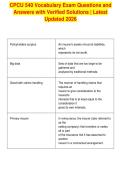
CPCU 540 Vocabulary Exam Questions and
Answers with Verified Solutions | Latest
Updated 2026
Policyholders surplus An insurer's assets minus its liabilities,
which
represents its net worth.
Big data Sets of data that are too large to be
gathered and
analyzed by traditional methods.
Good-faith claims handling The manner of handling claims that
requires an
insurer to give consideration to the
insured's
interests that is at least equal to the
consideration it
gives its own interests.
Primary insurer In reinsurance, the insurer (also referred to
as the
ceding company) that transfers or cedes
all or part
of the insurance risk it has assumed to
another
insurer in a contractual arrangement.
,Reinsurer The insurer that assumes some or all of
the
potential costs of insured loss exposures
of the
primary insurer in an reinsurance
contractual
agreement.
Ceding commission An amount paid by the reinsurer to the
primary
insurer to cover part or all of the primary
insurer's
policy acquisition expenses and other
costs.
Large-line capacity An insurer's ability to provide larger
amounts of
insurance for property loss exposures, or
higher
limits of liability for liability loss exposures,
than it is
otherwise willing to provide.
Surplus relief A flow of funds into an insurer's
policyholders'
surplus when policyholders' surplus has
been
reduced by the insurer's rapid growth in
written
premiums.
, Line underwriter An underwriter who is primarily responsible
for
implementing the steps in the underwriting
process.
Staff underwriter An underwriter who assists underwriting
management with making and
implementing
underwriting policy.
Combined Ratio A profitability ratio that indicates whether
an insurer
has made an underwriting loss or gain.
Hit ratio The ratio of insurance policies written to
those that
have been quoted to applicants for
insurance.
Loss ratio A ratio that measures losses and loss
adjustment
expenses against earned premiums and
that
reflects the percentage of premiums being
consumed by losses.
Reserve The amount the insurer estimates and sets
aside to
pay on an existing claim.
Answers with Verified Solutions | Latest
Updated 2026
Policyholders surplus An insurer's assets minus its liabilities,
which
represents its net worth.
Big data Sets of data that are too large to be
gathered and
analyzed by traditional methods.
Good-faith claims handling The manner of handling claims that
requires an
insurer to give consideration to the
insured's
interests that is at least equal to the
consideration it
gives its own interests.
Primary insurer In reinsurance, the insurer (also referred to
as the
ceding company) that transfers or cedes
all or part
of the insurance risk it has assumed to
another
insurer in a contractual arrangement.
,Reinsurer The insurer that assumes some or all of
the
potential costs of insured loss exposures
of the
primary insurer in an reinsurance
contractual
agreement.
Ceding commission An amount paid by the reinsurer to the
primary
insurer to cover part or all of the primary
insurer's
policy acquisition expenses and other
costs.
Large-line capacity An insurer's ability to provide larger
amounts of
insurance for property loss exposures, or
higher
limits of liability for liability loss exposures,
than it is
otherwise willing to provide.
Surplus relief A flow of funds into an insurer's
policyholders'
surplus when policyholders' surplus has
been
reduced by the insurer's rapid growth in
written
premiums.
, Line underwriter An underwriter who is primarily responsible
for
implementing the steps in the underwriting
process.
Staff underwriter An underwriter who assists underwriting
management with making and
implementing
underwriting policy.
Combined Ratio A profitability ratio that indicates whether
an insurer
has made an underwriting loss or gain.
Hit ratio The ratio of insurance policies written to
those that
have been quoted to applicants for
insurance.
Loss ratio A ratio that measures losses and loss
adjustment
expenses against earned premiums and
that
reflects the percentage of premiums being
consumed by losses.
Reserve The amount the insurer estimates and sets
aside to
pay on an existing claim.


