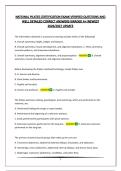
The information obtained in a postural screening includes which of the following?
A. Overall symmetry, height, weight, and balance.
B. Overall symmetry, muscle development, and alignment deviations. C. Pelvic symmetry,
muscular patterns, and movement deviations.
D. Overall symmetry, alignment deviations, and proprioception. - ANSWER B. Overall
symmetry, muscle development, and alignment deviations.
Before developing the Pilates method/Contrology, Joseph Pilates was
A: A. Dancer and director.
B. Stock broker and businessman.
C. Pugilist and acrobat.
D. Doctor and professor. - ANSWER C. Pugilist and acrobat.
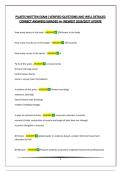
The Pilates exercises rocking, grasshopper, and swimming, which are performed on the
reformer, are:
A. Performed holding the straps or rope handles.
B. Performed at the beginning of a reformer workout.
C. Easily performed by participants with spinal stenosis.
D. Extension exercises performed on the long box. - ANSWER D. Extension exercises
performed on the long box.
The primary muscles/muscle groups that make up the core are:
A. Transverse abdominis, abdominal external oblique, iliocostalis, and adductors.
B. Hamstrings, rectus abdominis, abdominal internal oblique, and tensor fascia latae.
C. Diaphragm, transverse abdominus, multifidus, and pelvic floor.
1
,D. Transverse abdominis, gluteus maximus, multifidus, and pelvic floor. - ANSWER C.
Diaphragm, transverse abdominus, multifidus, and pelvic floor.
An example of assisted retraction and resisted protraction on the Pilates apparatus is:
A. Pulling straps on the reformer.
B. Swan from floor on the low chair.
C. Swan on the ladder barrel.
D. Swan on the low chair. - ANSWER D. Swan on the low chair.
Which of the following describes the muscular contraction in which the muscle shortens to
produce force and accelerate movement?
A. Concentric.
B. Isometric.
C. Eccentric.
D. Isotonic. - ANSWER A. Concentric.
Identify which of the following ARE NOT within the scope of practice for a Pilates teacher.
a. Promote exercise to improve overall health
b. Coach, provide general information and direct clients to seek medical attention.
c. Offering counseling.
d. Recognize conditions that would preclude a client from safely participating in a Pilates
exercise program. - ANSWER c. Offering counseling.
Identify which of the following ARE within the scope of practice for a Pilates teacher.
a. Prescribing an exercise program
b. Design Pilates exercise programs according to an individual's needs
c. Prescribing diets or recommending supplements.
d.Diagnosing a client with any medical, mental or physical condition. - ANSWER b. Design
Pilates exercise programs according to an individual's needs
2
, What are the 13 Code of Ethics? - ANSWER 1. Do no harm.
2. Teach within the scope of practice.
3. Maintain professional boundaries.
4. Maintain client confidentiality.
5. Direct clients to seek medical attention when necessarily.
6. Do not discriminate against clients or colleagues on any level.
7. Do not intentionally solicit other Pilates professionals's clients.
8. Treat clients and colleagues with respect, truth, fairness, and integrity.
9. Comply with all applicable business, employment and intellectual property laws.
10. Maintain professional appearance and conduct.
11. Do not misrepresent skills, training, professional credentials, identity or services
12. Continue gaining education to enhance skills and knowledge.
13. Maintain appropriate teacher-to-student ratios in all class settings.
What are the continuing education requirements for certificates? - ANSWER Certificants
must earn 16 NPCP-approved CECs in order to renew their certification.
How often must certificates complete their CECs? - ANSWER All CECs must be completed
within a two (2) year renewal period.
True or False. The NCPC may refuse to certify, suspend, or revoke an existing certification, or
otherwise take action with regard to the application or certification of an individual. -
ANSWER True
Best business practices - ANSWER
Client documentation - ANSWER
3
A. Overall symmetry, height, weight, and balance.
B. Overall symmetry, muscle development, and alignment deviations. C. Pelvic symmetry,
muscular patterns, and movement deviations.
D. Overall symmetry, alignment deviations, and proprioception. - ANSWER B. Overall
symmetry, muscle development, and alignment deviations.
Before developing the Pilates method/Contrology, Joseph Pilates was
A: A. Dancer and director.
B. Stock broker and businessman.
C. Pugilist and acrobat.
D. Doctor and professor. - ANSWER C. Pugilist and acrobat.
The Pilates exercises rocking, grasshopper, and swimming, which are performed on the
reformer, are:
A. Performed holding the straps or rope handles.
B. Performed at the beginning of a reformer workout.
C. Easily performed by participants with spinal stenosis.
D. Extension exercises performed on the long box. - ANSWER D. Extension exercises
performed on the long box.
The primary muscles/muscle groups that make up the core are:
A. Transverse abdominis, abdominal external oblique, iliocostalis, and adductors.
B. Hamstrings, rectus abdominis, abdominal internal oblique, and tensor fascia latae.
C. Diaphragm, transverse abdominus, multifidus, and pelvic floor.
1
,D. Transverse abdominis, gluteus maximus, multifidus, and pelvic floor. - ANSWER C.
Diaphragm, transverse abdominus, multifidus, and pelvic floor.
An example of assisted retraction and resisted protraction on the Pilates apparatus is:
A. Pulling straps on the reformer.
B. Swan from floor on the low chair.
C. Swan on the ladder barrel.
D. Swan on the low chair. - ANSWER D. Swan on the low chair.
Which of the following describes the muscular contraction in which the muscle shortens to
produce force and accelerate movement?
A. Concentric.
B. Isometric.
C. Eccentric.
D. Isotonic. - ANSWER A. Concentric.
Identify which of the following ARE NOT within the scope of practice for a Pilates teacher.
a. Promote exercise to improve overall health
b. Coach, provide general information and direct clients to seek medical attention.
c. Offering counseling.
d. Recognize conditions that would preclude a client from safely participating in a Pilates
exercise program. - ANSWER c. Offering counseling.
Identify which of the following ARE within the scope of practice for a Pilates teacher.
a. Prescribing an exercise program
b. Design Pilates exercise programs according to an individual's needs
c. Prescribing diets or recommending supplements.
d.Diagnosing a client with any medical, mental or physical condition. - ANSWER b. Design
Pilates exercise programs according to an individual's needs
2
, What are the 13 Code of Ethics? - ANSWER 1. Do no harm.
2. Teach within the scope of practice.
3. Maintain professional boundaries.
4. Maintain client confidentiality.
5. Direct clients to seek medical attention when necessarily.
6. Do not discriminate against clients or colleagues on any level.
7. Do not intentionally solicit other Pilates professionals's clients.
8. Treat clients and colleagues with respect, truth, fairness, and integrity.
9. Comply with all applicable business, employment and intellectual property laws.
10. Maintain professional appearance and conduct.
11. Do not misrepresent skills, training, professional credentials, identity or services
12. Continue gaining education to enhance skills and knowledge.
13. Maintain appropriate teacher-to-student ratios in all class settings.
What are the continuing education requirements for certificates? - ANSWER Certificants
must earn 16 NPCP-approved CECs in order to renew their certification.
How often must certificates complete their CECs? - ANSWER All CECs must be completed
within a two (2) year renewal period.
True or False. The NCPC may refuse to certify, suspend, or revoke an existing certification, or
otherwise take action with regard to the application or certification of an individual. -
ANSWER True
Best business practices - ANSWER
Client documentation - ANSWER
3