

Written by students who passed Immediately available after payment Read online or as PDF Wrong document? Swap it for free 4.6 TrustPilot
logo-home
Document preview thumbnail
Preview 2 out of 9 pages
Exam (elaborations)

EDU 331 Teaching Reading Final Exam Questions & Answers | EDU 331 | 100+ Questions | Science of Reading, Phonics, Phonemic Awareness, Fluency, Vocabulary & Reading Comprehension

Document preview thumbnail
Preview 2 out of 9 pages

This comprehensive EDU 331 Teaching Reading Final Exam Questions and Answers study guide contains 100+ exam-style questions with detailed answers covering the foundational principles of the Science of Reading, literacy development, evidence-based reading instruction, phonics, phonemic awareness, vocabulary, fluency, and reading comprehension. Designed for teacher education and literacy instruction courses, this resource prepares students for final examinations while strengthening their understanding of research-based reading pedagogy, structured literacy, and effective classroom instruction. The organized question-and-answer format enables future educators to review essential concepts, reinforce instructional strategies, and develop confidence in teaching reading across elementary grade levels. The study guide comprehensively reviews high-yield literacy topics including Scarborough's Reading Rope, the Simple View of Reading, the Four-Part Processing Model, Ehri's Phases of Word Recognition Development, phonological awareness, phonemic awareness, phonics instruction, graphemes, phonemes, blending, segmentation, deletion, substitution, consonant blends, digraphs, trigraphs, vowel teams, syllable types, explicit and systematic phonics instruction, decodable texts, connected texts, orthographic mapping, fluency, prosody, vocabulary instruction, Tier 1–3 vocabulary, morphology, etymology, derivational suffixes, word matrices, comprehension strategies, cohesive devices, text structures, graphic organizers, background knowledge, comprehension models, scaffolding, and evidence-based literacy assessment. These concepts reflect the core competencies expected of pre-service teachers preparing to deliver scientifically grounded reading instruction in elementary classrooms. The material is aligned with internationally recognized literacy research and teacher education standards. Primary references include Scarborough, H. S. (2001). Connecting Early Language and Literacy to Later Reading (Reading Rope Model), Gough, P. B., & Tunmer, W. E. (1986). Decoding, Reading, and Reading Disability (Simple View of Reading), Remedial and Special Education, Ehri, L. C. (2005). Learning to Read Words: Theory, Findings, and Issues, Kilpatrick, D. A. (2015). Essentials of Assessing, Preventing, and Overcoming Reading Difficulties, Moats, L. C. (2020). Speech to Print: Language Essentials for Teachers, The Reading League's Science of Reading Defining Guide, and the National Reading Panel (2000). Teaching Children to Read. These authoritative sources establish the evidence-based principles of structured literacy, decoding, vocabulary development, comprehension, and reading instruction reflected throughout this examination guide. Relevant Students: EDU 331 students, Teacher Education students, Elementary Education majors, Literacy Education students, Reading Specialist candidates, Early Childhood Education students, Primary Education students, Special Education students, English Language Arts Education students, Pre-service teachers, K–6 Education students, Curriculum and Instruction students, Reading interventionists, Literacy coaches, Graduate Education students, Teacher certification candidates. Keywords: EDU 331, Teaching Reading, EDU 331 final exam, Science of Reading, reading instruction, literacy education, structured literacy, Scarborough Reading Rope, Simple View of Reading, phonics, phonemic awareness, phonological awareness, orthographic mapping, word recognition, reading comprehension, fluency, prosody, vocabulary instruction, morphology, etymology, graphemes, phonemes, decodable text, connected text, explicit phonics, systematic phonics, Ehri phases, syllable types, digraphs, trigraphs, vowel teams, word matrix, derivational suffixes, text structure, comprehension strategies, background knowledge, literacy assessment, elementary reading, teacher education, reading pedagogy, literacy methods, elementary education, teacher certification, reading methods exam, education study guide

Content preview

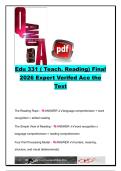
Edu 331 ( Teach. Reading) Final
2026 Expert Verifed Ace the
Test


The Reading Rope - ANSWER ✔✔language comprehension + word

recognition = skilled reading


The Simple View of Reading - ANSWER ✔✔word recognition x

language comprehension = reading comprehension


Four Part Processing Model - ANSWER ✔✔context, meaning,

structure, and visual (letters/words).

, Ehri's Phases of Word Recognition Development - ANSWER ✔✔Pre-

alphabetic; Partial-Alphabetic; Full-alphabetic; Consolidated-alphabetic;

Automatic


Phoneme - ANSWER ✔✔The smallest unit of spoken language that

makes a difference in a word's meaning.


Grapheme - ANSWER ✔✔The written representation of a phoneme.


Phonological awareness - ANSWER ✔✔An umbrella term that

includes the awareness of the larger parts of spoken language, such as

words, syllables, onsets and rimes, and phonemes.


Phonemic awareness - ANSWER ✔✔The ability to detect, identify,

and manipulate phonemes in spoken words


Phonemic awareness task - ANSWER ✔✔Isolation; Blending;

Segmentation; Deletion; Addition; Substitution


Isolation - ANSWER ✔✔Recognizes individual sounds in the word.


Blending - ANSWER ✔✔Combines the sounds to form a whole word.


Segmentation - ANSWER ✔✔Separates the word into individual

phonemes and says each sound.

Document information

Uploaded on
June 30, 2026
Number of pages
9
Written in
2025/2026
Type
Exam (elaborations)
Contains
Questions & answers
$18.99

Wrong document? Swap it for free Within 14 days of purchase and before downloading, you can choose a different document. You can simply spend the amount again.
Written by students who passed
Immediately available after payment
Read online or as PDF

Seller avatar
Reputation scores are based on the amount of documents a seller has sold for a fee and the reviews they have received for those documents. There are three levels: Bronze, Silver and Gold. The better the reputation, the more your can rely on the quality of the sellers work.
NinjaNerd
3.5
(75)
Sold
389
Followers
6
Items
15052
Last sold
3 hours ago


Why students choose Stuvia

Created by fellow students, verified by reviews

Quality you can trust: written by students who passed their tests and reviewed by others who've used these notes.

Didn't get what you expected? Choose another document

No worries! You can instantly pick a different document that better fits what you're looking for.

Pay as you like, start learning right away

No subscription, no commitments. Pay the way you're used to via credit card and download your PDF document instantly.

Student with book image

“Bought, downloaded, and aced it. It really can be that simple.”

Alisha Student

Working on your references?

Create accurate citations in APA, MLA and Harvard with our free citation generator.

Working on your references?

Frequently asked questions

