Introductory Clinical
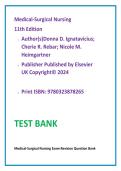
Pharmacology
12th Edition
• Author(s)Susan Ford
• Print ISBN: 9781975163730
TEST BANK
Question 1
A nurse explains pharmacokinetics to a patient. Which
statement best describes this concept?
,A. How drugs affect the body
B. How the body absorbs, distributes, metabolizes, and excretes
drugs
C. The study of drug interactions
D. The chemical structure of drugs
Correct Answer: B
Rationale:
Pharmacokinetics refers to what the body does to a drug,
including absorption, distribution, metabolism, and excretion.
Pharmacodynamics, in contrast, describes how drugs affect the
body.
Question 2
Which route of administration provides the fastest drug
absorption?
A. Oral
B. Subcutaneous
C. Intravenous
D. Intramuscular
Correct Answer: C
Rationale:
Intravenous administration delivers medication directly into the
,bloodstream, resulting in immediate absorption and rapid onset
of action.
Question 3
A nurse is teaching about first-pass metabolism. Which organ is
primarily responsible?
A. Kidneys
B. Liver
C. Lungs
D. Intestines
Correct Answer: B
Rationale:
First-pass metabolism occurs in the liver, where orally
administered drugs are metabolized before reaching systemic
circulation, potentially reducing drug bioavailability.
Question 4
Which factor can decrease drug absorption from the
gastrointestinal tract?
A. Increased blood flow
B. Presence of food in the stomach
, C. Liquid drug formulation
D. Increased surface area
Correct Answer: B
Rationale:
Food can delay gastric emptying and alter drug dissolution,
thereby decreasing or delaying drug absorption depending on
the medication.
Question 5
A drug binds extensively to plasma proteins. What is the clinical
implication?
A. Increased free drug levels
B. Decreased drug effect
C. Prolonged drug action
D. Immediate drug excretion
Correct Answer: C
Rationale:
Protein-bound drugs are inactive while bound and released
slowly, prolonging drug action. Only free (unbound) drug is
pharmacologically active.
Question 6
Pharmacology
12th Edition
• Author(s)Susan Ford
• Print ISBN: 9781975163730
TEST BANK
Question 1
A nurse explains pharmacokinetics to a patient. Which
statement best describes this concept?
,A. How drugs affect the body
B. How the body absorbs, distributes, metabolizes, and excretes
drugs
C. The study of drug interactions
D. The chemical structure of drugs
Correct Answer: B
Rationale:
Pharmacokinetics refers to what the body does to a drug,
including absorption, distribution, metabolism, and excretion.
Pharmacodynamics, in contrast, describes how drugs affect the
body.
Question 2
Which route of administration provides the fastest drug
absorption?
A. Oral
B. Subcutaneous
C. Intravenous
D. Intramuscular
Correct Answer: C
Rationale:
Intravenous administration delivers medication directly into the
,bloodstream, resulting in immediate absorption and rapid onset
of action.
Question 3
A nurse is teaching about first-pass metabolism. Which organ is
primarily responsible?
A. Kidneys
B. Liver
C. Lungs
D. Intestines
Correct Answer: B
Rationale:
First-pass metabolism occurs in the liver, where orally
administered drugs are metabolized before reaching systemic
circulation, potentially reducing drug bioavailability.
Question 4
Which factor can decrease drug absorption from the
gastrointestinal tract?
A. Increased blood flow
B. Presence of food in the stomach
, C. Liquid drug formulation
D. Increased surface area
Correct Answer: B
Rationale:
Food can delay gastric emptying and alter drug dissolution,
thereby decreasing or delaying drug absorption depending on
the medication.
Question 5
A drug binds extensively to plasma proteins. What is the clinical
implication?
A. Increased free drug levels
B. Decreased drug effect
C. Prolonged drug action
D. Immediate drug excretion
Correct Answer: C
Rationale:
Protein-bound drugs are inactive while bound and released
slowly, prolonging drug action. Only free (unbound) drug is
pharmacologically active.
Question 6