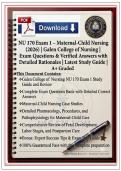
, NU 170 Exam 1 – Maternal-Child Nursing
(2026) | Galen College of Nursing | Actual8
Exam Questions & Verified Answers with
Detailed Rationales | Latest Study Guide |
A+ Graded
Q1. Which statement best describes the difference
between pharmacokinetics and pharmacodynamics?
A) Pharmacokinetics is the study of drug-receptor
interactions; pharmacodynamics is the study of drug
movement through the body.
B) Pharmacokinetics is what the body does to the drug;
pharmacodynamics is what the drug does to the body.
C) Pharmacokinetics is the study of drug toxicity;
pharmacodynamics is the study of drug efficacy.
D) Pharmacokinetics is the study of drug absorption;
pharmacodynamics is the study of drug excretion.
Correct Answer: B. Pharmacokinetics is what the body
does to the drug; pharmacodynamics is what the drug
does to the body.
,Rationale: Pharmacokinetics describes the movement of
drugs through the body (absorption, distribution,
metabolism, excretion). Pharmacodynamics describes the
biochemical and physiological effects of drugs on the
body at the receptor level.
Q2. A drug has a half-life of 12 hours. Approximately how
many hours will it take for the drug to reach a steady
state?
A) 12 hours
B) 24 hours
C) 48 hours
D) 60 hours
Correct Answer: C. 48 hours
Rationale: Steady state is achieved after approximately 4-
5 half-lives. With a 12-hour half-life, steady state is
reached in about 48 hours (4 half-lives) to 60 hours (5
half-lives). The answer choice of 48 hours is correct as a
minimum estimation.
, Q3. A patient with renal impairment is at increased risk
for drug toxicity primarily because:
A) The liver cannot metabolize the drug
B) The drug is absorbed more rapidly
C) The drug is excreted more slowly, leading to
accumulation
D) The drug binds more tightly to plasma proteins
Correct Answer: C. The drug is excreted more slowly,
leading to accumulation
Rationale: The kidneys are the primary route of drug
excretion. Renal impairment slows drug elimination,
causing accumulation of the drug and its metabolites,
which increases the risk of toxicity. Dosage adjustments
are often required.
Q4. A drug that is highly protein-bound (e.g., warfarin) is
administered with a second highly protein-bound drug.
What is the expected effect?
A) Decreased free drug levels of the first drug
B) Increased free drug levels of the first drug
(2026) | Galen College of Nursing | Actual8
Exam Questions & Verified Answers with
Detailed Rationales | Latest Study Guide |
A+ Graded
Q1. Which statement best describes the difference
between pharmacokinetics and pharmacodynamics?
A) Pharmacokinetics is the study of drug-receptor
interactions; pharmacodynamics is the study of drug
movement through the body.
B) Pharmacokinetics is what the body does to the drug;
pharmacodynamics is what the drug does to the body.
C) Pharmacokinetics is the study of drug toxicity;
pharmacodynamics is the study of drug efficacy.
D) Pharmacokinetics is the study of drug absorption;
pharmacodynamics is the study of drug excretion.
Correct Answer: B. Pharmacokinetics is what the body
does to the drug; pharmacodynamics is what the drug
does to the body.
,Rationale: Pharmacokinetics describes the movement of
drugs through the body (absorption, distribution,
metabolism, excretion). Pharmacodynamics describes the
biochemical and physiological effects of drugs on the
body at the receptor level.
Q2. A drug has a half-life of 12 hours. Approximately how
many hours will it take for the drug to reach a steady
state?
A) 12 hours
B) 24 hours
C) 48 hours
D) 60 hours
Correct Answer: C. 48 hours
Rationale: Steady state is achieved after approximately 4-
5 half-lives. With a 12-hour half-life, steady state is
reached in about 48 hours (4 half-lives) to 60 hours (5
half-lives). The answer choice of 48 hours is correct as a
minimum estimation.
, Q3. A patient with renal impairment is at increased risk
for drug toxicity primarily because:
A) The liver cannot metabolize the drug
B) The drug is absorbed more rapidly
C) The drug is excreted more slowly, leading to
accumulation
D) The drug binds more tightly to plasma proteins
Correct Answer: C. The drug is excreted more slowly,
leading to accumulation
Rationale: The kidneys are the primary route of drug
excretion. Renal impairment slows drug elimination,
causing accumulation of the drug and its metabolites,
which increases the risk of toxicity. Dosage adjustments
are often required.
Q4. A drug that is highly protein-bound (e.g., warfarin) is
administered with a second highly protein-bound drug.
What is the expected effect?
A) Decreased free drug levels of the first drug
B) Increased free drug levels of the first drug