

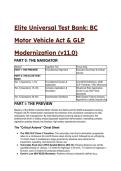
Elite Universal Test Bank: BC
Motor Vehicle Act & GLP
Modernization (v11.0)
PART 0: THE NAVIGATOR
Section Cognitive Tier Focus Area
PART I: THE PREVIEW Foundational Alignment Executive Summary & Critical
Axioms
PART II: THE ELITE TEST
BANK
Tier 1 (Questions 1–15) Foundational Syntax & Core MVA Definitions, 2026
Application GLP Timelines, VRU Minimums
Tier 2 (Questions 16–35) Complex Application & Situational Rule Application,
Simulation Xavier's Law, MLP Gear
Standards
Tier 3 (Questions 36–60) Grandmaster Synthesis Multi-System Failure Analysis,
Algorithmic Liability Sequencing
PART I: THE PREVIEW
Mastery of the British Columbia Motor Vehicle Act (MVA) and the 2026 Graduated Licensing
Program (GLP) modernization represents the transition from procedural compliance to elite,
anticipatory risk management. By internalizing these evolving statutory frameworks, the
professional driver or safety analyst bypasses superficial memorization, translating complex
legislative updates directly into flawless, high-stakes operational execution.
The "Critical Axioms" Cheat Sheet
● The 2026 GLP Class 5 Transition: The secondary road test is eliminated; progression
relies on a continuous 24-month Novice clean driving record, followed by an unforgiving
12-month Class 5 probationary stage governed by absolute zero-tolerance for
impairment, speeding, and electronic device use.
● Vulnerable Road User (VRU) Spatial Metrics (Bill 23): Passing distances are strictly
quantified based on velocity: 1.0 metre for highways ≤ 50 km/h, 1.5 metres for highways >
50 km/h, and 0.5 metres for protected infrastructure.
● Xavier's Law (Bill M226) Mandates: Reckless driving is statutorily defined (e.g.,
, wheelies, extreme speeding) and triggers an immediate, unappealable 30-day roadside
prohibition, completely bypassing standard judicial review timelines.
● Electronic Device Absolute Prohibition (s. 214.2): Use is defined by presence and
position (e.g., wedged in a seat). GLP drivers face absolute bans on all electronics,
including hands-free infrastructure, triggering immediate Driver Improvement Program
interventions.
PART II: THE ELITE TEST BANK
Tier 1: Foundational Syntax & Application
Q1: A driver operating a vehicle in a 50 km/h municipality observes a cyclist traveling in the
same direction. Based on the principles of the Vulnerable Road User framework (Bill 23), what
is the MINIMUM lawful passing distance the driver must maintain? A) 0.5 metres B) 1.0 metre
C) 1.5 metres D) 3.0 metres
● The Answer: B (1.0 metre)
● Distractor Analysis:
○ A is incorrect: A 0.5-metre distance applies strictly to users in separated and
protected cycling lanes or on sidewalks.
○ C is incorrect: The 1.5-metre parameter is activated only when the highway speed
limit exceeds 50 km/h.
○ D is incorrect: The 3.0-metre metric refers to the minimum following distance behind
a vulnerable road user, not the lateral passing distance.
The Mentor's Analysis: Bill 23 mathematically anchors the duty of care to the speed limit of the
highway. When facing vulnerable road user interactions, the immediate priority is calculating
lateral spatial requirements based on the posted velocity. By utilizing proportional spacing
algorithms, you bypass the common trap of relying on subjective "safe distance" estimates.
Professional/Academic Intuition: Lateral passing clearances scale directly with velocity:
1.0m at ≤ 50 km/h, escalating to 1.5m at > 50 km/h.
Q2: A 26-year-old individual obtains a Class 7 Learner (L) licence under the modernized 2026
GLP framework. Assuming no approved driver training is undertaken, what is the MINIMUM
duration this individual must remain in the Learner stage before road testing for a Novice (N)
licence? A) 6 months B) 9 months C) 12 months D) 24 months
● The Answer: B (9 months)
● Distractor Analysis:
○ A is incorrect: The 6-month timeline applies only if approved training is completed.
○ C is incorrect: The 12-month Learner baseline is the legacy standard and remains
the baseline only for drivers under 25 years of age.
○ D is incorrect: 24 months represents the duration of the subsequent Novice stage,
not the Learner stage.
The Mentor's Analysis: The 2026 GLP modernization bifurcates the Learner timeline based on
cognitive maturity and age demographics. When managing adult learners (25 and older), the
immediate priority is applying the accelerated timeline. By utilizing the Adult Learner Exemption,
you bypass the legacy trap of imposing universal 12-month wait periods on mature candidates.
Professional/Academic Intuition: Under the 2026 framework, age dictates the baseline
Learner phase: 12 months for youth, 9 months for adults ≥ 25.
Q3: Under the proposed Xavier's Law (Bill M226), a peace officer observes a driver performing
,a "wheelie" on a public highway. Which administrative penalty is the IMMEDIATE statutory
requirement? A) A 7-day vehicle impoundment and an Administrative Driving Prohibition. B) A
30-day unappealable driving prohibition issued roadside. C) A 90-day Immediate Roadside
Prohibition (IRP). D) A mandatory referral to the Superintendent of Motor Vehicles for a future
hearing.
● The Answer: B (A 30-day unappealable driving prohibition issued roadside.)
● Distractor Analysis:
○ A is incorrect: While impoundment applies to stunt driving, the specific mechanism
of Xavier's law dictates a specialized 30-day prohibition, superseding standard
7-day thresholds.
○ C is incorrect: A 90-day IRP is strictly reserved for alcohol/drug impairment failures
or refusals, not mechanical reckless driving.
○ D is incorrect: The law explicitly removes the avenue of appeal or delayed hearings,
prioritizing immediate roadside removal.
The Mentor's Analysis: Xavier's Law removes judicial and administrative delays for clearly
defined acts of reckless driving. When encountering high-risk stunts, the immediate priority is
severing the driver's legal right to operate a vehicle. By utilizing Immediate Roadside
Revocation, you bypass the trap of delayed accountability that allows reckless drivers to remain
on the road pending a hearing. Professional/Academic Intuition: Statutorily defined
reckless acts under Bill M226 trigger immediate, non-appealable 30-day prohibitions.
Q4: According to Section 214.2 of the BC Motor Vehicle Act regarding electronic devices, a
Novice (N) driver places their smartphone on the passenger seat, untouched, while navigating
using the phone's audible GPS instructions. Which conclusion is MOST ACCURATE? A) The
action is legal because the device is not being held in the driver's hand. B) The action is legal
because the GPS is providing audible, hands-free directions. C) The action is illegal and
violates the absolute restriction on electronic device use for GLP drivers. D) The action is illegal
only if the phone screen is illuminated and visible to the driver.
● The Answer: C (The action is illegal and violates the absolute restriction on electronic
device use for GLP drivers.)
● Distractor Analysis:
○ A is incorrect: "Use" is broadly defined; for GLP drivers, any operational presence
constitutes a violation.
○ B is incorrect: GLP drivers are strictly prohibited from utilizing hands-free or audible
electronic infrastructure.
○ D is incorrect: The legal threshold for a GLP driver does not depend on screen
illumination; the mere function of the device violates the restriction.
The Mentor's Analysis: The MVA imposes a total technology blackout on GLP drivers to
prevent cognitive overload. When evaluating GLP compliance, the immediate priority is
confirming the total absence of electronic integration. By enforcing the Absolute Prohibition
Doctrine, you bypass the common novice trap of equating "hands-free" with "legal."
Professional/Academic Intuition: For Class 7 drivers, "hands-free" is legally synonymous
with "prohibited device use."
Q5: Based on BC MVA parking regulations, what is the MINIMUM legal distance a vehicle may
be parked from the approach side of a crosswalk? A) 1.5 metres B) 5.0 metres C) 6.0 metres D)
15.0 metres
● The Answer: C (6.0 metres)
● Distractor Analysis:
○ A is incorrect: 1.5 metres is the clearance required for a private driveway or garage
, entrance.
○ B is incorrect: 5.0 metres is the specific clearance mandated for a fire hydrant.
○ D is incorrect: 15.0 metres is the clearance required for a railway crossing.
The Mentor's Analysis: Parking limits are engineered to preserve sightlines for pedestrians
and approaching vehicles. When securing a vehicle near pedestrian infrastructure, the
immediate priority is preserving the 6-metre visual corridor. By utilizing Sightline Preservation
Metrics, you bypass the novice error of crowding intersections and obstructing pedestrian
visibility. Professional/Academic Intuition: Crosswalk approaches demand a rigid
6.0-metre sterile zone to ensure reciprocal visibility between drivers and pedestrians.
Q6: A driver is traveling in the right lane of a 50 km/h zone. A BC Transit bus, stopped in a
designated bus bay, activates its left turn signal to re-enter the roadway. According to Section
169.1, what is the driver's REQUIRED action? A) Maintain speed and pass cautiously, as
through-traffic maintains the right-of-way. B) Yield the right-of-way to the bus, allowing it to enter
the traveled lane. C) Yield only if the bus has already crossed the solid white line. D) Stop
immediately, regardless of following traffic, to allow the bus to merge.
● The Answer: B (Yield the right-of-way to the bus, allowing it to enter the traveled lane.)
● Distractor Analysis:
○ A is incorrect: Section 169.1 expressly overrides standard through-traffic
right-of-way rules in speed zones of 60 km/h or less.
○ C is incorrect: The duty to yield is triggered by the bus's signal and display device,
not its physical encroachment into the lane.
○ D is incorrect: Yielding must be done safely; slamming on brakes to stop
immediately without regard for following traffic constitutes a separate MVA violation
(sudden stop/unsafe deceleration).
The Mentor's Analysis: Transit flow supersedes individual vehicle momentum in urban
corridors. When a bus signals re-entry in a zone ≤ 60 km/h, the immediate priority is smoothly
decelerating to concede the lane. By utilizing Transit Priority Yielding, you bypass the common
trap of assuming the through-lane possesses absolute dominance. Professional/Academic
Intuition: In speed zones ≤ 60 km/h, an active transit signal legally transfers the
right-of-way from the through-driver to the bus.
Q7: Under the 2026 Motorcyclist Licensing Program (MLP) updates, a new rider is purchasing
gear for their Learner stage. Which certification standard is MANDATORY to comply with BC
MVA helmet regulations? A) ISO 9001 B) ANSI Z87.1 C) ECE 22.06 (or DOT / Snell equivalent)
D) CE EN 17092
● The Answer: C (ECE 22.06 (or DOT / Snell equivalent))
● Distractor Analysis:
○ A is incorrect: ISO 9001 is a generic quality management standard, not a
crash-rated helmet certification.
○ B is incorrect: ANSI Z87.1 pertains exclusively to industrial eye protection.
○ D is incorrect: CE EN 17092 is the European standard for motorcycle protective
clothing (jackets/pants) regarding abrasion resistance, not the primary helmet
standard.
The Mentor's Analysis: Cranial protection is governed by strict, internationally recognized
kinetic impact standards. When outfitting a rider, the immediate priority is verifying DOT, Snell,
or ECE compliance. By utilizing Regulated Helmet Certifications, you bypass the fatal trap of
utilizing novelty or uncertified headgear. Professional/Academic Intuition: Legal operation of
a motorcycle in BC requires strict adherence to DOT, Snell, or ECE helmet certifications;
novelty gear is a statutory violation.
Motor Vehicle Act & GLP
Modernization (v11.0)
PART 0: THE NAVIGATOR
Section Cognitive Tier Focus Area
PART I: THE PREVIEW Foundational Alignment Executive Summary & Critical
Axioms
PART II: THE ELITE TEST
BANK
Tier 1 (Questions 1–15) Foundational Syntax & Core MVA Definitions, 2026
Application GLP Timelines, VRU Minimums
Tier 2 (Questions 16–35) Complex Application & Situational Rule Application,
Simulation Xavier's Law, MLP Gear
Standards
Tier 3 (Questions 36–60) Grandmaster Synthesis Multi-System Failure Analysis,
Algorithmic Liability Sequencing
PART I: THE PREVIEW
Mastery of the British Columbia Motor Vehicle Act (MVA) and the 2026 Graduated Licensing
Program (GLP) modernization represents the transition from procedural compliance to elite,
anticipatory risk management. By internalizing these evolving statutory frameworks, the
professional driver or safety analyst bypasses superficial memorization, translating complex
legislative updates directly into flawless, high-stakes operational execution.
The "Critical Axioms" Cheat Sheet
● The 2026 GLP Class 5 Transition: The secondary road test is eliminated; progression
relies on a continuous 24-month Novice clean driving record, followed by an unforgiving
12-month Class 5 probationary stage governed by absolute zero-tolerance for
impairment, speeding, and electronic device use.
● Vulnerable Road User (VRU) Spatial Metrics (Bill 23): Passing distances are strictly
quantified based on velocity: 1.0 metre for highways ≤ 50 km/h, 1.5 metres for highways >
50 km/h, and 0.5 metres for protected infrastructure.
● Xavier's Law (Bill M226) Mandates: Reckless driving is statutorily defined (e.g.,
, wheelies, extreme speeding) and triggers an immediate, unappealable 30-day roadside
prohibition, completely bypassing standard judicial review timelines.
● Electronic Device Absolute Prohibition (s. 214.2): Use is defined by presence and
position (e.g., wedged in a seat). GLP drivers face absolute bans on all electronics,
including hands-free infrastructure, triggering immediate Driver Improvement Program
interventions.
PART II: THE ELITE TEST BANK
Tier 1: Foundational Syntax & Application
Q1: A driver operating a vehicle in a 50 km/h municipality observes a cyclist traveling in the
same direction. Based on the principles of the Vulnerable Road User framework (Bill 23), what
is the MINIMUM lawful passing distance the driver must maintain? A) 0.5 metres B) 1.0 metre
C) 1.5 metres D) 3.0 metres
● The Answer: B (1.0 metre)
● Distractor Analysis:
○ A is incorrect: A 0.5-metre distance applies strictly to users in separated and
protected cycling lanes or on sidewalks.
○ C is incorrect: The 1.5-metre parameter is activated only when the highway speed
limit exceeds 50 km/h.
○ D is incorrect: The 3.0-metre metric refers to the minimum following distance behind
a vulnerable road user, not the lateral passing distance.
The Mentor's Analysis: Bill 23 mathematically anchors the duty of care to the speed limit of the
highway. When facing vulnerable road user interactions, the immediate priority is calculating
lateral spatial requirements based on the posted velocity. By utilizing proportional spacing
algorithms, you bypass the common trap of relying on subjective "safe distance" estimates.
Professional/Academic Intuition: Lateral passing clearances scale directly with velocity:
1.0m at ≤ 50 km/h, escalating to 1.5m at > 50 km/h.
Q2: A 26-year-old individual obtains a Class 7 Learner (L) licence under the modernized 2026
GLP framework. Assuming no approved driver training is undertaken, what is the MINIMUM
duration this individual must remain in the Learner stage before road testing for a Novice (N)
licence? A) 6 months B) 9 months C) 12 months D) 24 months
● The Answer: B (9 months)
● Distractor Analysis:
○ A is incorrect: The 6-month timeline applies only if approved training is completed.
○ C is incorrect: The 12-month Learner baseline is the legacy standard and remains
the baseline only for drivers under 25 years of age.
○ D is incorrect: 24 months represents the duration of the subsequent Novice stage,
not the Learner stage.
The Mentor's Analysis: The 2026 GLP modernization bifurcates the Learner timeline based on
cognitive maturity and age demographics. When managing adult learners (25 and older), the
immediate priority is applying the accelerated timeline. By utilizing the Adult Learner Exemption,
you bypass the legacy trap of imposing universal 12-month wait periods on mature candidates.
Professional/Academic Intuition: Under the 2026 framework, age dictates the baseline
Learner phase: 12 months for youth, 9 months for adults ≥ 25.
Q3: Under the proposed Xavier's Law (Bill M226), a peace officer observes a driver performing
,a "wheelie" on a public highway. Which administrative penalty is the IMMEDIATE statutory
requirement? A) A 7-day vehicle impoundment and an Administrative Driving Prohibition. B) A
30-day unappealable driving prohibition issued roadside. C) A 90-day Immediate Roadside
Prohibition (IRP). D) A mandatory referral to the Superintendent of Motor Vehicles for a future
hearing.
● The Answer: B (A 30-day unappealable driving prohibition issued roadside.)
● Distractor Analysis:
○ A is incorrect: While impoundment applies to stunt driving, the specific mechanism
of Xavier's law dictates a specialized 30-day prohibition, superseding standard
7-day thresholds.
○ C is incorrect: A 90-day IRP is strictly reserved for alcohol/drug impairment failures
or refusals, not mechanical reckless driving.
○ D is incorrect: The law explicitly removes the avenue of appeal or delayed hearings,
prioritizing immediate roadside removal.
The Mentor's Analysis: Xavier's Law removes judicial and administrative delays for clearly
defined acts of reckless driving. When encountering high-risk stunts, the immediate priority is
severing the driver's legal right to operate a vehicle. By utilizing Immediate Roadside
Revocation, you bypass the trap of delayed accountability that allows reckless drivers to remain
on the road pending a hearing. Professional/Academic Intuition: Statutorily defined
reckless acts under Bill M226 trigger immediate, non-appealable 30-day prohibitions.
Q4: According to Section 214.2 of the BC Motor Vehicle Act regarding electronic devices, a
Novice (N) driver places their smartphone on the passenger seat, untouched, while navigating
using the phone's audible GPS instructions. Which conclusion is MOST ACCURATE? A) The
action is legal because the device is not being held in the driver's hand. B) The action is legal
because the GPS is providing audible, hands-free directions. C) The action is illegal and
violates the absolute restriction on electronic device use for GLP drivers. D) The action is illegal
only if the phone screen is illuminated and visible to the driver.
● The Answer: C (The action is illegal and violates the absolute restriction on electronic
device use for GLP drivers.)
● Distractor Analysis:
○ A is incorrect: "Use" is broadly defined; for GLP drivers, any operational presence
constitutes a violation.
○ B is incorrect: GLP drivers are strictly prohibited from utilizing hands-free or audible
electronic infrastructure.
○ D is incorrect: The legal threshold for a GLP driver does not depend on screen
illumination; the mere function of the device violates the restriction.
The Mentor's Analysis: The MVA imposes a total technology blackout on GLP drivers to
prevent cognitive overload. When evaluating GLP compliance, the immediate priority is
confirming the total absence of electronic integration. By enforcing the Absolute Prohibition
Doctrine, you bypass the common novice trap of equating "hands-free" with "legal."
Professional/Academic Intuition: For Class 7 drivers, "hands-free" is legally synonymous
with "prohibited device use."
Q5: Based on BC MVA parking regulations, what is the MINIMUM legal distance a vehicle may
be parked from the approach side of a crosswalk? A) 1.5 metres B) 5.0 metres C) 6.0 metres D)
15.0 metres
● The Answer: C (6.0 metres)
● Distractor Analysis:
○ A is incorrect: 1.5 metres is the clearance required for a private driveway or garage
, entrance.
○ B is incorrect: 5.0 metres is the specific clearance mandated for a fire hydrant.
○ D is incorrect: 15.0 metres is the clearance required for a railway crossing.
The Mentor's Analysis: Parking limits are engineered to preserve sightlines for pedestrians
and approaching vehicles. When securing a vehicle near pedestrian infrastructure, the
immediate priority is preserving the 6-metre visual corridor. By utilizing Sightline Preservation
Metrics, you bypass the novice error of crowding intersections and obstructing pedestrian
visibility. Professional/Academic Intuition: Crosswalk approaches demand a rigid
6.0-metre sterile zone to ensure reciprocal visibility between drivers and pedestrians.
Q6: A driver is traveling in the right lane of a 50 km/h zone. A BC Transit bus, stopped in a
designated bus bay, activates its left turn signal to re-enter the roadway. According to Section
169.1, what is the driver's REQUIRED action? A) Maintain speed and pass cautiously, as
through-traffic maintains the right-of-way. B) Yield the right-of-way to the bus, allowing it to enter
the traveled lane. C) Yield only if the bus has already crossed the solid white line. D) Stop
immediately, regardless of following traffic, to allow the bus to merge.
● The Answer: B (Yield the right-of-way to the bus, allowing it to enter the traveled lane.)
● Distractor Analysis:
○ A is incorrect: Section 169.1 expressly overrides standard through-traffic
right-of-way rules in speed zones of 60 km/h or less.
○ C is incorrect: The duty to yield is triggered by the bus's signal and display device,
not its physical encroachment into the lane.
○ D is incorrect: Yielding must be done safely; slamming on brakes to stop
immediately without regard for following traffic constitutes a separate MVA violation
(sudden stop/unsafe deceleration).
The Mentor's Analysis: Transit flow supersedes individual vehicle momentum in urban
corridors. When a bus signals re-entry in a zone ≤ 60 km/h, the immediate priority is smoothly
decelerating to concede the lane. By utilizing Transit Priority Yielding, you bypass the common
trap of assuming the through-lane possesses absolute dominance. Professional/Academic
Intuition: In speed zones ≤ 60 km/h, an active transit signal legally transfers the
right-of-way from the through-driver to the bus.
Q7: Under the 2026 Motorcyclist Licensing Program (MLP) updates, a new rider is purchasing
gear for their Learner stage. Which certification standard is MANDATORY to comply with BC
MVA helmet regulations? A) ISO 9001 B) ANSI Z87.1 C) ECE 22.06 (or DOT / Snell equivalent)
D) CE EN 17092
● The Answer: C (ECE 22.06 (or DOT / Snell equivalent))
● Distractor Analysis:
○ A is incorrect: ISO 9001 is a generic quality management standard, not a
crash-rated helmet certification.
○ B is incorrect: ANSI Z87.1 pertains exclusively to industrial eye protection.
○ D is incorrect: CE EN 17092 is the European standard for motorcycle protective
clothing (jackets/pants) regarding abrasion resistance, not the primary helmet
standard.
The Mentor's Analysis: Cranial protection is governed by strict, internationally recognized
kinetic impact standards. When outfitting a rider, the immediate priority is verifying DOT, Snell,
or ECE compliance. By utilizing Regulated Helmet Certifications, you bypass the fatal trap of
utilizing novelty or uncertified headgear. Professional/Academic Intuition: Legal operation of
a motorcycle in BC requires strict adherence to DOT, Snell, or ECE helmet certifications;
novelty gear is a statutory violation.


