

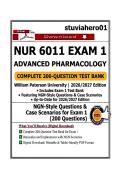
,NUR 6011 EXAM 1 – ADVANCED PHARMACOLOGY
William Paterson University | Complete 200-Question
Test Bank | NGN-Style Questions & Case Scenarios |
2026/2027 Edition | 100% Pass Guarantee
EXAM 1
Topic Area Questions
Pharmacokinetics & Pharmacodynamics 1–25
Pharmacogenomics & Individual Variation 26–40
Autonomic Nervous System Pharmacology 41–65
Cardiovascular & Renal Pharmacology 66–90
Central Nervous System Pharmacology 91–115
Endocrine & Metabolic Pharmacology 116–130
Antimicrobial & Anti-Infective Pharmacology 131–155
Pain Management & Opioid Pharmacology 156–175
Hematologic & Immunologic Pharmacology 176–185
Comprehensive NGN Case Scenarios 186–200
,SECTION 1: PHARMACOKINETICS & PHARMACODYNAMICS (Questions 1–25)
1. A patient with renal impairment is prescribed a medication that is primarily
eliminated by the kidneys. Which pharmacokinetic parameter is most affected?
A) Absorption
B) Distribution
C) Metabolism
D) Excretion
Answer: D) Excretion
Rationale: Renal impairment reduces the excretion of medications, leading to
accumulation and increased risk of toxicity. Lower doses or extended dosing
intervals are needed. This is a critical concept in pharmacokinetics.
2. A patient is started on a medication with a half-life of 24 hours. Approximately
how long will it take to reach steady-state concentrations?
A) 24 hours
B) 48 hours
C) 72 hours
D) 5 days (120 hours)
Answer: D) 5 days (120 hours)
Rationale: Steady-state is reached after approximately 5 half-lives. For a drug
with a 24-hour half-life, steady-state is achieved in about 5 days (5 × 24 = 120
hours).
3. A patient is prescribed a medication that is 95% protein-bound. What is the
clinical significance of this?
A) The drug has a rapid onset of action
, B) The drug is less likely to interact with other medications
k k k k k k k k k k
C) The drug is highly bound and may be displaced by other highly protein-bound
k k k k k k k k k k k k k
drugs, increasing free drug concentration
k k k k k
D) The drug is primarily excreted unchanged in the urine
k k k k k k k k k
Answer: C) The drug is highly bound and may be displaced by other highly protein-
k k k k k k k k k k k k k k
bound drugs, increasing free drug concentration
k k k k k
Rationale: Highly protein-bound drugs (≥90%) are at risk for displacement
k k k k k k k k k
interactions. When another drug competes for binding sites, the free (active)
k k k k k k k k k k k
concentration of the first drug increases, potentially causing toxicity.
k k k k k k k k k
4. A patient on warfarin (highly protein-bound) is started on a new medication that
k k k k k k k k k k k k k
also binds to albumin. Which effect should the nurse anticipate?
k k k k k k k k k k
A) Decreased warfarin effect
k k k
B) Increased warfarin effect (bleeding risk)
k k k k k
C) No change in warfarin effect
k k k k k
D) Increased warfarin metabolism
k k k
Answer: B) Increased warfarin effect (bleeding risk)
k k k k k k
Rationale: Displacement of warfarin from protein-binding sites increases free
k k k k k k k k
warfarin concentration, leading to increased anticoagulant effect and bleeding risk.
k k k k k k k k k k
This is a classic drug-drug interaction.
k k k k k k
5. A medication has a narrow therapeutic index. This means:
k k k k k k k k k
A) The drug has a wide safety margin
k k k k k k k
B) The drug requires close monitoring of serum levels
k k k k k k k k
C) The drug has no side effects
k k k k k k
D) The drug is always safe
k k k k k
. Answer: B) The drug requires close monitoring of serum levels
k k k k k k k k k k
Rationale: A narrow therapeutic index means there is a small difference between
k k k k k k k k k k k
the therapeutic dose and the toxic dose. Lithium, phenytoin, digoxin, and warfarin
k k k k k k k k k k k k
are examples requiring serum level monitoring
k k k k k k
William Paterson University | Complete 200-Question
Test Bank | NGN-Style Questions & Case Scenarios |
2026/2027 Edition | 100% Pass Guarantee
EXAM 1
Topic Area Questions
Pharmacokinetics & Pharmacodynamics 1–25
Pharmacogenomics & Individual Variation 26–40
Autonomic Nervous System Pharmacology 41–65
Cardiovascular & Renal Pharmacology 66–90
Central Nervous System Pharmacology 91–115
Endocrine & Metabolic Pharmacology 116–130
Antimicrobial & Anti-Infective Pharmacology 131–155
Pain Management & Opioid Pharmacology 156–175
Hematologic & Immunologic Pharmacology 176–185
Comprehensive NGN Case Scenarios 186–200
,SECTION 1: PHARMACOKINETICS & PHARMACODYNAMICS (Questions 1–25)
1. A patient with renal impairment is prescribed a medication that is primarily
eliminated by the kidneys. Which pharmacokinetic parameter is most affected?
A) Absorption
B) Distribution
C) Metabolism
D) Excretion
Answer: D) Excretion
Rationale: Renal impairment reduces the excretion of medications, leading to
accumulation and increased risk of toxicity. Lower doses or extended dosing
intervals are needed. This is a critical concept in pharmacokinetics.
2. A patient is started on a medication with a half-life of 24 hours. Approximately
how long will it take to reach steady-state concentrations?
A) 24 hours
B) 48 hours
C) 72 hours
D) 5 days (120 hours)
Answer: D) 5 days (120 hours)
Rationale: Steady-state is reached after approximately 5 half-lives. For a drug
with a 24-hour half-life, steady-state is achieved in about 5 days (5 × 24 = 120
hours).
3. A patient is prescribed a medication that is 95% protein-bound. What is the
clinical significance of this?
A) The drug has a rapid onset of action
, B) The drug is less likely to interact with other medications
k k k k k k k k k k
C) The drug is highly bound and may be displaced by other highly protein-bound
k k k k k k k k k k k k k
drugs, increasing free drug concentration
k k k k k
D) The drug is primarily excreted unchanged in the urine
k k k k k k k k k
Answer: C) The drug is highly bound and may be displaced by other highly protein-
k k k k k k k k k k k k k k
bound drugs, increasing free drug concentration
k k k k k
Rationale: Highly protein-bound drugs (≥90%) are at risk for displacement
k k k k k k k k k
interactions. When another drug competes for binding sites, the free (active)
k k k k k k k k k k k
concentration of the first drug increases, potentially causing toxicity.
k k k k k k k k k
4. A patient on warfarin (highly protein-bound) is started on a new medication that
k k k k k k k k k k k k k
also binds to albumin. Which effect should the nurse anticipate?
k k k k k k k k k k
A) Decreased warfarin effect
k k k
B) Increased warfarin effect (bleeding risk)
k k k k k
C) No change in warfarin effect
k k k k k
D) Increased warfarin metabolism
k k k
Answer: B) Increased warfarin effect (bleeding risk)
k k k k k k
Rationale: Displacement of warfarin from protein-binding sites increases free
k k k k k k k k
warfarin concentration, leading to increased anticoagulant effect and bleeding risk.
k k k k k k k k k k
This is a classic drug-drug interaction.
k k k k k k
5. A medication has a narrow therapeutic index. This means:
k k k k k k k k k
A) The drug has a wide safety margin
k k k k k k k
B) The drug requires close monitoring of serum levels
k k k k k k k k
C) The drug has no side effects
k k k k k k
D) The drug is always safe
k k k k k
. Answer: B) The drug requires close monitoring of serum levels
k k k k k k k k k k
Rationale: A narrow therapeutic index means there is a small difference between
k k k k k k k k k k k
the therapeutic dose and the toxic dose. Lithium, phenytoin, digoxin, and warfarin
k k k k k k k k k k k k
are examples requiring serum level monitoring
k k k k k k


