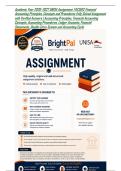
Academic Year 2026–2027 UNISA Assignment: MNG2602 Contemporary
Management Issues Fully Solved Assignment with Verified Answers |
Change Management, Innovation and Technology, Leadership Challenges,
Business Sustainability, Global Management Trends and Organisational
Transformation
,Question 1: According to the systems theory approach to management, which of
the following best describes the concept of "equifinality"?
A. There is only one optimal way to achieve a desired outcome.
B. A system can reach the same final state from different initial conditions and via
different paths.
C. The output of one system becomes the input for another system.
D. All parts of the organization must work in perfect harmony to achieve goals.
CORRECT ANSWER: B. A system can reach the same final state from different initial
conditions and via different paths.
Rationale: Equifinality is a core principle of open systems theory, suggesting that in a
dynamic environment, there are multiple ways to achieve the same end result. This
contrasts with closed-system thinking, which assumes a single best way. Options A and
D describe mechanistic or closed-system views, while C describes the sequential
interdependence of systems.
Question 2: In the context of stakeholder theory, which group is considered a
"primary" stakeholder?
A. The media.
B. Trade associations.
C. Employees.
D. Activist groups.
CORRECT ANSWER: C. Employees.
Rationale: Primary stakeholders are those who have a formal, direct, and contractual
relationship with the organization and are essential for its survival, including employees,
shareholders, customers, and suppliers. The media, trade associations, and activist
groups are considered secondary stakeholders, as they are influential but do not have a
direct formal contractual tie.
Question 3: Which of the following is a key characteristic of a learning organization
as defined by Peter Senge?
A. Bureaucratic hierarchy.
B. A focus on individual rather than team learning.
C. Systems thinking.
D. Resistance to change as a means of stability.
CORRECT ANSWER: C. Systems thinking.
Rationale: Systems thinking is the cornerstone of Senge's five disciplines of a learning
organization, providing a framework for seeing interrelationships and patterns rather
,than static snapshots. Bureaucracy and resistance to change are antithetical to a
learning organization, which promotes team learning over isolated individual learning.
Question 4: Which management approach is most aligned with the principles of the
"circular economy" in contemporary business?
A. A linear take-make-dispose model.
B. A cradle-to-grave approach.
C. A cradle-to-cradle approach that designs out waste.
D. A focus solely on maximizing shareholder return.
CORRECT ANSWER: C. A cradle-to-cradle approach that designs out waste.
Rationale: The circular economy aims to eliminate waste and the continual use of
resources by designing products and processes that are regenerative. The "cradle-to-
cradle" approach is central to this, viewing waste as a resource. The linear model and
solely financial focus are incompatible with this contemporary management issue.
Question 5: The "Gig Economy" presents a significant challenge to traditional
management. Which of the following is a primary issue managers face in this
context?
A. Determining pay rates based on seniority.
B. Maintaining a stable, fixed organizational culture among a fluid workforce.
C. Managing large, permanent office spaces.
D. Ensuring compliance with traditional 9-to-5 working hours.
CORRECT ANSWER: B. Maintaining a stable, fixed organizational culture among a
fluid workforce.
Rationale: The gig economy relies on independent contractors and freelance workers,
making it difficult to socialize and embed a consistent organizational culture. Managing
this fluid workforce is a primary challenge. Options A, C, and D are more relevant to
traditional employment models, not the flexible, remote, and transient nature of the gig
economy.
Question 6: Which of the following is a primary criticism of the shareholder
primacy model of corporate governance?
A. It aligns perfectly with long-term sustainability goals.
B. It often leads to underinvestment in employee development and social responsibility.
C. It ensures a fair distribution of wealth among all stakeholders.
D. It prioritizes the interests of the community above all else.
, CORRECT ANSWER: B. It often leads to underinvestment in employee development
and social responsibility.
Rationale: The shareholder primacy model focuses on maximizing returns for
shareholders, often at the expense of other stakeholders like employees or the
environment. This can lead to short-termism and underinvestment in areas that are not
immediately profitable, a key criticism in contemporary management literature.
Question 7: What is the fundamental premise of the "Resource-Based View" (RBV)
of the firm?
A. Competitive advantage is solely determined by the external market structure.
B. A firm's internal resources and capabilities are the primary drivers of competitive
advantage.
C. The industry's average profitability is the only predictor of a firm's success.
D. The most important resource is access to cheap labor.
CORRECT ANSWER: B. A firm's internal resources and capabilities are the primary
drivers of competitive advantage.
Rationale: RBV contends that firms are heterogeneous in terms of their resources and
capabilities, and that these internal factors—when they are valuable, rare, inimitable,
and non-substitutable (VRIN)—are the true source of sustainable competitive
advantage, not just external factors.
Question 8: In the context of ethical management, which of the following is an
example of a "conflict of interest"?
A. A manager donating to a charity they support.
B. A manager approving a contract for a supplier owned by their spouse.
C. A manager who strictly enforces company policy.
D. A manager who takes a pay cut to avoid layoffs.
CORRECT ANSWER: B. A manager approving a contract for a supplier owned by
their spouse.
Rationale: A conflict of interest arises when an individual's personal or private interests
could improperly influence their professional duties. Approving a contract for a family-
owned supplier presents a clear conflict where personal gain may be prioritized over the
company's best interests.
Question 9: Which of the following best describes "Agile Management" as a
contemporary approach?
Management Issues Fully Solved Assignment with Verified Answers |
Change Management, Innovation and Technology, Leadership Challenges,
Business Sustainability, Global Management Trends and Organisational
Transformation
,Question 1: According to the systems theory approach to management, which of
the following best describes the concept of "equifinality"?
A. There is only one optimal way to achieve a desired outcome.
B. A system can reach the same final state from different initial conditions and via
different paths.
C. The output of one system becomes the input for another system.
D. All parts of the organization must work in perfect harmony to achieve goals.
CORRECT ANSWER: B. A system can reach the same final state from different initial
conditions and via different paths.
Rationale: Equifinality is a core principle of open systems theory, suggesting that in a
dynamic environment, there are multiple ways to achieve the same end result. This
contrasts with closed-system thinking, which assumes a single best way. Options A and
D describe mechanistic or closed-system views, while C describes the sequential
interdependence of systems.
Question 2: In the context of stakeholder theory, which group is considered a
"primary" stakeholder?
A. The media.
B. Trade associations.
C. Employees.
D. Activist groups.
CORRECT ANSWER: C. Employees.
Rationale: Primary stakeholders are those who have a formal, direct, and contractual
relationship with the organization and are essential for its survival, including employees,
shareholders, customers, and suppliers. The media, trade associations, and activist
groups are considered secondary stakeholders, as they are influential but do not have a
direct formal contractual tie.
Question 3: Which of the following is a key characteristic of a learning organization
as defined by Peter Senge?
A. Bureaucratic hierarchy.
B. A focus on individual rather than team learning.
C. Systems thinking.
D. Resistance to change as a means of stability.
CORRECT ANSWER: C. Systems thinking.
Rationale: Systems thinking is the cornerstone of Senge's five disciplines of a learning
organization, providing a framework for seeing interrelationships and patterns rather
,than static snapshots. Bureaucracy and resistance to change are antithetical to a
learning organization, which promotes team learning over isolated individual learning.
Question 4: Which management approach is most aligned with the principles of the
"circular economy" in contemporary business?
A. A linear take-make-dispose model.
B. A cradle-to-grave approach.
C. A cradle-to-cradle approach that designs out waste.
D. A focus solely on maximizing shareholder return.
CORRECT ANSWER: C. A cradle-to-cradle approach that designs out waste.
Rationale: The circular economy aims to eliminate waste and the continual use of
resources by designing products and processes that are regenerative. The "cradle-to-
cradle" approach is central to this, viewing waste as a resource. The linear model and
solely financial focus are incompatible with this contemporary management issue.
Question 5: The "Gig Economy" presents a significant challenge to traditional
management. Which of the following is a primary issue managers face in this
context?
A. Determining pay rates based on seniority.
B. Maintaining a stable, fixed organizational culture among a fluid workforce.
C. Managing large, permanent office spaces.
D. Ensuring compliance with traditional 9-to-5 working hours.
CORRECT ANSWER: B. Maintaining a stable, fixed organizational culture among a
fluid workforce.
Rationale: The gig economy relies on independent contractors and freelance workers,
making it difficult to socialize and embed a consistent organizational culture. Managing
this fluid workforce is a primary challenge. Options A, C, and D are more relevant to
traditional employment models, not the flexible, remote, and transient nature of the gig
economy.
Question 6: Which of the following is a primary criticism of the shareholder
primacy model of corporate governance?
A. It aligns perfectly with long-term sustainability goals.
B. It often leads to underinvestment in employee development and social responsibility.
C. It ensures a fair distribution of wealth among all stakeholders.
D. It prioritizes the interests of the community above all else.
, CORRECT ANSWER: B. It often leads to underinvestment in employee development
and social responsibility.
Rationale: The shareholder primacy model focuses on maximizing returns for
shareholders, often at the expense of other stakeholders like employees or the
environment. This can lead to short-termism and underinvestment in areas that are not
immediately profitable, a key criticism in contemporary management literature.
Question 7: What is the fundamental premise of the "Resource-Based View" (RBV)
of the firm?
A. Competitive advantage is solely determined by the external market structure.
B. A firm's internal resources and capabilities are the primary drivers of competitive
advantage.
C. The industry's average profitability is the only predictor of a firm's success.
D. The most important resource is access to cheap labor.
CORRECT ANSWER: B. A firm's internal resources and capabilities are the primary
drivers of competitive advantage.
Rationale: RBV contends that firms are heterogeneous in terms of their resources and
capabilities, and that these internal factors—when they are valuable, rare, inimitable,
and non-substitutable (VRIN)—are the true source of sustainable competitive
advantage, not just external factors.
Question 8: In the context of ethical management, which of the following is an
example of a "conflict of interest"?
A. A manager donating to a charity they support.
B. A manager approving a contract for a supplier owned by their spouse.
C. A manager who strictly enforces company policy.
D. A manager who takes a pay cut to avoid layoffs.
CORRECT ANSWER: B. A manager approving a contract for a supplier owned by
their spouse.
Rationale: A conflict of interest arises when an individual's personal or private interests
could improperly influence their professional duties. Approving a contract for a family-
owned supplier presents a clear conflict where personal gain may be prioritized over the
company's best interests.
Question 9: Which of the following best describes "Agile Management" as a
contemporary approach?