

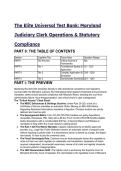
The Elite Universal Test Bank: Maryland
Judiciary Clerk Operations & Statutory
Compliance
PART 0: THE TABLE OF CONTENTS
Section Cognitive Tier Focus Area Question Range
PART I The Preview Critical Axioms & N/A
Frameworks
PART II Tier 1 Foundational Syntax & Q1 – Q15
Application
PART II Tier 2 Complex Application & Q16 – Q30
Simulation
PART II Tier 3 Grandmaster Synthesis Q31 – Q40
PART I: THE PREVIEW
Mastering this test bank translates directly to elite operational competence and regulatory
survival within the Maryland Judiciary. By internalizing these statutory thresholds and procedural
mandates, clerks ensure absolute compliance with Maryland Rules, shielding the court from
administrative failure, fiscal misappropriation, and critical errors in case management.
The "Critical Axioms" Cheat Sheet:
● The MDEC Deficiencies & Strikings Doctrine: Under Rule 20-203, a lack of a
Certificate of Service mandates an automatic Strike. Missing an MDJ-008 (Notice
Regarding Restricted Information) mandates a Rejection. Omnibus motions are strictly
deficient and must be split.
● The Expungement Matrix: Form CC-DC-CR-072A handles non-guilty dispositions
(Acquittals, Dismissals, PBJ, Stet) with a $0 fee. Form CC-DC-CR-072B handles eligible
Guilty dispositions with a nonrefundable $30 fee. A General Waiver and Release is
mandatory if filing within the 3-year statutory waiting period.
● The Rule 1-325 Fee Waiver Mandate: Litigants represented by an MLSC-approved
provider (e.g., Legal Aid, Public Defender) receive an automatic waiver of prepaid costs
without requiring a judicial order. If a discretionary waiver is denied by a judge, the litigant
has exactly 10 days to pay the unwaived costs.
● The Fiscal Sovereignty Rule: Cashiers must be technologically denied the capability to
close out their own cash registers or unilaterally void transactions. Separation of duties
requires independent, documented supervisory review of all voids and register closeouts
to prevent systemic misappropriation.
● The 2022 Nomenclature Shift: The highest court is exclusively the Supreme Court of
Maryland (formerly Court of Appeals); the intermediate is the Appellate Court of Maryland
, (formerly Court of Special Appeals). Legacy case numbers retain their original formatting,
but all syntax post-December 14, 2022, must reflect the updated constitutional
nomenclature.
PART II: THE ELITE TEST BANK
Q1: An attorney files a new pleading via the Maryland Electronic Courts (MDEC) system. Upon
review, the clerk notes that the submission is completely lacking a Certificate of Service. Based
on Maryland Rule 20-203, which action is the MOST APPROPRIATE? A) Issue a Deficiency
Notice and allow the attorney 14 days to cure the defect. B) Accept the filing, print the
document, and manually mail a copy to the opposing party. C) Accept the filing and then
immediately strike the submission, entering a docket note with the reason. D) Reject the
submission entirely so it never appears on the court docket.
● The Answer: C (Accept the filing and then immediately strike the submission, entering a
docket note with the reason.)
● Distractor Analysis:
○ A is incorrect: A missing Certificate of Service does not warrant a curable deficiency
notice; it is a fatal procedural flaw requiring a strike.
○ B is incorrect: It is not the clerk's duty to perform service of process for a party, nor
does it cure the rule violation.
○ D is incorrect: The clerk must first accept the filing to create a transparent, auditable
docket entry, and then strike it. Rejecting it outright obscures the timeline of events.
The Mentor's Analysis: Transparency in the docket is paramount. When facing a missing
Certificate of Service, the immediate priority is preserving the audit trail while enforcing
procedural mandates. Historically, courts struggled with "invisible" rejections that left no record
of an attorney's attempt to file. By utilizing the Accept and Strike protocol, you bypass the trap of
erasing history while preventing an invalid document from advancing. Professional/Academic
Intuition: A missing Certificate of Service is a mandatory strike, not a rejection, ensuring the
court record accurately reflects the attorney's failed attempt.
Q2: A self-represented litigant brings a paper filing to the counter at the District Court. The
document contains highly sensitive medical records. The clerk notes that the litigant did not
include form MDJ-008. What is the FIRST procedural step the clerk must take? A) Scan the
document into MDEC and manually redact the medical information on the screen. B) Accept the
document but place it in a locked physical cabinet, entirely bypassing MDEC. C) Return the
filing to the litigant with a Returned Paper Filing Status Notice (MDJ-006) without scanning it into
Odyssey. D) Docket the submission normally, as it is the litigant's responsibility to protect their
own privacy.
● The Answer: C (Return the filing to the litigant with a Returned Paper Filing Status Notice
(MDJ-006) without scanning it into Odyssey.)
● Distractor Analysis:
○ A is incorrect: Clerks are explicitly forbidden from acting as legal counsel or
independently redacting substantive public filings without judicial authorization.
○ B is incorrect: Bypassing the electronic case management system violates the
fundamental architecture of MDEC.
○ D is incorrect: Accepting confidential information without the required Notice
Regarding Restricted Information (MDJ-008) violates Rule 20-201.1 and
compromises legal privacy standards.
, The Mentor's Analysis: The clerk is the gatekeeper of the public record, not the editor. When
facing deficient paper filings containing restricted data, the immediate priority is halting the
digitization process. The advent of electronic filing amplified the risk of sensitive data exposure;
thus, the MDJ-008 acts as a critical firewall. By utilizing the MDJ-006 Return Notice, you bypass
the severe liability of publishing confidential health data to the public portal.
Professional/Academic Intuition: Deficient over-the-counter paper filings must be rejected
with an MDJ-006 and docketed using the event code RPFSN, never scanned into the
substantive case file.
Q3: A criminal defendant successfully completed a Probation Before Judgment (PBJ) sentence.
Four years have passed since the probation was officially discharged. The defendant files for
expungement using form CC-DC-CR-072A. What fee must the clerk collect for this specific
filing? A) $30, because a PBJ implies an underlying admission of guilt. B) $0, because a PBJ is
statutorily eligible for fee-free expungement under this specific form. C) $50, because it has
been more than three years since the disposition. D) $0, but only if the defendant
simultaneously files a General Waiver and Release.
● The Answer: B ($0, because a PBJ is statutorily eligible for fee-free expungement under
this specific form.)
● Distractor Analysis:
○ A is incorrect: While a PBJ may stem from a guilty plea, for expungement purposes,
it falls under the fee-free category (along with acquittals, dismissals, and stet
dockets) via form CC-DC-CR-072A.
○ C is incorrect: The waiting period determines eligibility, not the financial cost. There
is no $50 fee in Maryland expungement statutes.
○ D is incorrect: A General Waiver and Release is only required if the petitioner is
filing before the 3-year waiting period has expired. Since four years have passed, it
is irrelevant.
The Mentor's Analysis: Access to a clean slate should not be hindered by phantom costs.
When processing CC-DC-CR-072A, the immediate priority is recognizing the disposition type.
The legislative intent behind splitting expungement forms was to remove financial barriers for
those who were not formally convicted. By utilizing the statutory fee matrix, you bypass the
common novice error of assessing the standard $30 guilty disposition fee to a PBJ.
Professional/Academic Intuition: Expungements for Acquittal, Dismissal, PBJ, Nolle
Prosequi, or Stet utilizing form CC-DC-CR-072A require absolutely no filing fee.
Q4: According to the Maryland Rules on fee waivers (Rule 1-325), an attorney files a new civil
complaint accompanied by a Request for Waiver of Prepaid Costs. The attorney provides
documentation that they are representing the client through Maryland Legal Aid, a Maryland
Legal Services Corporation (MLSC) approved provider. What is the MOST ACCURATE
immediate action for the clerk? A) Route the request to the Administrative Judge for a
discretionary ruling. B) Grant the prepayment waiver automatically without the need for a court
order. C) Charge the filing fee initially, but set it in an escrow account pending judicial review. D)
Reject the filing until the client submits an individual affidavit of indigency.
● The Answer: B (Grant the prepayment waiver automatically without the need for a court
order.)
● Distractor Analysis:
○ A is incorrect: MLSC-backed representation removes the discretionary element;
routing it to a judge wastes judicial resources and delays justice.
○ C is incorrect: Escrowing prepaid fees contradicts the very definition of a
prepayment waiver.
Judiciary Clerk Operations & Statutory
Compliance
PART 0: THE TABLE OF CONTENTS
Section Cognitive Tier Focus Area Question Range
PART I The Preview Critical Axioms & N/A
Frameworks
PART II Tier 1 Foundational Syntax & Q1 – Q15
Application
PART II Tier 2 Complex Application & Q16 – Q30
Simulation
PART II Tier 3 Grandmaster Synthesis Q31 – Q40
PART I: THE PREVIEW
Mastering this test bank translates directly to elite operational competence and regulatory
survival within the Maryland Judiciary. By internalizing these statutory thresholds and procedural
mandates, clerks ensure absolute compliance with Maryland Rules, shielding the court from
administrative failure, fiscal misappropriation, and critical errors in case management.
The "Critical Axioms" Cheat Sheet:
● The MDEC Deficiencies & Strikings Doctrine: Under Rule 20-203, a lack of a
Certificate of Service mandates an automatic Strike. Missing an MDJ-008 (Notice
Regarding Restricted Information) mandates a Rejection. Omnibus motions are strictly
deficient and must be split.
● The Expungement Matrix: Form CC-DC-CR-072A handles non-guilty dispositions
(Acquittals, Dismissals, PBJ, Stet) with a $0 fee. Form CC-DC-CR-072B handles eligible
Guilty dispositions with a nonrefundable $30 fee. A General Waiver and Release is
mandatory if filing within the 3-year statutory waiting period.
● The Rule 1-325 Fee Waiver Mandate: Litigants represented by an MLSC-approved
provider (e.g., Legal Aid, Public Defender) receive an automatic waiver of prepaid costs
without requiring a judicial order. If a discretionary waiver is denied by a judge, the litigant
has exactly 10 days to pay the unwaived costs.
● The Fiscal Sovereignty Rule: Cashiers must be technologically denied the capability to
close out their own cash registers or unilaterally void transactions. Separation of duties
requires independent, documented supervisory review of all voids and register closeouts
to prevent systemic misappropriation.
● The 2022 Nomenclature Shift: The highest court is exclusively the Supreme Court of
Maryland (formerly Court of Appeals); the intermediate is the Appellate Court of Maryland
, (formerly Court of Special Appeals). Legacy case numbers retain their original formatting,
but all syntax post-December 14, 2022, must reflect the updated constitutional
nomenclature.
PART II: THE ELITE TEST BANK
Q1: An attorney files a new pleading via the Maryland Electronic Courts (MDEC) system. Upon
review, the clerk notes that the submission is completely lacking a Certificate of Service. Based
on Maryland Rule 20-203, which action is the MOST APPROPRIATE? A) Issue a Deficiency
Notice and allow the attorney 14 days to cure the defect. B) Accept the filing, print the
document, and manually mail a copy to the opposing party. C) Accept the filing and then
immediately strike the submission, entering a docket note with the reason. D) Reject the
submission entirely so it never appears on the court docket.
● The Answer: C (Accept the filing and then immediately strike the submission, entering a
docket note with the reason.)
● Distractor Analysis:
○ A is incorrect: A missing Certificate of Service does not warrant a curable deficiency
notice; it is a fatal procedural flaw requiring a strike.
○ B is incorrect: It is not the clerk's duty to perform service of process for a party, nor
does it cure the rule violation.
○ D is incorrect: The clerk must first accept the filing to create a transparent, auditable
docket entry, and then strike it. Rejecting it outright obscures the timeline of events.
The Mentor's Analysis: Transparency in the docket is paramount. When facing a missing
Certificate of Service, the immediate priority is preserving the audit trail while enforcing
procedural mandates. Historically, courts struggled with "invisible" rejections that left no record
of an attorney's attempt to file. By utilizing the Accept and Strike protocol, you bypass the trap of
erasing history while preventing an invalid document from advancing. Professional/Academic
Intuition: A missing Certificate of Service is a mandatory strike, not a rejection, ensuring the
court record accurately reflects the attorney's failed attempt.
Q2: A self-represented litigant brings a paper filing to the counter at the District Court. The
document contains highly sensitive medical records. The clerk notes that the litigant did not
include form MDJ-008. What is the FIRST procedural step the clerk must take? A) Scan the
document into MDEC and manually redact the medical information on the screen. B) Accept the
document but place it in a locked physical cabinet, entirely bypassing MDEC. C) Return the
filing to the litigant with a Returned Paper Filing Status Notice (MDJ-006) without scanning it into
Odyssey. D) Docket the submission normally, as it is the litigant's responsibility to protect their
own privacy.
● The Answer: C (Return the filing to the litigant with a Returned Paper Filing Status Notice
(MDJ-006) without scanning it into Odyssey.)
● Distractor Analysis:
○ A is incorrect: Clerks are explicitly forbidden from acting as legal counsel or
independently redacting substantive public filings without judicial authorization.
○ B is incorrect: Bypassing the electronic case management system violates the
fundamental architecture of MDEC.
○ D is incorrect: Accepting confidential information without the required Notice
Regarding Restricted Information (MDJ-008) violates Rule 20-201.1 and
compromises legal privacy standards.
, The Mentor's Analysis: The clerk is the gatekeeper of the public record, not the editor. When
facing deficient paper filings containing restricted data, the immediate priority is halting the
digitization process. The advent of electronic filing amplified the risk of sensitive data exposure;
thus, the MDJ-008 acts as a critical firewall. By utilizing the MDJ-006 Return Notice, you bypass
the severe liability of publishing confidential health data to the public portal.
Professional/Academic Intuition: Deficient over-the-counter paper filings must be rejected
with an MDJ-006 and docketed using the event code RPFSN, never scanned into the
substantive case file.
Q3: A criminal defendant successfully completed a Probation Before Judgment (PBJ) sentence.
Four years have passed since the probation was officially discharged. The defendant files for
expungement using form CC-DC-CR-072A. What fee must the clerk collect for this specific
filing? A) $30, because a PBJ implies an underlying admission of guilt. B) $0, because a PBJ is
statutorily eligible for fee-free expungement under this specific form. C) $50, because it has
been more than three years since the disposition. D) $0, but only if the defendant
simultaneously files a General Waiver and Release.
● The Answer: B ($0, because a PBJ is statutorily eligible for fee-free expungement under
this specific form.)
● Distractor Analysis:
○ A is incorrect: While a PBJ may stem from a guilty plea, for expungement purposes,
it falls under the fee-free category (along with acquittals, dismissals, and stet
dockets) via form CC-DC-CR-072A.
○ C is incorrect: The waiting period determines eligibility, not the financial cost. There
is no $50 fee in Maryland expungement statutes.
○ D is incorrect: A General Waiver and Release is only required if the petitioner is
filing before the 3-year waiting period has expired. Since four years have passed, it
is irrelevant.
The Mentor's Analysis: Access to a clean slate should not be hindered by phantom costs.
When processing CC-DC-CR-072A, the immediate priority is recognizing the disposition type.
The legislative intent behind splitting expungement forms was to remove financial barriers for
those who were not formally convicted. By utilizing the statutory fee matrix, you bypass the
common novice error of assessing the standard $30 guilty disposition fee to a PBJ.
Professional/Academic Intuition: Expungements for Acquittal, Dismissal, PBJ, Nolle
Prosequi, or Stet utilizing form CC-DC-CR-072A require absolutely no filing fee.
Q4: According to the Maryland Rules on fee waivers (Rule 1-325), an attorney files a new civil
complaint accompanied by a Request for Waiver of Prepaid Costs. The attorney provides
documentation that they are representing the client through Maryland Legal Aid, a Maryland
Legal Services Corporation (MLSC) approved provider. What is the MOST ACCURATE
immediate action for the clerk? A) Route the request to the Administrative Judge for a
discretionary ruling. B) Grant the prepayment waiver automatically without the need for a court
order. C) Charge the filing fee initially, but set it in an escrow account pending judicial review. D)
Reject the filing until the client submits an individual affidavit of indigency.
● The Answer: B (Grant the prepayment waiver automatically without the need for a court
order.)
● Distractor Analysis:
○ A is incorrect: MLSC-backed representation removes the discretionary element;
routing it to a judge wastes judicial resources and delays justice.
○ C is incorrect: Escrowing prepaid fees contradicts the very definition of a
prepayment waiver.


