
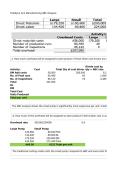
Teledyne Isco Manufacturing ABC Analysis
a. How much overhead will be assigned to each product if these three cost drivers are used to alloca
Divide cost by
Activity: Cost Total Qty of cost driver qty = ABC rate
DM Add costs 56,000 280,000 0.2
No. of Prod runs 60,480 60 1,008
No. of inspections 85,120 19 4,480
Total 201,600
DL
DM
Total Cost
Units Produced
Total per unit
The ABC analysis shows the small pump is significantly more expensive per unit, mostly due to high
b. How much of the overhead will be assigned to each product if direct labor cost is used to allocate
Overhead rate 201600/224000 0.9
Large Pump Small Pump
120,960 80,640 FOH
134,400 89,600 DL
179,200 100,800 DM
434,560 271,040 Total
$48.50 $121 Total per unit
The traditional costing under-costs the small pump compared to ABC and over-costs the large pump
c. Write a memo to the marketing manager explaining why the large pump might be experiencing re
recommendation for which costing system to use.
Dear Marketing Manager,
, c. Write a memo to the marketing manager explaining why the large pump might be experiencing re
recommendation for which costing system to use.
Dear Marketing Manager,
Following your request I have reviewed the production costs of both of our pumps, small and large u
on the direct labour) and Activity-Based Costing (ABC) based on the activities performed and identifi
insights into the pricing and perceived market value of each product.
Key Findings:
Under the traditional approach. overhead is allocated based solely on direct labour and thus, assigns
($48.50 per unit) and $89,640 in overhead to the Small Pump ($121 per unit).
However, using ABC, which consideres actual cost drivers (material used, production runs and inspe
overhead to the Large Pump ($45.25 per unit) and $109,760 in the overhead to the Small Pump ($13
Large Pump Small Pump
Traditional (current Costing) $120,960 $89,640
per unit $48.50 $121
ABC Method $91,840 $109,760
per unit $45.25 $134
In my findings the traditional method we are currently using overstates the costs of the Large Pump,
Pump, which requires more oversight and quality control.
The pricing resistance you are seeing for the Large Pump is likely due to its being overpriced compa
I am guessing. Customers might be perceiving it as expensive and most likely more expensive to ou
I recommend transitioning to ABC method moving forward for internal product costing and pricing st
a. How much overhead will be assigned to each product if these three cost drivers are used to alloca
Divide cost by
Activity: Cost Total Qty of cost driver qty = ABC rate
DM Add costs 56,000 280,000 0.2
No. of Prod runs 60,480 60 1,008
No. of inspections 85,120 19 4,480
Total 201,600
DL
DM
Total Cost
Units Produced
Total per unit
The ABC analysis shows the small pump is significantly more expensive per unit, mostly due to high
b. How much of the overhead will be assigned to each product if direct labor cost is used to allocate
Overhead rate 201600/224000 0.9
Large Pump Small Pump
120,960 80,640 FOH
134,400 89,600 DL
179,200 100,800 DM
434,560 271,040 Total
$48.50 $121 Total per unit
The traditional costing under-costs the small pump compared to ABC and over-costs the large pump
c. Write a memo to the marketing manager explaining why the large pump might be experiencing re
recommendation for which costing system to use.
Dear Marketing Manager,
, c. Write a memo to the marketing manager explaining why the large pump might be experiencing re
recommendation for which costing system to use.
Dear Marketing Manager,
Following your request I have reviewed the production costs of both of our pumps, small and large u
on the direct labour) and Activity-Based Costing (ABC) based on the activities performed and identifi
insights into the pricing and perceived market value of each product.
Key Findings:
Under the traditional approach. overhead is allocated based solely on direct labour and thus, assigns
($48.50 per unit) and $89,640 in overhead to the Small Pump ($121 per unit).
However, using ABC, which consideres actual cost drivers (material used, production runs and inspe
overhead to the Large Pump ($45.25 per unit) and $109,760 in the overhead to the Small Pump ($13
Large Pump Small Pump
Traditional (current Costing) $120,960 $89,640
per unit $48.50 $121
ABC Method $91,840 $109,760
per unit $45.25 $134
In my findings the traditional method we are currently using overstates the costs of the Large Pump,
Pump, which requires more oversight and quality control.
The pricing resistance you are seeing for the Large Pump is likely due to its being overpriced compa
I am guessing. Customers might be perceiving it as expensive and most likely more expensive to ou
I recommend transitioning to ABC method moving forward for internal product costing and pricing st


