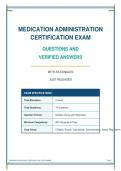
MEDICATION ADMINISTRATION
CERTIFICATION EXAM
QUESTIONS AND
VERIFIED ANSWERS
WITH RATIONALES
JUST RELEASED
EXAM SPECIFICATIONS
Time Allocation: 2 Hours
Total Questions: 75 Questions
Question Format: Multiple Choice with Rationales
Minimum Competency: 80% Required to Pass
Core Focus: 5 Rights, Routes, Calculations, Documentation, Safety, Regulations
Medication Administration Certification Exam Just Released Page 1
, Exam Overview & Content Outline
EXAM PURPOSE
Medication Administration Certification Exam validates competency in safe medication administration
for unlicensed personnel in assisted living, group homes, and healthcare settings per state
regulations. Covers 5 Rights, routes, calculations, documentation, and medication safety.
CONTENT DISTRIBUTION
• Medication Fundamentals (25%) — 5 Rights, 3 Checks, medication classifications, terminology,
abbreviations
• Administration Routes & Techniques (25%) — Oral, topical, ophthalmic, otic, inhalation, rectal,
sublingual
• Calculations & Measurements (20%) — Dosage calculations, conversions, household vs metric,
liquid measurement
• Documentation & Safety (30%) — MAR, medication errors, adverse reactions, storage, disposal,
controlled substances
QUESTION FORMAT & SCORING
Each item presents four options. Correct answers are highlighted in green with checkmark (✓).
Every question includes detailed rationale with standards. Requires 80% to pass.
STUDY STRATEGY
Master 5 Rights of Medication Administration and 3 Checks. Know medication routes and proper
technique. Practice dosage calculations and metric conversions. Understand MAR documentation.
Study medication errors, side effects, and adverse reactions. Know controlled substance regulations.
Review infection control.
CURRICULUM ALIGNMENT
Questions reflect current standards: State medication administration regulations, OSHA, CDC, FDA
guidelines, and medication safety best practices for unlicensed assistive personnel.
Medication Administration Certification Exam Just Released Page 2
, SECTION I: Medication Fundamentals
1. The 5 Rights of Medication Administration are:
A. Right room, right bed, right time, right nurse, right chart
✓ B. Right patient, right medication, right dose, right route, right time
C. Right color, right size, right shape, right smell, right taste
D. Right hospital, right floor, right shift, right supervisor, right doctor
Rationale: 5 Rights: 1) Right Patient - two identifiers (name, DOB), 2) Right Medication - check label 3 times,
3) Right Dose - verify calculations, 4) Right Route - oral, topical, etc., 5) Right Time - within 30-60 min
window. Some add: Right Documentation, Right to Refuse, Right Assessment, Right Response. Prevents
errors.
2. The 3 Checks performed when administering medication:
A. Check patient, check room, check chart
✓ B. Check when removing from storage, when preparing, at bedside before giving
C. Check morning, noon, night
D. Check temperature, pulse, respiration
Rationale: 3 Checks: 1) When removing medication from storage/drawer - check label against MAR, 2)
When preparing/pouring medication - verify again, 3) At bedside before administering to patient - final check
with patient present. Compare medication label to MAR all 3 times. Prevents wrong medication errors.
3. Medication abbreviation 'BID' means:
A. Once daily
✓ B. Twice daily
C. Three times daily
D. Four times daily
Rationale: BID = bis in die (Latin) = twice daily, typically 12 hours apart (e.g., 9am and 9pm). QD = once
daily. TID = three times daily (q8h). QID = four times daily (q6h). PRN = as needed. AC = before meals. PC
= after meals. HS = bedtime. Avoid error-prone abbreviations per Joint Commission.
4. Controlled substances must be:
A. Stored with all other medications
✓ B. Double-locked, counted each shift, documented
C. Accessible to all staff
D. Discarded after each use
Rationale: Controlled Substances (Schedule II-V): Double-locked cabinet/drawer. Count at beginning and
end of each shift by two staff. Document on controlled substance log: date, time, patient, medication, dose,
count, signatures. Discrepancies reported immediately. Wasting witnessed and documented. DEA
regulations apply.
5. Medication that must be refrigerated:
A. All medications
Medication Administration Certification Exam Just Released Page 3
CERTIFICATION EXAM
QUESTIONS AND
VERIFIED ANSWERS
WITH RATIONALES
JUST RELEASED
EXAM SPECIFICATIONS
Time Allocation: 2 Hours
Total Questions: 75 Questions
Question Format: Multiple Choice with Rationales
Minimum Competency: 80% Required to Pass
Core Focus: 5 Rights, Routes, Calculations, Documentation, Safety, Regulations
Medication Administration Certification Exam Just Released Page 1
, Exam Overview & Content Outline
EXAM PURPOSE
Medication Administration Certification Exam validates competency in safe medication administration
for unlicensed personnel in assisted living, group homes, and healthcare settings per state
regulations. Covers 5 Rights, routes, calculations, documentation, and medication safety.
CONTENT DISTRIBUTION
• Medication Fundamentals (25%) — 5 Rights, 3 Checks, medication classifications, terminology,
abbreviations
• Administration Routes & Techniques (25%) — Oral, topical, ophthalmic, otic, inhalation, rectal,
sublingual
• Calculations & Measurements (20%) — Dosage calculations, conversions, household vs metric,
liquid measurement
• Documentation & Safety (30%) — MAR, medication errors, adverse reactions, storage, disposal,
controlled substances
QUESTION FORMAT & SCORING
Each item presents four options. Correct answers are highlighted in green with checkmark (✓).
Every question includes detailed rationale with standards. Requires 80% to pass.
STUDY STRATEGY
Master 5 Rights of Medication Administration and 3 Checks. Know medication routes and proper
technique. Practice dosage calculations and metric conversions. Understand MAR documentation.
Study medication errors, side effects, and adverse reactions. Know controlled substance regulations.
Review infection control.
CURRICULUM ALIGNMENT
Questions reflect current standards: State medication administration regulations, OSHA, CDC, FDA
guidelines, and medication safety best practices for unlicensed assistive personnel.
Medication Administration Certification Exam Just Released Page 2
, SECTION I: Medication Fundamentals
1. The 5 Rights of Medication Administration are:
A. Right room, right bed, right time, right nurse, right chart
✓ B. Right patient, right medication, right dose, right route, right time
C. Right color, right size, right shape, right smell, right taste
D. Right hospital, right floor, right shift, right supervisor, right doctor
Rationale: 5 Rights: 1) Right Patient - two identifiers (name, DOB), 2) Right Medication - check label 3 times,
3) Right Dose - verify calculations, 4) Right Route - oral, topical, etc., 5) Right Time - within 30-60 min
window. Some add: Right Documentation, Right to Refuse, Right Assessment, Right Response. Prevents
errors.
2. The 3 Checks performed when administering medication:
A. Check patient, check room, check chart
✓ B. Check when removing from storage, when preparing, at bedside before giving
C. Check morning, noon, night
D. Check temperature, pulse, respiration
Rationale: 3 Checks: 1) When removing medication from storage/drawer - check label against MAR, 2)
When preparing/pouring medication - verify again, 3) At bedside before administering to patient - final check
with patient present. Compare medication label to MAR all 3 times. Prevents wrong medication errors.
3. Medication abbreviation 'BID' means:
A. Once daily
✓ B. Twice daily
C. Three times daily
D. Four times daily
Rationale: BID = bis in die (Latin) = twice daily, typically 12 hours apart (e.g., 9am and 9pm). QD = once
daily. TID = three times daily (q8h). QID = four times daily (q6h). PRN = as needed. AC = before meals. PC
= after meals. HS = bedtime. Avoid error-prone abbreviations per Joint Commission.
4. Controlled substances must be:
A. Stored with all other medications
✓ B. Double-locked, counted each shift, documented
C. Accessible to all staff
D. Discarded after each use
Rationale: Controlled Substances (Schedule II-V): Double-locked cabinet/drawer. Count at beginning and
end of each shift by two staff. Document on controlled substance log: date, time, patient, medication, dose,
count, signatures. Discrepancies reported immediately. Wasting witnessed and documented. DEA
regulations apply.
5. Medication that must be refrigerated:
A. All medications
Medication Administration Certification Exam Just Released Page 3