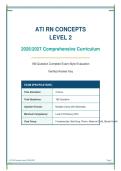
ATI RN CONCEPTS
LEVEL 2
2026/2027 Comprehensive Curriculum
180-Question Complete Exam-Style Evaluation
Verified Answer Key
EXAM SPECIFICATIONS
Time Allocation: 3 Hours
Total Questions: 180 Questions
Question Format: Multiple Choice with Rationales
Minimum Competency: Level 2 Proficiency 65%
Core Focus: Fundamentals, Med-Surg, Pharm, Maternal-Child, Mental Health
ATI RN Concepts Level 2 2026-2027 Page 1
, Exam Overview & Content Outline
EXAM PURPOSE
ATI RN Concepts Level 2 Comprehensive Curriculum covers fundamental nursing concepts,
medical-surgical nursing, pharmacology, maternal-child, and mental health. Based on ATI Nursing
Education Content Mastery Series and NCLEX-RN Test Plan 2026 for intermediate nursing students.
CONTENT DISTRIBUTION
• Fundamentals & Safety (25%) — Nursing process, safety, infection control, vital signs, mobility,
nutrition, elimination
• Adult Medical-Surgical (30%) — Cardiovascular, respiratory, endocrine, GI, renal, neuro,
musculoskeletal, integumentary
• Pharmacology (20%) — Drug classes, calculations, administration, side effects, interactions,
patient teaching
• Maternal-Child Nursing (15%) — Antepartum, intrapartum, postpartum, newborn, pediatrics,
growth and development
• Mental Health & Professional Issues (10%) — Therapeutic communication, psychiatric disorders,
legal/ethical, prioritization
QUESTION FORMAT & SCORING
Each item presents four options. Correct answers are highlighted in green with checkmark (✓).
Every question includes detailed rationale with nursing standards. ATI Level 2 Proficiency requires
65% correct.
STUDY STRATEGY
Master nursing process: ADPIE. Know normal lab values and vital signs. Understand pharmacology
basics and med administration. Review medical-surgical pathophysiology. Study maternal-child
milestones. Practice prioritization and delegation. Review infection control and safety.
CURRICULUM ALIGNMENT
Questions reflect 2026-2027 standards: ATI Nursing Education, NCLEX-RN Test Plan, AACN
Essentials, ANA Scope and Standards, QSEN competencies, and current nursing practice
guidelines.
ATI RN Concepts Level 2 2026-2027 Page 2
, SECTION I: Fundamentals & Safety
1. Normal adult respiratory rate:
A. 8-12
✓ B. 12-20
C. 22-28
D. 30-40
Rationale: Normal VS adults: Temp 97-99°F (36.1-37.2°C), HR 60-100, RR 12-20, BP <120/80, SpO2
95-100% room air, Pain 0/10. Tachypnea >20, bradypnea <12. Tachycardia >100, bradycardia <60.
Hypertension ≥130/80. Assess trends. Count RR for 30 seconds if regular, 60 if irregular.
2. Airborne precautions PPE:
A. Gloves only
✓ B. N95 respirator, gown, gloves
C. Surgical mask
D. No PPE
Rationale: Airborne: TB, measles, varicella, disseminated shingles. N95 respirator (fit-tested), negative
pressure room, door closed. Droplet: influenza, pertussis, meningitis - surgical mask, private room or cohort.
Contact: MRSA, VRE, C. diff - gown, gloves. Standard precautions: all patients.
3. Pressure injury Stage 2:
A. Intact skin, non-blanchable redness
✓ B. Partial-thickness skin loss, shallow open ulcer, red-pink wound bed
C. Full-thickness tissue loss
D. Eschar
Rationale: Stage 1: Intact, non-blanchable redness. Stage 2: Partial-thickness, shallow open ulcer, red-pink,
no slough. Stage 3: Full-thickness, subcutaneous fat visible. Stage 4: Full-thickness with
bone/tendon/muscle exposed. Unstageable: covered by slough/eschar. DTI: purple/maroon intact.
Prevention: turn q2h, nutrition, moisture management.
4. Nasogastric tube placement verification:
A. Auscultation only
✓ B. X-ray is gold standard
C. Aspirate only
D. Water test
Rationale: NGT placement: X-ray gold standard before first use/feeding/med. Aspirate pH ≤5.5 suggests
gastric. Auscultation unreliable. Measure NEX (nose-ear-xiphoid) + 10cm. Mark at naris. Secure. Check
placement q4h, before meds/feedings, if displaced. Complications: aspiration, mucosal damage. Never use
air bolus.
5. Fall risk assessment - Morse Scale high risk:
A. Score 0-24
ATI RN Concepts Level 2 2026-2027 Page 3
, ✓ B. Score ≥45
C. Score 25-44
D. Score not used
Rationale: Morse Fall Scale: History falls 25, Secondary diagnosis 15, Ambulatory aid 0-30, IV/heparin lock
20, Gait 0-20, Mental status 0-15. 0-24 low, 25-44 moderate, ≥45 high risk. Interventions: bed alarm, call
light, non-skid socks, hourly rounding, medication review. Universal precautions all patients.
6. Myocardial infarction priority intervention:
A. Morphine only
✓ B. MONA: Morphine, Oxygen if <90%, Nitroglycerin, Aspirin; 12-lead EKG, troponin
C. Wait and see
D. Discharge home
Rationale: MI: MONA - Morphine for pain, Oxygen if SpO2 <90% (not routine), Nitro sublingual, Aspirin
324mg chewed. 12-lead EKG within 10 min. Troponin. STEMI: PCI within 90 min or thrombolytics 30 min.
NSTEMI: heparin, risk stratify. ABCs first. Pain relief, reduce workload.
7. COPD exacerbation priority:
A. Antibiotics only
✓ B. Bronchodilators (SABA), oxygen target 88-92%, steroids
C. Intubate immediately
D. Chest physiotherapy
Rationale: COPD exacerbation: SABA albuterol + anticholinergic ipratropium, systemic steroids prednisone,
antibiotics if purulent sputum. Oxygen target 88-92% (avoid >92% - hypoxic drive). NIPPV BiPAP if
respiratory acidosis. Smoking cessation. Pulmonary rehab. Avoid high-flow O2 - CO2 retention risk.
8. Diabetic ketoacidosis signs:
A. Hypoglycemia
✓ B. Hyperglycemia >250, ketones, acidosis pH <7.3, Kussmaul respirations
C. No ketones
D. Bradypnea
Rationale: DKA: Type 1, glucose >250, ketones blood/urine, pH <7.3, HCO3 <18, anion gap >12. Kussmaul
respirations (deep, rapid), fruity breath, dehydration, N/V, abdominal pain. Treatment: IV fluids NS, insulin
infusion 0.1 u/kg/hr, K+ replacement, monitor glucose/K+ q1hr. HHS: higher glucose, no ketones, more
dehydrated.
9. Stroke assessment - Cincinnati Scale:
A. Temperature, pulse, respirations
✓ B. Facial droop, Arm drift, Speech abnormal
C. Pupil size only
D. Blood pressure
Rationale: Cincinnati Prehospital Stroke Scale: Facial droop (smile), Arm drift (close eyes, extend arms),
Speech (repeat phrase). 1 sign = 72% probability stroke. NIH Stroke Scale comprehensive. Time is brain:
ATI RN Concepts Level 2 2026-2027 Page 4
LEVEL 2
2026/2027 Comprehensive Curriculum
180-Question Complete Exam-Style Evaluation
Verified Answer Key
EXAM SPECIFICATIONS
Time Allocation: 3 Hours
Total Questions: 180 Questions
Question Format: Multiple Choice with Rationales
Minimum Competency: Level 2 Proficiency 65%
Core Focus: Fundamentals, Med-Surg, Pharm, Maternal-Child, Mental Health
ATI RN Concepts Level 2 2026-2027 Page 1
, Exam Overview & Content Outline
EXAM PURPOSE
ATI RN Concepts Level 2 Comprehensive Curriculum covers fundamental nursing concepts,
medical-surgical nursing, pharmacology, maternal-child, and mental health. Based on ATI Nursing
Education Content Mastery Series and NCLEX-RN Test Plan 2026 for intermediate nursing students.
CONTENT DISTRIBUTION
• Fundamentals & Safety (25%) — Nursing process, safety, infection control, vital signs, mobility,
nutrition, elimination
• Adult Medical-Surgical (30%) — Cardiovascular, respiratory, endocrine, GI, renal, neuro,
musculoskeletal, integumentary
• Pharmacology (20%) — Drug classes, calculations, administration, side effects, interactions,
patient teaching
• Maternal-Child Nursing (15%) — Antepartum, intrapartum, postpartum, newborn, pediatrics,
growth and development
• Mental Health & Professional Issues (10%) — Therapeutic communication, psychiatric disorders,
legal/ethical, prioritization
QUESTION FORMAT & SCORING
Each item presents four options. Correct answers are highlighted in green with checkmark (✓).
Every question includes detailed rationale with nursing standards. ATI Level 2 Proficiency requires
65% correct.
STUDY STRATEGY
Master nursing process: ADPIE. Know normal lab values and vital signs. Understand pharmacology
basics and med administration. Review medical-surgical pathophysiology. Study maternal-child
milestones. Practice prioritization and delegation. Review infection control and safety.
CURRICULUM ALIGNMENT
Questions reflect 2026-2027 standards: ATI Nursing Education, NCLEX-RN Test Plan, AACN
Essentials, ANA Scope and Standards, QSEN competencies, and current nursing practice
guidelines.
ATI RN Concepts Level 2 2026-2027 Page 2
, SECTION I: Fundamentals & Safety
1. Normal adult respiratory rate:
A. 8-12
✓ B. 12-20
C. 22-28
D. 30-40
Rationale: Normal VS adults: Temp 97-99°F (36.1-37.2°C), HR 60-100, RR 12-20, BP <120/80, SpO2
95-100% room air, Pain 0/10. Tachypnea >20, bradypnea <12. Tachycardia >100, bradycardia <60.
Hypertension ≥130/80. Assess trends. Count RR for 30 seconds if regular, 60 if irregular.
2. Airborne precautions PPE:
A. Gloves only
✓ B. N95 respirator, gown, gloves
C. Surgical mask
D. No PPE
Rationale: Airborne: TB, measles, varicella, disseminated shingles. N95 respirator (fit-tested), negative
pressure room, door closed. Droplet: influenza, pertussis, meningitis - surgical mask, private room or cohort.
Contact: MRSA, VRE, C. diff - gown, gloves. Standard precautions: all patients.
3. Pressure injury Stage 2:
A. Intact skin, non-blanchable redness
✓ B. Partial-thickness skin loss, shallow open ulcer, red-pink wound bed
C. Full-thickness tissue loss
D. Eschar
Rationale: Stage 1: Intact, non-blanchable redness. Stage 2: Partial-thickness, shallow open ulcer, red-pink,
no slough. Stage 3: Full-thickness, subcutaneous fat visible. Stage 4: Full-thickness with
bone/tendon/muscle exposed. Unstageable: covered by slough/eschar. DTI: purple/maroon intact.
Prevention: turn q2h, nutrition, moisture management.
4. Nasogastric tube placement verification:
A. Auscultation only
✓ B. X-ray is gold standard
C. Aspirate only
D. Water test
Rationale: NGT placement: X-ray gold standard before first use/feeding/med. Aspirate pH ≤5.5 suggests
gastric. Auscultation unreliable. Measure NEX (nose-ear-xiphoid) + 10cm. Mark at naris. Secure. Check
placement q4h, before meds/feedings, if displaced. Complications: aspiration, mucosal damage. Never use
air bolus.
5. Fall risk assessment - Morse Scale high risk:
A. Score 0-24
ATI RN Concepts Level 2 2026-2027 Page 3
, ✓ B. Score ≥45
C. Score 25-44
D. Score not used
Rationale: Morse Fall Scale: History falls 25, Secondary diagnosis 15, Ambulatory aid 0-30, IV/heparin lock
20, Gait 0-20, Mental status 0-15. 0-24 low, 25-44 moderate, ≥45 high risk. Interventions: bed alarm, call
light, non-skid socks, hourly rounding, medication review. Universal precautions all patients.
6. Myocardial infarction priority intervention:
A. Morphine only
✓ B. MONA: Morphine, Oxygen if <90%, Nitroglycerin, Aspirin; 12-lead EKG, troponin
C. Wait and see
D. Discharge home
Rationale: MI: MONA - Morphine for pain, Oxygen if SpO2 <90% (not routine), Nitro sublingual, Aspirin
324mg chewed. 12-lead EKG within 10 min. Troponin. STEMI: PCI within 90 min or thrombolytics 30 min.
NSTEMI: heparin, risk stratify. ABCs first. Pain relief, reduce workload.
7. COPD exacerbation priority:
A. Antibiotics only
✓ B. Bronchodilators (SABA), oxygen target 88-92%, steroids
C. Intubate immediately
D. Chest physiotherapy
Rationale: COPD exacerbation: SABA albuterol + anticholinergic ipratropium, systemic steroids prednisone,
antibiotics if purulent sputum. Oxygen target 88-92% (avoid >92% - hypoxic drive). NIPPV BiPAP if
respiratory acidosis. Smoking cessation. Pulmonary rehab. Avoid high-flow O2 - CO2 retention risk.
8. Diabetic ketoacidosis signs:
A. Hypoglycemia
✓ B. Hyperglycemia >250, ketones, acidosis pH <7.3, Kussmaul respirations
C. No ketones
D. Bradypnea
Rationale: DKA: Type 1, glucose >250, ketones blood/urine, pH <7.3, HCO3 <18, anion gap >12. Kussmaul
respirations (deep, rapid), fruity breath, dehydration, N/V, abdominal pain. Treatment: IV fluids NS, insulin
infusion 0.1 u/kg/hr, K+ replacement, monitor glucose/K+ q1hr. HHS: higher glucose, no ketones, more
dehydrated.
9. Stroke assessment - Cincinnati Scale:
A. Temperature, pulse, respirations
✓ B. Facial droop, Arm drift, Speech abnormal
C. Pupil size only
D. Blood pressure
Rationale: Cincinnati Prehospital Stroke Scale: Facial droop (smile), Arm drift (close eyes, extend arms),
Speech (repeat phrase). 1 sign = 72% probability stroke. NIH Stroke Scale comprehensive. Time is brain:
ATI RN Concepts Level 2 2026-2027 Page 4