

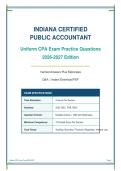
INDIANA CERTIFIED
PUBLIC ACCOUNTANT
Uniform CPA Exam Practice Questions
2026-2027 Edition
Verified Answers Plus Rationales
Q&A; | Instant Download PDF
EXAM SPECIFICATIONS
Time Allocation: 4 Hours Per Section
Sections: AUD, BEC, FAR, REG
Question Format: Multiple Choice + TBS with Rationales
Minimum Competency: 75 Scaled Score Per Section
Core Focus: Auditing, Business, Financial, Regulation, Indiana Law
Indiana CPA Exam Prep 2026-2027 Page 1
, Exam Overview & Content Outline
EXAM PURPOSE
Indiana CPA license requires passing Uniform CPA Examination: AUD (Auditing), BEC (Business
Environment), FAR (Financial Accounting), REG (Regulation). Based on AICPA Blueprints, NASBA,
and Indiana Board of Accountancy requirements per IC 25-2.1.
CONTENT DISTRIBUTION
• AUD - Auditing & Attestation (25%) — Ethics, risk assessment, procedures, evidence, reporting,
SSARS, SSAE
• BEC - Business Environment & Concepts (25%) — Corporate governance, economics, financial
management, IT, operations
• FAR - Financial Accounting & Reporting (25%) — GAAP, financial statements, transactions,
governmental, NFP
• REG - Regulation (25%) — Ethics, business law, federal taxation, Indiana state tax, professional
responsibilities
QUESTION FORMAT & SCORING
Each section: Multiple choice + Task-Based Simulations (TBS). Correct answers are highlighted in
green with checkmark (✓). Every question includes detailed rationale with accounting standards.
AICPA requires 75 scaled score per section.
STUDY STRATEGY
Master AICPA Blueprints for each section. Know GAAS, GAAP, IRC, and Indiana tax law.
Understand audit procedures and evidence. Review financial statement preparation and analysis.
Study business law and ethics. Practice TBS and simulations. Review IC 25-2.1 and 872 IAC.
CURRICULUM ALIGNMENT
Questions reflect 2026-2027 standards: AICPA Uniform CPA Exam Blueprints, GAAP, GAAS, IRC,
Indiana Code 25-2.1, 872 IAC, and Indiana Board of Accountancy rules.
Indiana CPA Exam Prep 2026-2027 Page 2
, SECTION I: AUD - Auditing & Attestation
1. GAAS general standards require auditor to have:
A. CPA license only
✓ B. Adequate technical training, proficiency, independence
C. Client relationship
D. No requirements
Rationale: GAAS General Standards: 1) Adequate technical training and proficiency, 2) Independence in
mental attitude, 3) Due professional care. Independence: both in fact and appearance. Cannot have
financial interest or relationship. Competence required. AU-C 200.
2. Audit risk model: AR = IR × CR × DR. Detection risk is:
A. Set by auditor
✓ B. Risk that auditor fails to detect material misstatement
C. Client risk
D. Inherent risk
Rationale: Audit Risk = Inherent Risk × Control Risk × Detection Risk. IR: susceptibility to misstatement. CR:
controls fail to prevent/detect. DR: auditor's procedures fail to detect. Auditor controls DR by
nature/timing/extent of procedures. Inverse relationship: if IR/CR high, DR must be low.
3. Substantive procedures include:
A. Inquiries only
✓ B. Tests of details and analytical procedures
C. Control testing only
D. No testing
Rationale: Substantive procedures: Tests of details (vouching, tracing, confirmation, inspection) and
analytical procedures (ratios, trends). Performed to detect material misstatements. Required for all
significant accounts. Differs from tests of controls. AU-C 330.
4. Unmodified opinion means:
A. Qualified opinion
✓ B. Financial statements fairly presented in accordance with GAAP
C. Adverse opinion
D. Disclaimer
Rationale: Unmodified (unqualified) opinion: Financial statements present fairly in all material respects per
GAAP. Highest level. Modified: Qualified (except for), Adverse (not fairly presented), Disclaimer (scope
limitation). AU-C 700. Basis paragraph explains.
5. SSARS applies to:
A. Audits
✓ B. Compilations and reviews of non-issuers
C. Tax returns
Indiana CPA Exam Prep 2026-2027 Page 3
PUBLIC ACCOUNTANT
Uniform CPA Exam Practice Questions
2026-2027 Edition
Verified Answers Plus Rationales
Q&A; | Instant Download PDF
EXAM SPECIFICATIONS
Time Allocation: 4 Hours Per Section
Sections: AUD, BEC, FAR, REG
Question Format: Multiple Choice + TBS with Rationales
Minimum Competency: 75 Scaled Score Per Section
Core Focus: Auditing, Business, Financial, Regulation, Indiana Law
Indiana CPA Exam Prep 2026-2027 Page 1
, Exam Overview & Content Outline
EXAM PURPOSE
Indiana CPA license requires passing Uniform CPA Examination: AUD (Auditing), BEC (Business
Environment), FAR (Financial Accounting), REG (Regulation). Based on AICPA Blueprints, NASBA,
and Indiana Board of Accountancy requirements per IC 25-2.1.
CONTENT DISTRIBUTION
• AUD - Auditing & Attestation (25%) — Ethics, risk assessment, procedures, evidence, reporting,
SSARS, SSAE
• BEC - Business Environment & Concepts (25%) — Corporate governance, economics, financial
management, IT, operations
• FAR - Financial Accounting & Reporting (25%) — GAAP, financial statements, transactions,
governmental, NFP
• REG - Regulation (25%) — Ethics, business law, federal taxation, Indiana state tax, professional
responsibilities
QUESTION FORMAT & SCORING
Each section: Multiple choice + Task-Based Simulations (TBS). Correct answers are highlighted in
green with checkmark (✓). Every question includes detailed rationale with accounting standards.
AICPA requires 75 scaled score per section.
STUDY STRATEGY
Master AICPA Blueprints for each section. Know GAAS, GAAP, IRC, and Indiana tax law.
Understand audit procedures and evidence. Review financial statement preparation and analysis.
Study business law and ethics. Practice TBS and simulations. Review IC 25-2.1 and 872 IAC.
CURRICULUM ALIGNMENT
Questions reflect 2026-2027 standards: AICPA Uniform CPA Exam Blueprints, GAAP, GAAS, IRC,
Indiana Code 25-2.1, 872 IAC, and Indiana Board of Accountancy rules.
Indiana CPA Exam Prep 2026-2027 Page 2
, SECTION I: AUD - Auditing & Attestation
1. GAAS general standards require auditor to have:
A. CPA license only
✓ B. Adequate technical training, proficiency, independence
C. Client relationship
D. No requirements
Rationale: GAAS General Standards: 1) Adequate technical training and proficiency, 2) Independence in
mental attitude, 3) Due professional care. Independence: both in fact and appearance. Cannot have
financial interest or relationship. Competence required. AU-C 200.
2. Audit risk model: AR = IR × CR × DR. Detection risk is:
A. Set by auditor
✓ B. Risk that auditor fails to detect material misstatement
C. Client risk
D. Inherent risk
Rationale: Audit Risk = Inherent Risk × Control Risk × Detection Risk. IR: susceptibility to misstatement. CR:
controls fail to prevent/detect. DR: auditor's procedures fail to detect. Auditor controls DR by
nature/timing/extent of procedures. Inverse relationship: if IR/CR high, DR must be low.
3. Substantive procedures include:
A. Inquiries only
✓ B. Tests of details and analytical procedures
C. Control testing only
D. No testing
Rationale: Substantive procedures: Tests of details (vouching, tracing, confirmation, inspection) and
analytical procedures (ratios, trends). Performed to detect material misstatements. Required for all
significant accounts. Differs from tests of controls. AU-C 330.
4. Unmodified opinion means:
A. Qualified opinion
✓ B. Financial statements fairly presented in accordance with GAAP
C. Adverse opinion
D. Disclaimer
Rationale: Unmodified (unqualified) opinion: Financial statements present fairly in all material respects per
GAAP. Highest level. Modified: Qualified (except for), Adverse (not fairly presented), Disclaimer (scope
limitation). AU-C 700. Basis paragraph explains.
5. SSARS applies to:
A. Audits
✓ B. Compilations and reviews of non-issuers
C. Tax returns
Indiana CPA Exam Prep 2026-2027 Page 3


