

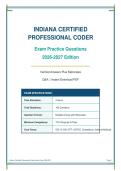
INDIANA CERTIFIED
PROFESSIONAL CODER
Exam Practice Questions
2026-2027 Edition
Verified Answers Plus Rationales
Q&A; | Instant Download PDF
EXAM SPECIFICATIONS
Time Allocation: 4 Hours
Total Questions: 100 Questions
Question Format: Multiple Choice with Rationales
Minimum Competency: 70% Required to Pass
Core Focus: ICD-10-CM, CPT, HCPCS, Compliance, Indiana Medicaid
Indiana Certified Professional Coder Exam Prep 2026-2027 Page 1
, Exam Overview & Content Outline
EXAM PURPOSE
Indiana Certified Professional Coder (CPC) certification covers medical coding for physician services
using ICD-10-CM, CPT, HCPCS Level II. Based on AAPC CPC exam, CMS guidelines, AMA CPT,
and Indiana Medicaid requirements for professional fee coding.
CONTENT DISTRIBUTION
• ICD-10-CM Diagnosis Coding (25%) — Guidelines, conventions, chapters, sequencing, specificity,
Z codes
• CPT Procedural Coding (30%) — E/M, Surgery, Radiology, Pathology, Medicine, Anesthesia,
modifiers
• HCPCS Level II & Compliance (20%) — Supply codes, DME, drugs, compliance, fraud/abuse,
HIPAA
• Medical Terminology & Anatomy (15%) — Body systems, prefixes, suffixes, root words,
procedures
• Reimbursement & Indiana Medicaid (10%) — RVUs, fee schedules, Indiana Medicaid, managed
care, billing
QUESTION FORMAT & SCORING
Each item presents four options. Correct answers are highlighted in green with checkmark (✓).
Every question includes detailed rationale with coding guidelines. AAPC requires 70% to pass CPC
exam.
STUDY STRATEGY
Master ICD-10-CM Official Guidelines and conventions. Know CPT sections and modifiers.
Understand E/M 2021 guidelines. Review HCPCS Level II. Study medical terminology and anatomy.
Review compliance, fraud/abuse, HIPAA. Practice timed coding scenarios. Review Indiana Medicaid
policies.
CURRICULUM ALIGNMENT
Questions reflect 2026-2027 standards: AAPC CPC exam, ICD-10-CM, AMA CPT 2026, HCPCS
Level II, CMS guidelines, OIG compliance, HIPAA, and Indiana Medicaid policies.
Indiana Certified Professional Coder Exam Prep 2026-2027 Page 2
, SECTION I: ICD-10-CM Diagnosis Coding
1. ICD-10-CM code for Type 2 diabetes with diabetic nephropathy:
A. E11.9
✓ B. E11.21
C. E10.21
D. N18.9
Rationale: ICD-10-CM: E11.21 Type 2 diabetes mellitus with diabetic nephropathy. Combination code
required. E11.9 = Type 2 without complications. E10 = Type 1. N18.9 = CKD unspecified. Code first
diabetes, then manifestation. Sequencing per guidelines. Use additional code for CKD stage if known.
2. ICD-10-CM placeholder X is used when:
A. Always required
✓ B. Code requires 7th character but 6th not needed
C. Never used
D. For all codes
Rationale: Placeholder X: Used when 7th character required but no 6th character exists. Example:
S52.5__A (fracture of lower end of radius). 7th character: A initial encounter, D subsequent, S sequela. X
fills 6th position. Not used if 6th character present. Required for valid code.
3. Z code for encounter for screening mammogram:
A. C50.911
✓ B. Z12.31
C. R92.8
D. Z00.00
Rationale: Z12.31: Encounter for screening mammogram for malignant neoplasm of breast. Z codes =
factors influencing health status. Screening = no symptoms. C50.911 = malignant neoplasm breast. R92.8 =
abnormal mammogram. Z00.00 = general adult exam. Screening Z codes first-listed.
4. ICD-10-CM code for acute myocardial infarction, initial episode:
A. I25.10
✓ B. I21.9
C. I20.0
D. R07.9
Rationale: I21.9: Acute myocardial infarction, unspecified site. I21.0-I21.4 specify site. Initial episode = first 4
weeks. After 4 weeks = I25.2 old MI. I25.10 = atherosclerotic heart disease. I20.0 = unstable angina. R07.9
= chest pain. Timeframe critical for coding.
5. Code for sepsis due to E. coli:
A. A41.9 only
✓ B. A41.51, code for sepsis first then organism
C. B96.20 only
Indiana Certified Professional Coder Exam Prep 2026-2027 Page 3
PROFESSIONAL CODER
Exam Practice Questions
2026-2027 Edition
Verified Answers Plus Rationales
Q&A; | Instant Download PDF
EXAM SPECIFICATIONS
Time Allocation: 4 Hours
Total Questions: 100 Questions
Question Format: Multiple Choice with Rationales
Minimum Competency: 70% Required to Pass
Core Focus: ICD-10-CM, CPT, HCPCS, Compliance, Indiana Medicaid
Indiana Certified Professional Coder Exam Prep 2026-2027 Page 1
, Exam Overview & Content Outline
EXAM PURPOSE
Indiana Certified Professional Coder (CPC) certification covers medical coding for physician services
using ICD-10-CM, CPT, HCPCS Level II. Based on AAPC CPC exam, CMS guidelines, AMA CPT,
and Indiana Medicaid requirements for professional fee coding.
CONTENT DISTRIBUTION
• ICD-10-CM Diagnosis Coding (25%) — Guidelines, conventions, chapters, sequencing, specificity,
Z codes
• CPT Procedural Coding (30%) — E/M, Surgery, Radiology, Pathology, Medicine, Anesthesia,
modifiers
• HCPCS Level II & Compliance (20%) — Supply codes, DME, drugs, compliance, fraud/abuse,
HIPAA
• Medical Terminology & Anatomy (15%) — Body systems, prefixes, suffixes, root words,
procedures
• Reimbursement & Indiana Medicaid (10%) — RVUs, fee schedules, Indiana Medicaid, managed
care, billing
QUESTION FORMAT & SCORING
Each item presents four options. Correct answers are highlighted in green with checkmark (✓).
Every question includes detailed rationale with coding guidelines. AAPC requires 70% to pass CPC
exam.
STUDY STRATEGY
Master ICD-10-CM Official Guidelines and conventions. Know CPT sections and modifiers.
Understand E/M 2021 guidelines. Review HCPCS Level II. Study medical terminology and anatomy.
Review compliance, fraud/abuse, HIPAA. Practice timed coding scenarios. Review Indiana Medicaid
policies.
CURRICULUM ALIGNMENT
Questions reflect 2026-2027 standards: AAPC CPC exam, ICD-10-CM, AMA CPT 2026, HCPCS
Level II, CMS guidelines, OIG compliance, HIPAA, and Indiana Medicaid policies.
Indiana Certified Professional Coder Exam Prep 2026-2027 Page 2
, SECTION I: ICD-10-CM Diagnosis Coding
1. ICD-10-CM code for Type 2 diabetes with diabetic nephropathy:
A. E11.9
✓ B. E11.21
C. E10.21
D. N18.9
Rationale: ICD-10-CM: E11.21 Type 2 diabetes mellitus with diabetic nephropathy. Combination code
required. E11.9 = Type 2 without complications. E10 = Type 1. N18.9 = CKD unspecified. Code first
diabetes, then manifestation. Sequencing per guidelines. Use additional code for CKD stage if known.
2. ICD-10-CM placeholder X is used when:
A. Always required
✓ B. Code requires 7th character but 6th not needed
C. Never used
D. For all codes
Rationale: Placeholder X: Used when 7th character required but no 6th character exists. Example:
S52.5__A (fracture of lower end of radius). 7th character: A initial encounter, D subsequent, S sequela. X
fills 6th position. Not used if 6th character present. Required for valid code.
3. Z code for encounter for screening mammogram:
A. C50.911
✓ B. Z12.31
C. R92.8
D. Z00.00
Rationale: Z12.31: Encounter for screening mammogram for malignant neoplasm of breast. Z codes =
factors influencing health status. Screening = no symptoms. C50.911 = malignant neoplasm breast. R92.8 =
abnormal mammogram. Z00.00 = general adult exam. Screening Z codes first-listed.
4. ICD-10-CM code for acute myocardial infarction, initial episode:
A. I25.10
✓ B. I21.9
C. I20.0
D. R07.9
Rationale: I21.9: Acute myocardial infarction, unspecified site. I21.0-I21.4 specify site. Initial episode = first 4
weeks. After 4 weeks = I25.2 old MI. I25.10 = atherosclerotic heart disease. I20.0 = unstable angina. R07.9
= chest pain. Timeframe critical for coding.
5. Code for sepsis due to E. coli:
A. A41.9 only
✓ B. A41.51, code for sepsis first then organism
C. B96.20 only
Indiana Certified Professional Coder Exam Prep 2026-2027 Page 3


