

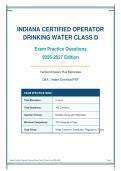
INDIANA CERTIFIED OPERATOR
DRINKING WATER CLASS D
Exam Practice Questions
2026-2027 Edition
Verified Answers Plus Rationales
Q&A; | Instant Download PDF
EXAM SPECIFICATIONS
Time Allocation: 3 Hours
Total Questions: 100 Questions
Question Format: Multiple Choice with Rationales
Minimum Competency: 70% Required to Pass
Core Focus: Water Treatment, Distribution, Regulations, Safety
Indiana Certified Operator Drinking Water Class D Exam Prep 2026-2027 Page 1
, Exam Overview & Content Outline
EXAM PURPOSE
Indiana Class D Water Operator certification covers very small water systems serving 25-500 people.
Based on Safe Drinking Water Act, Indiana 327 IAC 8, and IDEM requirements for groundwater
systems, disinfection, distribution, sampling, and reporting.
CONTENT DISTRIBUTION
• Water Treatment & Disinfection (30%) — Chlorination, CT values, wellhead protection, filtration
basics, pH control
• Distribution System (25%) — Hydraulics, pumps, storage, cross-connection, backflow, mains,
valves, hydrants
• Water Quality & Sampling (20%) — Coliform, chlorine residual, turbidity, lead/copper, nitrates,
sampling plans
• Safety & Regulations (15%) — SDWA, Indiana 327 IAC 8, chemical handling, confined space,
electrical safety
• Mathematics & Operations (10%) — Dosage calculations, flow rates, pressure, volume, detention
time, horsepower
QUESTION FORMAT & SCORING
Each item presents four options. Correct answers are highlighted in green with checkmark (✓).
Every question includes detailed rationale with water standards. IDEM requires 70% to pass Class D
exam.
STUDY STRATEGY
Master disinfection and CT calculations. Know SDWA regulations and MCLs. Understand distribution
system components. Review sampling procedures and chain of custody. Study Indiana 327 IAC 8
rules. Practice math: dosage, flow, pressure, volume. Review safety and chemical handling.
CURRICULUM ALIGNMENT
Questions reflect 2026-2027 standards: EPA Safe Drinking Water Act, Indiana 327 IAC 8, IDEM
Drinking Water Branch, AWWA standards, and 10 States Standards.
Indiana Certified Operator Drinking Water Class D Exam Prep 2026-2027 Page 2
, SECTION I: Water Treatment & Disinfection
1. Free chlorine residual minimum in distribution system:
A. 0.0 mg/L
✓ B. 0.2 mg/L
C. 5.0 mg/L
D. 10.0 mg/L
Rationale: SDWA/Indiana 327 IAC 8: Minimum free chlorine residual 0.2 mg/L at distant points in
distribution. Maximum 4.0 mg/L MRDL. Typical 0.5-2.0 mg/L. Measured daily at entry point and in
distribution. Ensures disinfection throughout system. Total chlorine includes combined. Log required.
2. CT value for Giardia inactivation is:
A. Chlorine concentration only
✓ B. Chlorine concentration × Contact time
C. Temperature only
D. pH only
Rationale: CT = Concentration (mg/L) × Time (minutes). EPA requirement: CT for 3-log Giardia inactivation.
Example: 1.0 mg/L × 60 min = 60 CT. Depends on pH, temp, chlorine type. Higher pH/temp = higher CT
needed. Calculated at peak hourly flow. Required for surface water and GWUDI.
3. Chlorine demand is:
A. Chlorine added
✓ B. Chlorine consumed by organics, ammonia, metals
C. Chlorine residual
D. Total chlorine
Rationale: Chlorine demand = chlorine consumed by organics, ammonia, iron, manganese, H2S. Dose =
Demand + Residual. Breakpoint chlorination: dose where combined chlorine destroyed, free chlorine rises.
Demand varies. High demand = more chlorine needed. Test: add chlorine, measure residual after 30 min.
4. Groundwater under direct influence of surface water (GWUDI) requires:
A. No treatment
✓ B. Filtration and disinfection like surface water
C. Chlorine only
D. No testing
Rationale: GWUDI: Groundwater influenced by surface water (lakes, rivers). Microscopic Particulate
Analysis (MPA) determines. If GWUDI: must meet Surface Water Treatment Rule - filtration + disinfection,
3-log Giardia, 4-log virus removal. CT required. True groundwater: disinfection only. IDEM determines.
5. Wellhead protection area radius typically:
A. 10 feet
✓ B. 200 feet minimum, 1-3 year time of travel
C. 1 mile
Indiana Certified Operator Drinking Water Class D Exam Prep 2026-2027 Page 3
DRINKING WATER CLASS D
Exam Practice Questions
2026-2027 Edition
Verified Answers Plus Rationales
Q&A; | Instant Download PDF
EXAM SPECIFICATIONS
Time Allocation: 3 Hours
Total Questions: 100 Questions
Question Format: Multiple Choice with Rationales
Minimum Competency: 70% Required to Pass
Core Focus: Water Treatment, Distribution, Regulations, Safety
Indiana Certified Operator Drinking Water Class D Exam Prep 2026-2027 Page 1
, Exam Overview & Content Outline
EXAM PURPOSE
Indiana Class D Water Operator certification covers very small water systems serving 25-500 people.
Based on Safe Drinking Water Act, Indiana 327 IAC 8, and IDEM requirements for groundwater
systems, disinfection, distribution, sampling, and reporting.
CONTENT DISTRIBUTION
• Water Treatment & Disinfection (30%) — Chlorination, CT values, wellhead protection, filtration
basics, pH control
• Distribution System (25%) — Hydraulics, pumps, storage, cross-connection, backflow, mains,
valves, hydrants
• Water Quality & Sampling (20%) — Coliform, chlorine residual, turbidity, lead/copper, nitrates,
sampling plans
• Safety & Regulations (15%) — SDWA, Indiana 327 IAC 8, chemical handling, confined space,
electrical safety
• Mathematics & Operations (10%) — Dosage calculations, flow rates, pressure, volume, detention
time, horsepower
QUESTION FORMAT & SCORING
Each item presents four options. Correct answers are highlighted in green with checkmark (✓).
Every question includes detailed rationale with water standards. IDEM requires 70% to pass Class D
exam.
STUDY STRATEGY
Master disinfection and CT calculations. Know SDWA regulations and MCLs. Understand distribution
system components. Review sampling procedures and chain of custody. Study Indiana 327 IAC 8
rules. Practice math: dosage, flow, pressure, volume. Review safety and chemical handling.
CURRICULUM ALIGNMENT
Questions reflect 2026-2027 standards: EPA Safe Drinking Water Act, Indiana 327 IAC 8, IDEM
Drinking Water Branch, AWWA standards, and 10 States Standards.
Indiana Certified Operator Drinking Water Class D Exam Prep 2026-2027 Page 2
, SECTION I: Water Treatment & Disinfection
1. Free chlorine residual minimum in distribution system:
A. 0.0 mg/L
✓ B. 0.2 mg/L
C. 5.0 mg/L
D. 10.0 mg/L
Rationale: SDWA/Indiana 327 IAC 8: Minimum free chlorine residual 0.2 mg/L at distant points in
distribution. Maximum 4.0 mg/L MRDL. Typical 0.5-2.0 mg/L. Measured daily at entry point and in
distribution. Ensures disinfection throughout system. Total chlorine includes combined. Log required.
2. CT value for Giardia inactivation is:
A. Chlorine concentration only
✓ B. Chlorine concentration × Contact time
C. Temperature only
D. pH only
Rationale: CT = Concentration (mg/L) × Time (minutes). EPA requirement: CT for 3-log Giardia inactivation.
Example: 1.0 mg/L × 60 min = 60 CT. Depends on pH, temp, chlorine type. Higher pH/temp = higher CT
needed. Calculated at peak hourly flow. Required for surface water and GWUDI.
3. Chlorine demand is:
A. Chlorine added
✓ B. Chlorine consumed by organics, ammonia, metals
C. Chlorine residual
D. Total chlorine
Rationale: Chlorine demand = chlorine consumed by organics, ammonia, iron, manganese, H2S. Dose =
Demand + Residual. Breakpoint chlorination: dose where combined chlorine destroyed, free chlorine rises.
Demand varies. High demand = more chlorine needed. Test: add chlorine, measure residual after 30 min.
4. Groundwater under direct influence of surface water (GWUDI) requires:
A. No treatment
✓ B. Filtration and disinfection like surface water
C. Chlorine only
D. No testing
Rationale: GWUDI: Groundwater influenced by surface water (lakes, rivers). Microscopic Particulate
Analysis (MPA) determines. If GWUDI: must meet Surface Water Treatment Rule - filtration + disinfection,
3-log Giardia, 4-log virus removal. CT required. True groundwater: disinfection only. IDEM determines.
5. Wellhead protection area radius typically:
A. 10 feet
✓ B. 200 feet minimum, 1-3 year time of travel
C. 1 mile
Indiana Certified Operator Drinking Water Class D Exam Prep 2026-2027 Page 3


