General
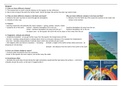
3.2 Why are there different climates?
1 ) The sunrays have to travel a shorter distance at the equator (so less reflection)
2 ) Due to the curving of the earth the further South /North the larger the surface the solar rays need to heat.
3.2 Why are there different climates in the North and South? Why are there different climates in the East and West?
1 ) Distance the solar rays have to travel through the atmosphere. 1 ) Distance from the North Sea (This causes the summers to be cooler and
2 ) Intensity of solar rays. winters to be warmer)
3.2 Seasons
- countries around the mid-latitudes (NL) have 4 seasons -> spring, summer, autumn, winter
-> caused by tilt of the earth - summer = Northern hemisphere tilt to the sun / Southern hemisphere tilt away from the sun
- winter = Northern hemisphere tilt away from the sun / Southern hemisphere tilt to the sun
- no season zone = at the equator the earth will not be closer or farer away from the sun
3.3 Vegetation, latitude and altitude
-> temperature gradient ; as you get further away from the equator the temperatures will fall
- tree line = boundary along altitude or latitude above which no trees grow (because of for example low temperature)
- snow line = boundary along altitude or latitude above which snow persists all year round
-> also happens when you look at a mountain -> increasing altitude (= height of the earths surface above sea level) - air
temperature will decrease
latitude = the distance from the north of the earth to the south
3.6 How can climate change by nature?
-> Tectonic plate movements move the continents
->Closer to the equator the more tropical, the further away the colder
3.6 Greenhouse effect
-> Normally the earth loses its heat during the night (sometimes clouds hold this heat above the surface) -> Co2 forms
a blanket around the earth, so the heat is trapped under it
, Tropical climates
Climate letters Name Climate graph Where?
Af climate A = tropical – always above 18
(above 18 degrees) degrees
Tropical rainforest climate
Almost on the equator f = missing no dry periods
Aw/s climate A = tropical – always above 18
(above 18 degrees) degrees
Savannah climate/monsoon climate
Around the equator w = dry in winter
or
s = dry in summer
Always above 18 degrees
The tropics are located around the equator (the sun is directly overhead at least once per year) -> Tropic of Cancer (23.4 degrees North)
-> Tropic of Capricorn (23.4 degrees South)
(Subtropics = Zone which bounds the tropics)
Aw/s climate (Am - monsoon climate)
Monsoon = seasonal weather changes in precipitation due to the movement of the ITCZ
and convectional rainfall
-> an extremely wet season (June to November) -> Monsoon climate has way more rain
than a normal As climate
-> this is also the period when the ITCZ is located in the Northern hemisphere ->
convectional rainfall
-> trade winds carry the precipitation - sea breeze (= wind is coming from the
sea) -> carries water vapour towards the land -> orographic rainfall (wet season)
-> an extremely dry season
-> the sun and the ITCZ are overhead in the Southern hemisphere -> weak level
of solar radiation -> less convectional rainfall
- land breeze (= wind is coming from the land) -> blows towards the ITCZ in the
Southern hemisphere -> rain will fall in the ocean (dry season)
3.2 Why are there different climates?
1 ) The sunrays have to travel a shorter distance at the equator (so less reflection)
2 ) Due to the curving of the earth the further South /North the larger the surface the solar rays need to heat.
3.2 Why are there different climates in the North and South? Why are there different climates in the East and West?
1 ) Distance the solar rays have to travel through the atmosphere. 1 ) Distance from the North Sea (This causes the summers to be cooler and
2 ) Intensity of solar rays. winters to be warmer)
3.2 Seasons
- countries around the mid-latitudes (NL) have 4 seasons -> spring, summer, autumn, winter
-> caused by tilt of the earth - summer = Northern hemisphere tilt to the sun / Southern hemisphere tilt away from the sun
- winter = Northern hemisphere tilt away from the sun / Southern hemisphere tilt to the sun
- no season zone = at the equator the earth will not be closer or farer away from the sun
3.3 Vegetation, latitude and altitude
-> temperature gradient ; as you get further away from the equator the temperatures will fall
- tree line = boundary along altitude or latitude above which no trees grow (because of for example low temperature)
- snow line = boundary along altitude or latitude above which snow persists all year round
-> also happens when you look at a mountain -> increasing altitude (= height of the earths surface above sea level) - air
temperature will decrease
latitude = the distance from the north of the earth to the south
3.6 How can climate change by nature?
-> Tectonic plate movements move the continents
->Closer to the equator the more tropical, the further away the colder
3.6 Greenhouse effect
-> Normally the earth loses its heat during the night (sometimes clouds hold this heat above the surface) -> Co2 forms
a blanket around the earth, so the heat is trapped under it
, Tropical climates
Climate letters Name Climate graph Where?
Af climate A = tropical – always above 18
(above 18 degrees) degrees
Tropical rainforest climate
Almost on the equator f = missing no dry periods
Aw/s climate A = tropical – always above 18
(above 18 degrees) degrees
Savannah climate/monsoon climate
Around the equator w = dry in winter
or
s = dry in summer
Always above 18 degrees
The tropics are located around the equator (the sun is directly overhead at least once per year) -> Tropic of Cancer (23.4 degrees North)
-> Tropic of Capricorn (23.4 degrees South)
(Subtropics = Zone which bounds the tropics)
Aw/s climate (Am - monsoon climate)
Monsoon = seasonal weather changes in precipitation due to the movement of the ITCZ
and convectional rainfall
-> an extremely wet season (June to November) -> Monsoon climate has way more rain
than a normal As climate
-> this is also the period when the ITCZ is located in the Northern hemisphere ->
convectional rainfall
-> trade winds carry the precipitation - sea breeze (= wind is coming from the
sea) -> carries water vapour towards the land -> orographic rainfall (wet season)
-> an extremely dry season
-> the sun and the ITCZ are overhead in the Southern hemisphere -> weak level
of solar radiation -> less convectional rainfall
- land breeze (= wind is coming from the land) -> blows towards the ITCZ in the
Southern hemisphere -> rain will fall in the ocean (dry season)