
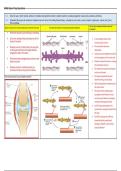
SNAB Topic 7 Key Questions
7.1 Know the way in which muscles, tendons, the skeleton and ligaments interact to enable movement, including antagonistic muscle pairs, extensors and flexors.
7.2 Understand the process of contraction of skeletal muscle in terms of the sliding filament theory, including the role of actin, myosin, troponin, tropomyosin, calcium ions (Ca2+),
ATP and ATPase.
How do nerve impulses stimulate muscle cell
Explain how pairs of muscles bring about movement of bones How does the structure of muscle tissue enable contraction?
contraction?
• Movement results by joints flexing or extending
• Joints can undergo these processes due to the • A nerve impulse arrives at the
action of muscles neuromuscular junction
• Muscles can only contract (they can only pull), • The muscle fibre becomes
so flexing and extension is brought about by depolarised
antagonistic pairs of muscles. • Calcium ions are released from the SR
• These are broadly categorized as extensors and into the cytoplasm of the muscle cell
flexors muscles. • Calcium ions bind to troponin, causing
the tropomyosin to move
• Muscles contract, and because they are • This exposes the myosin-binding sites
connected to bones, they move the bones
on the actin filament
How does the structure of a joint enable movement? • The myosin head binds the actin
filament forming a cross bridge
• ADP and phosphate are released from
the myosin head
• The myosin head changes shape
causing the actin filament to move
over the myosin filament (increasing
overlap, shortening sarcomere)
• An ATP molecule attaches to the
myosin head, causing it to detach from
the actin
• The ATP is hydrolysed to ADP and
phosphate by the myosin head,
allowing it reattach to actin further
along the filament
, 7.10 i) Know the structure of a muscle fibre. ii) Understand the structural and physiological differences between fast and slow twitch muscle fibres.
What are the different types of muscle tissue and their roles? Compare the roles and adaptations of slow and fast twitch muscle fibres.
• Fast twitch muscle fibres are adapted to work intensely for short periods, under anaerobic conditions
• Slow twitch muscle fibres are adapted for relatively low-intensity work for longer periods, using
aerobic respiration
Slow twitch fibres Fast twitch fibres
Appear red due to more capillaries and more Appear white (little myoglobin)
myoglobin
Many mitochondria (aerobic respiration) Few mitochondria (work anaerobically)
Little sarcoplasmic reticulum (less Ca2+ Extensive sarcoplasmic reticulum (greater
needed, low-intensity contraction) intensity of contraction)
Low glycogen content High glycogen content
Numerous capillaries Few capillaries
Fatigue-resistant Fatigue quickly
Type of Role in the body
muscle
Skeletal Attached to bones to control
voluntary movement of skeleton
Cardiac Makes up the walls of atria and
ventricles
Interconnected to allow cells to
contract together
Smooth Found in walls of blood vessels,
muscle airways and digestive system
Contract and relax to control lumen
diameters
7.1 Know the way in which muscles, tendons, the skeleton and ligaments interact to enable movement, including antagonistic muscle pairs, extensors and flexors.
7.2 Understand the process of contraction of skeletal muscle in terms of the sliding filament theory, including the role of actin, myosin, troponin, tropomyosin, calcium ions (Ca2+),
ATP and ATPase.
How do nerve impulses stimulate muscle cell
Explain how pairs of muscles bring about movement of bones How does the structure of muscle tissue enable contraction?
contraction?
• Movement results by joints flexing or extending
• Joints can undergo these processes due to the • A nerve impulse arrives at the
action of muscles neuromuscular junction
• Muscles can only contract (they can only pull), • The muscle fibre becomes
so flexing and extension is brought about by depolarised
antagonistic pairs of muscles. • Calcium ions are released from the SR
• These are broadly categorized as extensors and into the cytoplasm of the muscle cell
flexors muscles. • Calcium ions bind to troponin, causing
the tropomyosin to move
• Muscles contract, and because they are • This exposes the myosin-binding sites
connected to bones, they move the bones
on the actin filament
How does the structure of a joint enable movement? • The myosin head binds the actin
filament forming a cross bridge
• ADP and phosphate are released from
the myosin head
• The myosin head changes shape
causing the actin filament to move
over the myosin filament (increasing
overlap, shortening sarcomere)
• An ATP molecule attaches to the
myosin head, causing it to detach from
the actin
• The ATP is hydrolysed to ADP and
phosphate by the myosin head,
allowing it reattach to actin further
along the filament
, 7.10 i) Know the structure of a muscle fibre. ii) Understand the structural and physiological differences between fast and slow twitch muscle fibres.
What are the different types of muscle tissue and their roles? Compare the roles and adaptations of slow and fast twitch muscle fibres.
• Fast twitch muscle fibres are adapted to work intensely for short periods, under anaerobic conditions
• Slow twitch muscle fibres are adapted for relatively low-intensity work for longer periods, using
aerobic respiration
Slow twitch fibres Fast twitch fibres
Appear red due to more capillaries and more Appear white (little myoglobin)
myoglobin
Many mitochondria (aerobic respiration) Few mitochondria (work anaerobically)
Little sarcoplasmic reticulum (less Ca2+ Extensive sarcoplasmic reticulum (greater
needed, low-intensity contraction) intensity of contraction)
Low glycogen content High glycogen content
Numerous capillaries Few capillaries
Fatigue-resistant Fatigue quickly
Type of Role in the body
muscle
Skeletal Attached to bones to control
voluntary movement of skeleton
Cardiac Makes up the walls of atria and
ventricles
Interconnected to allow cells to
contract together
Smooth Found in walls of blood vessels,
muscle airways and digestive system
Contract and relax to control lumen
diameters


