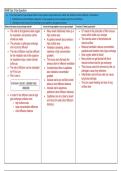
SNAB Topic 2 Key Questions
2.1. i) Know the properties of gas exchange surfaces in living organisms (large surface area to volume ratio, thickness of surface, difference in concentration).
i) Understand how the rate of diffusion is dependent on these properties and can be calculated using Fick’s Law of Diffusion.
ii) Understand how the structure of the mammalian lung is adapted for rapid gaseous exchange.
What are the features of gas exchange surfaces? How are the lungs adapted to carry out gas exchange? How does CF affect lung function?
• The cells of all organisms need oxygen • Many alveoli collectively make up a • CF results in the production of thick viscous
for respiration, and produce carbon high surface area mucus which builds up in airways
dioxide as waste • A capillary network also provides a • This narrows lumen of bronchioles and
• This process is called gas exchange high surface area reduces airflow
and occurs by diffusion • Ventilation (breathing, airflow) • Reduced ventilation reduces concentration
• The rate of diffusion must be sufficient maintains a high concentration gradients and therefore rate of gas exchange
for the metabolic rate of the organism gradient) • (less oxygen added to blood)
(or respiration stops, carbon dioxide • The mucus and cilia keep the • Many alveoli can get blocked off which
builds up) airways clear for effective ventilation reduces surface area for gas exchange
• The rate of diffusion can be calculated • Constant blood flow in capillaries • Thick mucus cannot be removed by cilia, so
by Fick’s Law also maintains concentration pathogens cause lung infections
• Fick’s Law is: gradient • Inflammation and immune cells can cause
• Alveolar wall is one cell thick which lung tissue damage
allows a short diffusion distance • This can cause bleeding and loss of lung
• Alveolar wall is squamous surface area
epithelium (short diffusion distance)
• In order for the diffusion rate be high • Capillaries are very close to alveoli
gas exchange surfaces have: and have thin walls (short diffusion
o high surface area distance)
o large concentration difference
o short diffusion distance
, 2.9 i) Know the basic structure of an amino acid (structures of specific amino acids are not required).
ii) Understand the formation of polypeptides and proteins (amino acid monomers linked by peptide bonds in condensation reactions).
iii) Understand the significance of a protein’s primary structure in determining its three-dimensional structure and properties (globular and fibrous proteins and the types of bonds
involved in its three-dimensional structure).
iv) Know the molecular structure of a globular protein and a fibrous protein and understand how their structures relate to their functions (including haemoglobin and collagen).
How do the levels of protein structure How is the structure of Haemoglobin
How do amino acids form polypeptides? How is the structure of Collagen related to its function?
form functional proteins? related to its function?
• Proteins are polymers of
General globular protein stuff:
monomeric units called ● Haemoglobin is a globular protein
amino acids so it is General fibrous protein stuff
● Soluble in water/ cytoplasm/ ● Made of amino acids joined by peptide bonds like all
extracellular fluid proteins
o the primary structure is order of ● Other examples are enzymes, ● insoluble in water
amino acids in a polypeptide antibodies ● form polymeric structures such as fibres
● It is made of amino acids joined by ● usually have a structural role, eg collagen, fibrin,
o (the polypeptide initially folds
peptide bonds like all other proteins elastin
• into secondary structures alpha ● It has hydrophilic R groups on ● contains little/no tertiary structure
• Amino acids are joined in helix or beta pleated sheet held surface ● hydrophobic R groups on surface of protein
condensation reactions by hydrogen bonding) ● Non-polar R groups in the
o the tertiary structure determines core/centre
• Where the carboxyl group of
the shape of the protein ● It has a tertiary structure
one amino acid combines o the tertiary structure is
with the amino group of the determined by the interactions
next. between amino acid R groups Unique features
• A peptide bond is formed as (disulphide, ionic, hydrogen • Has a triple helix of three polypeptide chains (contributes
well as water bonding and non-polar to strength)
interactions) Unique features: • Has a high proportion of the amino acid glycine, so that
o in order for the correct R group • Has four polypeptide chains polypeptides can come close together
interactions to take place, the • Has a haem prosthetic group • A repeating sequence of amino acids allows it to form a
that allows it to bind oxygen helix
amino acids have to be in the • Has covalent crosslinks between the three polypeptides
correct order (strength)
o so that their R groups can be • Forms collagen bundles (added strength)
positioned correctly
o some proteins are made of two
or more polypeptide chains
(quaternary structure)
o the correct shape of the protein
• Amino acids can be joined in allows its correct function
long chains called
polypeptides
• This occurs on ribosomes
during translation
•
2.1. i) Know the properties of gas exchange surfaces in living organisms (large surface area to volume ratio, thickness of surface, difference in concentration).
i) Understand how the rate of diffusion is dependent on these properties and can be calculated using Fick’s Law of Diffusion.
ii) Understand how the structure of the mammalian lung is adapted for rapid gaseous exchange.
What are the features of gas exchange surfaces? How are the lungs adapted to carry out gas exchange? How does CF affect lung function?
• The cells of all organisms need oxygen • Many alveoli collectively make up a • CF results in the production of thick viscous
for respiration, and produce carbon high surface area mucus which builds up in airways
dioxide as waste • A capillary network also provides a • This narrows lumen of bronchioles and
• This process is called gas exchange high surface area reduces airflow
and occurs by diffusion • Ventilation (breathing, airflow) • Reduced ventilation reduces concentration
• The rate of diffusion must be sufficient maintains a high concentration gradients and therefore rate of gas exchange
for the metabolic rate of the organism gradient) • (less oxygen added to blood)
(or respiration stops, carbon dioxide • The mucus and cilia keep the • Many alveoli can get blocked off which
builds up) airways clear for effective ventilation reduces surface area for gas exchange
• The rate of diffusion can be calculated • Constant blood flow in capillaries • Thick mucus cannot be removed by cilia, so
by Fick’s Law also maintains concentration pathogens cause lung infections
• Fick’s Law is: gradient • Inflammation and immune cells can cause
• Alveolar wall is one cell thick which lung tissue damage
allows a short diffusion distance • This can cause bleeding and loss of lung
• Alveolar wall is squamous surface area
epithelium (short diffusion distance)
• In order for the diffusion rate be high • Capillaries are very close to alveoli
gas exchange surfaces have: and have thin walls (short diffusion
o high surface area distance)
o large concentration difference
o short diffusion distance
, 2.9 i) Know the basic structure of an amino acid (structures of specific amino acids are not required).
ii) Understand the formation of polypeptides and proteins (amino acid monomers linked by peptide bonds in condensation reactions).
iii) Understand the significance of a protein’s primary structure in determining its three-dimensional structure and properties (globular and fibrous proteins and the types of bonds
involved in its three-dimensional structure).
iv) Know the molecular structure of a globular protein and a fibrous protein and understand how their structures relate to their functions (including haemoglobin and collagen).
How do the levels of protein structure How is the structure of Haemoglobin
How do amino acids form polypeptides? How is the structure of Collagen related to its function?
form functional proteins? related to its function?
• Proteins are polymers of
General globular protein stuff:
monomeric units called ● Haemoglobin is a globular protein
amino acids so it is General fibrous protein stuff
● Soluble in water/ cytoplasm/ ● Made of amino acids joined by peptide bonds like all
extracellular fluid proteins
o the primary structure is order of ● Other examples are enzymes, ● insoluble in water
amino acids in a polypeptide antibodies ● form polymeric structures such as fibres
● It is made of amino acids joined by ● usually have a structural role, eg collagen, fibrin,
o (the polypeptide initially folds
peptide bonds like all other proteins elastin
• into secondary structures alpha ● It has hydrophilic R groups on ● contains little/no tertiary structure
• Amino acids are joined in helix or beta pleated sheet held surface ● hydrophobic R groups on surface of protein
condensation reactions by hydrogen bonding) ● Non-polar R groups in the
o the tertiary structure determines core/centre
• Where the carboxyl group of
the shape of the protein ● It has a tertiary structure
one amino acid combines o the tertiary structure is
with the amino group of the determined by the interactions
next. between amino acid R groups Unique features
• A peptide bond is formed as (disulphide, ionic, hydrogen • Has a triple helix of three polypeptide chains (contributes
well as water bonding and non-polar to strength)
interactions) Unique features: • Has a high proportion of the amino acid glycine, so that
o in order for the correct R group • Has four polypeptide chains polypeptides can come close together
interactions to take place, the • Has a haem prosthetic group • A repeating sequence of amino acids allows it to form a
that allows it to bind oxygen helix
amino acids have to be in the • Has covalent crosslinks between the three polypeptides
correct order (strength)
o so that their R groups can be • Forms collagen bundles (added strength)
positioned correctly
o some proteins are made of two
or more polypeptide chains
(quaternary structure)
o the correct shape of the protein
• Amino acids can be joined in allows its correct function
long chains called
polypeptides
• This occurs on ribosomes
during translation
•