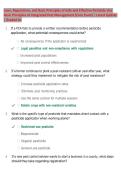
Laws, Regulations, and Basic Principles of Safe and Effective Pesticide Use
Basic Principles of Integrated Pest Management (Core Exam) | Latest Update
| Graded A+
1. If a PCA fails to provide a written recommendation before pesticide
application, what potential consequences could arise?
No consequences if the applicator is experienced
Legal penalties and non-compliance with regulations
Increased pest populations
Improved pest control effectiveness
2. If a farmer continues to plant a pest-resistant cultivar year after year, what
strategy could they implement to mitigate the risk of pest resistance?
Increase pesticide application rates
Eliminate pest monitoring practices
Use the same cultivar for multiple seasons
Rotate crops with non-resistant varieties
3. What is the specific type of pesticide that mandates direct contact with a
pesticide applicator when working alone?
Restricted-use pesticide
Biopesticide
Organic pesticide
General-use pesticide
4. If a new pest control adviser wants to start a business in a county, what steps
should they take regarding registration?
, They should only register if they plan to use chemical pesticides.
They can start operations without registration but must register within
30 days.
They should register with the state government instead of the county.
They should register with the agricultural commissioner before
starting operations in that county.
5. It is _______________ to use a pesticide in a manner inconsistent with its labeling.
proper
safe
legal
illegal
6. Records of pesticide application must be maintained for a period of:
Three years
One year
Five years
Two years
7. Describe how sanitation practices contribute to pest management in
agriculture.
Sanitation practices have no effect on pest populations.
Sanitation practices are only necessary during the harvest season.
Sanitation practices help reduce pest populations by eliminating
breeding grounds and food sources.
Sanitation practices only affect soil health, not pest management.
,8. What is a cultural practice that can help prevent pest infestations through
sanitation?
Regularly cleaning and removing debris from fields
Planting resistant crop varieties
Using traps to catch pests
Applying chemical pesticides
9. What is the tolerance level for organophosphate pesticide 'B' on celery?
1 PPM
3 PPM
0.5 PPM
2 PPM
10. What action should be taken regarding the dealer's copy of the pesticide
recommendation if the adviser's identity is unknown?
It should be discarded.
It should be sent to the state regulatory agency.
It should be shared with other advisers.
It should be kept for records.
11. What is the required retention period for written recommendations issued by
an agricultural PCA?
One year
Two years
Five years
, Indefinitely
12. Describe the significance of frass in monitoring pest populations.
Frass is a sign of soil fertility.
Frass suggests that no pests are present.
Frass shows that the pesticide is working effectively.
Frass indicates that insects are feeding and potentially reproducing
in the area.
13. What is the primary condition under which a pest control dealer can dilute
pesticides before selling them?
When the dealer has received special training.
When it is specified on the pesticide label.
When the dealer believes it will enhance effectiveness.
When the dealer is licensed in multiple states.
14. Describe the importance of using a closed system for employees involved in
pesticide handling.
A closed system increases the speed of pesticide application.
A closed system minimizes the risk of pesticide exposure to
employees during mixing and loading.
A closed system allows for easier access to pesticides.
A closed system is only necessary for large-scale operations.
15. Which of the following would be pesticide use 'in conflict' with the label
combining 2 or more pesticides in the application tank
Basic Principles of Integrated Pest Management (Core Exam) | Latest Update
| Graded A+
1. If a PCA fails to provide a written recommendation before pesticide
application, what potential consequences could arise?
No consequences if the applicator is experienced
Legal penalties and non-compliance with regulations
Increased pest populations
Improved pest control effectiveness
2. If a farmer continues to plant a pest-resistant cultivar year after year, what
strategy could they implement to mitigate the risk of pest resistance?
Increase pesticide application rates
Eliminate pest monitoring practices
Use the same cultivar for multiple seasons
Rotate crops with non-resistant varieties
3. What is the specific type of pesticide that mandates direct contact with a
pesticide applicator when working alone?
Restricted-use pesticide
Biopesticide
Organic pesticide
General-use pesticide
4. If a new pest control adviser wants to start a business in a county, what steps
should they take regarding registration?
, They should only register if they plan to use chemical pesticides.
They can start operations without registration but must register within
30 days.
They should register with the state government instead of the county.
They should register with the agricultural commissioner before
starting operations in that county.
5. It is _______________ to use a pesticide in a manner inconsistent with its labeling.
proper
safe
legal
illegal
6. Records of pesticide application must be maintained for a period of:
Three years
One year
Five years
Two years
7. Describe how sanitation practices contribute to pest management in
agriculture.
Sanitation practices have no effect on pest populations.
Sanitation practices are only necessary during the harvest season.
Sanitation practices help reduce pest populations by eliminating
breeding grounds and food sources.
Sanitation practices only affect soil health, not pest management.
,8. What is a cultural practice that can help prevent pest infestations through
sanitation?
Regularly cleaning and removing debris from fields
Planting resistant crop varieties
Using traps to catch pests
Applying chemical pesticides
9. What is the tolerance level for organophosphate pesticide 'B' on celery?
1 PPM
3 PPM
0.5 PPM
2 PPM
10. What action should be taken regarding the dealer's copy of the pesticide
recommendation if the adviser's identity is unknown?
It should be discarded.
It should be sent to the state regulatory agency.
It should be shared with other advisers.
It should be kept for records.
11. What is the required retention period for written recommendations issued by
an agricultural PCA?
One year
Two years
Five years
, Indefinitely
12. Describe the significance of frass in monitoring pest populations.
Frass is a sign of soil fertility.
Frass suggests that no pests are present.
Frass shows that the pesticide is working effectively.
Frass indicates that insects are feeding and potentially reproducing
in the area.
13. What is the primary condition under which a pest control dealer can dilute
pesticides before selling them?
When the dealer has received special training.
When it is specified on the pesticide label.
When the dealer believes it will enhance effectiveness.
When the dealer is licensed in multiple states.
14. Describe the importance of using a closed system for employees involved in
pesticide handling.
A closed system increases the speed of pesticide application.
A closed system minimizes the risk of pesticide exposure to
employees during mixing and loading.
A closed system allows for easier access to pesticides.
A closed system is only necessary for large-scale operations.
15. Which of the following would be pesticide use 'in conflict' with the label
combining 2 or more pesticides in the application tank