

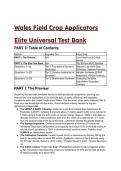
Wales Field Crop Applicators
Elite Universal Test Bank
PART 0: Table of Contents
Section Cognitive Tier Focus Area
PART I: The Preview N/A Core Directives & Critical
Axioms
PART II: The Elite Test Bank N/A The 30-Point MCQ Gauntlet
[Questions 1–10] Tier 1: Foundational Syntax & Statutory Law, Hard Deck
Application Definitions, Baseline Formulas
[Questions 11–20] Tier 2: Complex Application & Variable Synthesis, LERAP
Simulation Reductions, HWCN Protocols
[Questions 21–30] Tier 3: Grandmaster Synthesis Competing Variables,
High-Stakes Regulatory
Overlaps
PART I: The Preview
Mastering this test bank translates directly to elite operational competence, ensuring you
execute field crop applications at the absolute apex of safety, efficiency, and regulatory
compliance within the United Kingdom and Wales. This document strips away academic filler to
forge your raw knowledge into the sharp, clinical decision-making required by top-tier
agricultural professionals.
● The LERAP & GAEC 1 Overlap: Under the Local Environment Risk Assessment for
Pesticides (LERAP), Category B products allow a 5-metre aquatic buffer to be reduced to
1 metre using a 3-star low-drift nozzle or quarter-dosing. However, GAEC 1 mandates an
absolute minimum 2-metre protection zone from the centre of a watercourse, or 1 metre
from the landward side of the top of the bank—whichever dictates the greater distance.
● The Storage Imperative: Chemical stores must provide a minimum 30-minute fire
resistance. Secondary containment bund capacity must equal 110% of the total maximum
volume stored, escalating to 185% in environmentally sensitive areas. Powders must
ALWAYS be stored above liquids.
● The Calibration Constants: Forward speed (km/h) is determined by dividing 360 by the
time (in seconds) taken to travel 100 metres. Application volume (L/ha) is derived using
the formula: (Nozzle Output in L/min × 600) / (Forward Speed in km/h × Nozzle Spacing in
m).
● The Hutton Criteria: Potato Late Blight (Phytophthora infestans) risk is triggered strictly
by two consecutive days featuring a minimum temperature of 10°C and at least six hours
of relative humidity at or above 90%.
, ● Hazardous Waste Traceability: Moving >500kg of hazardous waste in Wales requires
Natural Resources Wales (NRW) registration. Every movement requires a Consignment
Note (e.g., AAAnnn/QxYYD format) retained strictly for 3 years.
PART II: The Elite Test Bank
Tier 1: Foundational Syntax & Application
Q1: A commercial field crop applicator is contracted to apply a systemic plant protection product
using a self-propelled, 24-metre horizontal boom sprayer across a winter wheat estate. Based
on the principles of statutory agricultural certification under the Control of Pesticides
Regulations, which precise combination of City & Guilds NPTC certifications is the ABSOLUTE
MINIMUM legal requirement before the operator can commence this task? A) PA1 and PA6 B)
PA2 and PA4 C) PA1 and PA2 D) PA1 and PA13
● The Answer: C (PA1 and PA2)
● Distractor Analysis:
○ A is incorrect: The PA6 module strictly certifies the safe use of pedestrian hand-held
equipment (such as knapsacks), rendering it completely invalid for operating a
24-metre tractor-mounted horizontal boom sprayer.
○ B is incorrect: The PA4 module is explicitly restricted to pelleted or granular
pesticide application. Furthermore, executing any specific module without the
foundational PA1 theory module is a statutory violation.
○ D is incorrect: The PA13 module regulates the safe sub-surface application of liquid
pesticides, an entirely different mechanical process than broadcast spraying via a
horizontal boom.
The Mentor's Analysis: The legal architecture of pesticide application in the UK demands strict
modular competency. The PA1 module is the non-negotiable theoretical foundation, while the
subsequent operational module rigidly dictates the exact hardware you are legally permitted to
operate. Attempting to cross-apply certifications across differing hardware classes constitutes a
severe regulatory breach.
Module Code Application Hardware Specification
PA1 Mandatory Foundation (Safe Use of Pesticides
Theory)
PA2 Ground Crop Sprayer (Mounted, Trailed,
Self-Propelled Boom)
PA4 Pelleted or Granular Applicators
PA6 Pedestrian Hand-Held Equipment (Knapsacks)
Professional/Academic Intuition: Never operate application hardware without its exact
corresponding PA module; PA1 establishes the legal baseline, while PA2 authorizes the
horizontal boom.
Q2: Under current National Sprayer Testing Scheme (NSTS) and Sustainable Use Directive
(SUD) standards, an agricultural contractor purchases a brand new 36-metre horizontal boom
sprayer in 2026. WHEN is the first mandatory NSTS inspection required, and what is the
statutory frequency of subsequent tests? A) Before it is 5 years old, then every 3 years
thereafter. B) Before it is 3 years old, then every 3 years thereafter. C) Before it is 5 years old,
then every 5 years thereafter. D) Before it is 6 years old, then every 3 years thereafter.
● The Answer: B (Before it is 3 years old, then every 3 years thereafter.)
, ● Distractor Analysis:
○ A is incorrect: While pre-2020 legacy legislation allowed a 5-year grace period for
the initial testing of new sprayers, current SUD regulations aggressively tightened
this timeline. Sprayers with booms >3m must now be tested before they reach 3
years of age.
○ C is incorrect: Five-year subsequent testing intervals represent outdated statutory
frameworks that were abolished to increase environmental oversight.
○ D is incorrect: A 6-year interval only applies to boom sprayers under 3 metres in
width or specialist granular/slug pellet applicators, not mass-scale 36-metre booms.
The Mentor's Analysis: Regulatory timelines are continually compressed to mitigate systemic
environmental risk. Post-2020 SUD directives drastically tightened equipment testing intervals
for large-scale applicators to prevent undetected hardware decay and subsequent chemical
leakage.
Equipment Classification Initial Test Requirement Subsequent Frequency
Horizontal Boom > 3m Before 3 years old Every 3 years
Horizontal Boom < 3m Before 5 years old Every 6 years
Granular Applicators Before 5 years old Every 6 years
Professional/Academic Intuition: For all horizontal booms exceeding 3 metres, the
absolute timeline is an initial test at year 3, followed by rigid 3-year recurring intervals.
Q3: During an unannounced Rural Payments Agency (RPA) Cross Compliance inspection, an
inspector verifies the Good Agricultural and Environmental Conditions (GAEC 1) buffer strips
next to a flowing watercourse. What is the MINIMUM mandated protection distance from the
centre of the watercourse where plant protection products must absolutely not be applied? A) 1
metre B) 2 metres C) 5 metres D) 6 metres
● The Answer: B (2 metres)
● Distractor Analysis:
○ A is incorrect: 1 metre is the minimum statutory distance from the landward top of
the bank of a watercourse under GAEC 1, not from the centre of the watercourse.
○ C is incorrect: 5 metres is the default aquatic buffer zone for many specific LERAP
products, but GAEC 1 defines the baseline absolute legal protection zone across all
operations as 2 metres from the centre.
○ D is incorrect: 6 metres applies to highly specific Drift Reduction Technology (DRT)
conditions or wildlife cover crop margins, not the standard GAEC 1 baseline.
The Mentor's Analysis: Environmental buffers are heavily scrutinized and carry massive
financial penalties for breaches. Operators must surgically differentiate between product-specific
LERAP buffers and the overarching, statutory baseline GAEC 1 constraints. GAEC 1 is the
ultimate hard deck below which no operation may ever fall. Professional/Academic Intuition:
Regardless of any LERAP reduction allowances, GAEC 1 imposes a permanent hard
deck: No plant protection products may be applied within 2 metres of the centre of a
watercourse, or 1 metre from the top of the bank.
Q4: A farm manager intends to construct a purpose-built chemical storage facility to house
concentrated herbicides and fungicides. Based on Health and Safety Executive (HSE) and
Environment Agency parameters for agricultural pesticide storage, which architectural
specification is MOST ACCURATE? A) The store must provide 60 minutes of fire resistance and
be located at least 10 metres from domestic dwellings. B) The bund must hold 110% of the total
chemical volume, and powders must be stored above liquids. C) The bund must hold 185% of
the largest single container, and liquids must be stored above powders. D) The store must
Elite Universal Test Bank
PART 0: Table of Contents
Section Cognitive Tier Focus Area
PART I: The Preview N/A Core Directives & Critical
Axioms
PART II: The Elite Test Bank N/A The 30-Point MCQ Gauntlet
[Questions 1–10] Tier 1: Foundational Syntax & Statutory Law, Hard Deck
Application Definitions, Baseline Formulas
[Questions 11–20] Tier 2: Complex Application & Variable Synthesis, LERAP
Simulation Reductions, HWCN Protocols
[Questions 21–30] Tier 3: Grandmaster Synthesis Competing Variables,
High-Stakes Regulatory
Overlaps
PART I: The Preview
Mastering this test bank translates directly to elite operational competence, ensuring you
execute field crop applications at the absolute apex of safety, efficiency, and regulatory
compliance within the United Kingdom and Wales. This document strips away academic filler to
forge your raw knowledge into the sharp, clinical decision-making required by top-tier
agricultural professionals.
● The LERAP & GAEC 1 Overlap: Under the Local Environment Risk Assessment for
Pesticides (LERAP), Category B products allow a 5-metre aquatic buffer to be reduced to
1 metre using a 3-star low-drift nozzle or quarter-dosing. However, GAEC 1 mandates an
absolute minimum 2-metre protection zone from the centre of a watercourse, or 1 metre
from the landward side of the top of the bank—whichever dictates the greater distance.
● The Storage Imperative: Chemical stores must provide a minimum 30-minute fire
resistance. Secondary containment bund capacity must equal 110% of the total maximum
volume stored, escalating to 185% in environmentally sensitive areas. Powders must
ALWAYS be stored above liquids.
● The Calibration Constants: Forward speed (km/h) is determined by dividing 360 by the
time (in seconds) taken to travel 100 metres. Application volume (L/ha) is derived using
the formula: (Nozzle Output in L/min × 600) / (Forward Speed in km/h × Nozzle Spacing in
m).
● The Hutton Criteria: Potato Late Blight (Phytophthora infestans) risk is triggered strictly
by two consecutive days featuring a minimum temperature of 10°C and at least six hours
of relative humidity at or above 90%.
, ● Hazardous Waste Traceability: Moving >500kg of hazardous waste in Wales requires
Natural Resources Wales (NRW) registration. Every movement requires a Consignment
Note (e.g., AAAnnn/QxYYD format) retained strictly for 3 years.
PART II: The Elite Test Bank
Tier 1: Foundational Syntax & Application
Q1: A commercial field crop applicator is contracted to apply a systemic plant protection product
using a self-propelled, 24-metre horizontal boom sprayer across a winter wheat estate. Based
on the principles of statutory agricultural certification under the Control of Pesticides
Regulations, which precise combination of City & Guilds NPTC certifications is the ABSOLUTE
MINIMUM legal requirement before the operator can commence this task? A) PA1 and PA6 B)
PA2 and PA4 C) PA1 and PA2 D) PA1 and PA13
● The Answer: C (PA1 and PA2)
● Distractor Analysis:
○ A is incorrect: The PA6 module strictly certifies the safe use of pedestrian hand-held
equipment (such as knapsacks), rendering it completely invalid for operating a
24-metre tractor-mounted horizontal boom sprayer.
○ B is incorrect: The PA4 module is explicitly restricted to pelleted or granular
pesticide application. Furthermore, executing any specific module without the
foundational PA1 theory module is a statutory violation.
○ D is incorrect: The PA13 module regulates the safe sub-surface application of liquid
pesticides, an entirely different mechanical process than broadcast spraying via a
horizontal boom.
The Mentor's Analysis: The legal architecture of pesticide application in the UK demands strict
modular competency. The PA1 module is the non-negotiable theoretical foundation, while the
subsequent operational module rigidly dictates the exact hardware you are legally permitted to
operate. Attempting to cross-apply certifications across differing hardware classes constitutes a
severe regulatory breach.
Module Code Application Hardware Specification
PA1 Mandatory Foundation (Safe Use of Pesticides
Theory)
PA2 Ground Crop Sprayer (Mounted, Trailed,
Self-Propelled Boom)
PA4 Pelleted or Granular Applicators
PA6 Pedestrian Hand-Held Equipment (Knapsacks)
Professional/Academic Intuition: Never operate application hardware without its exact
corresponding PA module; PA1 establishes the legal baseline, while PA2 authorizes the
horizontal boom.
Q2: Under current National Sprayer Testing Scheme (NSTS) and Sustainable Use Directive
(SUD) standards, an agricultural contractor purchases a brand new 36-metre horizontal boom
sprayer in 2026. WHEN is the first mandatory NSTS inspection required, and what is the
statutory frequency of subsequent tests? A) Before it is 5 years old, then every 3 years
thereafter. B) Before it is 3 years old, then every 3 years thereafter. C) Before it is 5 years old,
then every 5 years thereafter. D) Before it is 6 years old, then every 3 years thereafter.
● The Answer: B (Before it is 3 years old, then every 3 years thereafter.)
, ● Distractor Analysis:
○ A is incorrect: While pre-2020 legacy legislation allowed a 5-year grace period for
the initial testing of new sprayers, current SUD regulations aggressively tightened
this timeline. Sprayers with booms >3m must now be tested before they reach 3
years of age.
○ C is incorrect: Five-year subsequent testing intervals represent outdated statutory
frameworks that were abolished to increase environmental oversight.
○ D is incorrect: A 6-year interval only applies to boom sprayers under 3 metres in
width or specialist granular/slug pellet applicators, not mass-scale 36-metre booms.
The Mentor's Analysis: Regulatory timelines are continually compressed to mitigate systemic
environmental risk. Post-2020 SUD directives drastically tightened equipment testing intervals
for large-scale applicators to prevent undetected hardware decay and subsequent chemical
leakage.
Equipment Classification Initial Test Requirement Subsequent Frequency
Horizontal Boom > 3m Before 3 years old Every 3 years
Horizontal Boom < 3m Before 5 years old Every 6 years
Granular Applicators Before 5 years old Every 6 years
Professional/Academic Intuition: For all horizontal booms exceeding 3 metres, the
absolute timeline is an initial test at year 3, followed by rigid 3-year recurring intervals.
Q3: During an unannounced Rural Payments Agency (RPA) Cross Compliance inspection, an
inspector verifies the Good Agricultural and Environmental Conditions (GAEC 1) buffer strips
next to a flowing watercourse. What is the MINIMUM mandated protection distance from the
centre of the watercourse where plant protection products must absolutely not be applied? A) 1
metre B) 2 metres C) 5 metres D) 6 metres
● The Answer: B (2 metres)
● Distractor Analysis:
○ A is incorrect: 1 metre is the minimum statutory distance from the landward top of
the bank of a watercourse under GAEC 1, not from the centre of the watercourse.
○ C is incorrect: 5 metres is the default aquatic buffer zone for many specific LERAP
products, but GAEC 1 defines the baseline absolute legal protection zone across all
operations as 2 metres from the centre.
○ D is incorrect: 6 metres applies to highly specific Drift Reduction Technology (DRT)
conditions or wildlife cover crop margins, not the standard GAEC 1 baseline.
The Mentor's Analysis: Environmental buffers are heavily scrutinized and carry massive
financial penalties for breaches. Operators must surgically differentiate between product-specific
LERAP buffers and the overarching, statutory baseline GAEC 1 constraints. GAEC 1 is the
ultimate hard deck below which no operation may ever fall. Professional/Academic Intuition:
Regardless of any LERAP reduction allowances, GAEC 1 imposes a permanent hard
deck: No plant protection products may be applied within 2 metres of the centre of a
watercourse, or 1 metre from the top of the bank.
Q4: A farm manager intends to construct a purpose-built chemical storage facility to house
concentrated herbicides and fungicides. Based on Health and Safety Executive (HSE) and
Environment Agency parameters for agricultural pesticide storage, which architectural
specification is MOST ACCURATE? A) The store must provide 60 minutes of fire resistance and
be located at least 10 metres from domestic dwellings. B) The bund must hold 110% of the total
chemical volume, and powders must be stored above liquids. C) The bund must hold 185% of
the largest single container, and liquids must be stored above powders. D) The store must


