

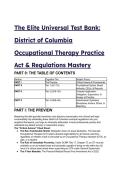
The Elite Universal Test Bank:
District of Columbia
Occupational Therapy Practice
Act & Regulations Mastery
PART 0: THE TABLE OF CONTENTS
Section Cognitive Tier Subject Focus
PART I The Preview Critical Axioms & Frameworks
PART II Tier 1 (Q1–15) Foundational Syntax: Board
Authority, CEUs, & Records
PART II Tier 2 (Q16–35) Complex Application:
Delegation, Supervision, &
Scopes of Practice
PART II Tier 3 (Q36–60) Grandmaster Synthesis:
Disciplinary Actions, Ethics, &
Reporting
PART I: THE PREVIEW
Mastering this elite gauntlet transforms rote statutory memorization into clinical and legal
invulnerability. By embedding these District of Columbia municipal regulations into your
analytical framework, you forge an inherently defensible, A-level professional practice that
withstands any Board scrutiny or malpractice inquiry.
The "Critical Axioms" Cheat Sheet:
● The Non-Transferable Shield: Delegation does not equal abdication. The licensed
Occupational Therapist (OT) retains absolute legal liability for all clinical outcomes,
regardless of whether a task is executed by an Occupational Therapy Assistant (OTA), an
aide, or a student.
● The Rule of Immediate Proximity: Under DCMR Title 17, Chapter 73, an OT must be
available on an as-needed basis and physically capable of being on-site within two (2)
hours if a clinical need arises when supervising an OTA under General Supervision.
● The 5-Year Mandate: The Personal Medical Record Fee Amendment Act of 2022
, dictates that adult records must be retained for exactly 5 years from the last contact.
Minor records must be held for 5 years after the minor reaches the age of majority.
● The Financial Cap: Disciplinary actions under HORA § 3-1205.14 carry a punitive ceiling.
The Board may impose civil fines up to $5,000 per individual violation, alongside
immediate summary suspension for imminent public danger.
PART II: THE ELITE TEST BANK
Q1: A newly licensed occupational therapist in the District of Columbia is reviewing the
regulatory oversight of their profession. Under the Health Occupations Revision General
Amendment Act of 2024, which entity exercises primary disciplinary and regulatory authority
over this practitioner? Based on the principles of District Regulatory Frameworks, which
action/conclusion is the MOST ACCURATE? A) The Board of Occupational Therapy B) The
Board of Allied Health Professionals C) The Board of Rehabilitative Therapies D) The District of
Columbia Department of Consumer Affairs
● The Answer: C (The Board of Rehabilitative Therapies)
● Distractor Analysis: * A is incorrect: The distinct Board of Occupational Therapy was
dissolved and merged under recent legislative changes into a consolidated board.
○ B is incorrect: The District of Columbia does not utilize a generalized "Allied Health"
board for these specific professions.
○ D is incorrect: Health professions are governed specifically by DC Health and its
specialized boards, not general consumer affairs agencies.
The Mentor's Analysis: The District recently merged physical therapy, occupational therapy,
audiology, speech-language pathology, and recreational therapy under a single umbrella to
streamline governance. When facing licensure issues, the immediate priority is addressing the
correct legal entity. By utilizing the Board of Rehabilitative Therapies, you bypass the common
trap of petitioning outdated administrative bodies. Professional/Academic Intuition: Always
operate under the most current statutory authority; the Board of Rehabilitative Therapies
now holds your license and your liability.
Q2: A patient requests a copy of their personal medical record in an electronic format. Under
the Personal Medical Record Fee Amendment Act of 2022, what is the maximum permissible
charge the facility can impose for the entire electronic request? Based on the principles of
Medical Record Compliance, which action/conclusion is the MOST ACCURATE? A) A flat fee of
$50.00 B) A hard cap of $86.54, inclusive of search and per-page fees C) A maximum of
$150.00 to cover data encryption D) The actual cost of printing, scanning, and mailing
● The Answer: B (A hard cap of $86.54, inclusive of search and per-page fees)
● Distractor Analysis: * A is incorrect: This is an arbitrary figure not supported by the DC
statutory fee schedule.
○ C is incorrect: This exceeds the strict statutory ceiling implemented by the 2022
legislation for electronic records.
○ D is incorrect: Actual costs for postage only apply to non-electronic (paper) format
requests, which are calculated differently.
The Mentor's Analysis: The 2022 Act strictly caps electronic record production at a $22.88
search fee plus a per-page fee, with an absolute total ceiling of $86.54. When facing record
requests, the immediate priority is ensuring financial compliance. By utilizing the Statutory
Electronic Fee Cap, you bypass the common trap of extorting patients through inflated
administrative processing fees. Professional/Academic Intuition: Access to healthcare data
, is a protected patient right; strict statutory fee caps prevent clinics from weaponizing
administrative costs to impede continuity of care.
Q3: An occupational therapist is preparing for license renewal under the DC Health rolling
renewal system. The therapist was born in an even-numbered year. When will their license
officially expire? Based on the principles of Licensure Maintenance, which action/conclusion is
the MOST ACCURATE? A) December 31st of every even-numbered year B) The last day of
their birth month every even-numbered year C) September 30th of every odd-numbered year D)
On their exact birthday every two years
● The Answer: B (The last day of their birth month every even-numbered year)
● Distractor Analysis: * A is incorrect: Expiration is tied directly to the individual's birth
month, not the calendar year-end.
○ C is incorrect: This represents the outdated legacy system (September 30 of odd
years) utilized prior to the June 2024 regulatory update.
○ D is incorrect: The statute dictates the last day of the month, not the literal birth
date.
The Mentor's Analysis: DC Health transitioned to a rolling renewal system to alleviate
systemic administrative bottlenecks. When facing renewal deadlines, the immediate priority is
calculating your exact compliance window based on your demographic data. By utilizing the
Birth Month Expiration Protocol, you bypass the common trap of inadvertently allowing your
license to lapse due to reliance on outdated fixed-date systems. Professional/Academic
Intuition: A lapsed license immediately suspends your legal right to practice; your birth
month is now your ultimate compliance deadline.
Q4: A licensed Occupational Therapist (OT) requires 24 hours of continuing education (CE) for
renewal. Under DC Health's public health priorities directive, how many of these hours MUST be
dedicated to authorized epidemiological topics? Based on the principles of Continuing
Education Compliance, which action/conclusion is the MOST ACCURATE? A) Exactly 1.0 hour
B) Exactly 2.0 hours C) Exactly 2.4 hours D) Exactly 5.0 hours
● The Answer: C (Exactly 2.4 hours)
● Distractor Analysis: * A is incorrect: One hour does not meet the mathematically
mandated threshold.
○ B is incorrect: Two hours is the requirement specifically designated for LGBTQ
cultural competency, which is a separate mandate from the general public health
priority percentage.
○ D is incorrect: Five hours excessively overshoots the statutorily mandated
percentage.
The Mentor's Analysis: DC Health mandates that exactly ten percent (10%) of the total CE
hours must focus on declared public health priorities. When facing CEU accumulation, the
immediate priority is satisfying strict categorical percentages. By utilizing the 10% Priority
Calculation (2.4 hours of a 24-hour total), you bypass the common trap of confusing the 2-hour
LGBTQ requirement with the proportional public health mandate. Professional/Academic
Intuition: Continuing education is not merely a professional preference; it is legally
bound to the epidemiological threat matrix of your specific jurisdiction.
Q5: An Occupational Therapy Assistant (OTA) is preparing for their biennial license renewal.
How many total continuing education hours must the OTA submit to the Board of Rehabilitative
Therapies? Based on the principles of Licensure Maintenance, which action/conclusion is the
MOST ACCURATE? A) 10 contact hours B) 12 contact hours C) 20 contact hours D) 24 contact
hours
● The Answer: B (12 contact hours)
District of Columbia
Occupational Therapy Practice
Act & Regulations Mastery
PART 0: THE TABLE OF CONTENTS
Section Cognitive Tier Subject Focus
PART I The Preview Critical Axioms & Frameworks
PART II Tier 1 (Q1–15) Foundational Syntax: Board
Authority, CEUs, & Records
PART II Tier 2 (Q16–35) Complex Application:
Delegation, Supervision, &
Scopes of Practice
PART II Tier 3 (Q36–60) Grandmaster Synthesis:
Disciplinary Actions, Ethics, &
Reporting
PART I: THE PREVIEW
Mastering this elite gauntlet transforms rote statutory memorization into clinical and legal
invulnerability. By embedding these District of Columbia municipal regulations into your
analytical framework, you forge an inherently defensible, A-level professional practice that
withstands any Board scrutiny or malpractice inquiry.
The "Critical Axioms" Cheat Sheet:
● The Non-Transferable Shield: Delegation does not equal abdication. The licensed
Occupational Therapist (OT) retains absolute legal liability for all clinical outcomes,
regardless of whether a task is executed by an Occupational Therapy Assistant (OTA), an
aide, or a student.
● The Rule of Immediate Proximity: Under DCMR Title 17, Chapter 73, an OT must be
available on an as-needed basis and physically capable of being on-site within two (2)
hours if a clinical need arises when supervising an OTA under General Supervision.
● The 5-Year Mandate: The Personal Medical Record Fee Amendment Act of 2022
, dictates that adult records must be retained for exactly 5 years from the last contact.
Minor records must be held for 5 years after the minor reaches the age of majority.
● The Financial Cap: Disciplinary actions under HORA § 3-1205.14 carry a punitive ceiling.
The Board may impose civil fines up to $5,000 per individual violation, alongside
immediate summary suspension for imminent public danger.
PART II: THE ELITE TEST BANK
Q1: A newly licensed occupational therapist in the District of Columbia is reviewing the
regulatory oversight of their profession. Under the Health Occupations Revision General
Amendment Act of 2024, which entity exercises primary disciplinary and regulatory authority
over this practitioner? Based on the principles of District Regulatory Frameworks, which
action/conclusion is the MOST ACCURATE? A) The Board of Occupational Therapy B) The
Board of Allied Health Professionals C) The Board of Rehabilitative Therapies D) The District of
Columbia Department of Consumer Affairs
● The Answer: C (The Board of Rehabilitative Therapies)
● Distractor Analysis: * A is incorrect: The distinct Board of Occupational Therapy was
dissolved and merged under recent legislative changes into a consolidated board.
○ B is incorrect: The District of Columbia does not utilize a generalized "Allied Health"
board for these specific professions.
○ D is incorrect: Health professions are governed specifically by DC Health and its
specialized boards, not general consumer affairs agencies.
The Mentor's Analysis: The District recently merged physical therapy, occupational therapy,
audiology, speech-language pathology, and recreational therapy under a single umbrella to
streamline governance. When facing licensure issues, the immediate priority is addressing the
correct legal entity. By utilizing the Board of Rehabilitative Therapies, you bypass the common
trap of petitioning outdated administrative bodies. Professional/Academic Intuition: Always
operate under the most current statutory authority; the Board of Rehabilitative Therapies
now holds your license and your liability.
Q2: A patient requests a copy of their personal medical record in an electronic format. Under
the Personal Medical Record Fee Amendment Act of 2022, what is the maximum permissible
charge the facility can impose for the entire electronic request? Based on the principles of
Medical Record Compliance, which action/conclusion is the MOST ACCURATE? A) A flat fee of
$50.00 B) A hard cap of $86.54, inclusive of search and per-page fees C) A maximum of
$150.00 to cover data encryption D) The actual cost of printing, scanning, and mailing
● The Answer: B (A hard cap of $86.54, inclusive of search and per-page fees)
● Distractor Analysis: * A is incorrect: This is an arbitrary figure not supported by the DC
statutory fee schedule.
○ C is incorrect: This exceeds the strict statutory ceiling implemented by the 2022
legislation for electronic records.
○ D is incorrect: Actual costs for postage only apply to non-electronic (paper) format
requests, which are calculated differently.
The Mentor's Analysis: The 2022 Act strictly caps electronic record production at a $22.88
search fee plus a per-page fee, with an absolute total ceiling of $86.54. When facing record
requests, the immediate priority is ensuring financial compliance. By utilizing the Statutory
Electronic Fee Cap, you bypass the common trap of extorting patients through inflated
administrative processing fees. Professional/Academic Intuition: Access to healthcare data
, is a protected patient right; strict statutory fee caps prevent clinics from weaponizing
administrative costs to impede continuity of care.
Q3: An occupational therapist is preparing for license renewal under the DC Health rolling
renewal system. The therapist was born in an even-numbered year. When will their license
officially expire? Based on the principles of Licensure Maintenance, which action/conclusion is
the MOST ACCURATE? A) December 31st of every even-numbered year B) The last day of
their birth month every even-numbered year C) September 30th of every odd-numbered year D)
On their exact birthday every two years
● The Answer: B (The last day of their birth month every even-numbered year)
● Distractor Analysis: * A is incorrect: Expiration is tied directly to the individual's birth
month, not the calendar year-end.
○ C is incorrect: This represents the outdated legacy system (September 30 of odd
years) utilized prior to the June 2024 regulatory update.
○ D is incorrect: The statute dictates the last day of the month, not the literal birth
date.
The Mentor's Analysis: DC Health transitioned to a rolling renewal system to alleviate
systemic administrative bottlenecks. When facing renewal deadlines, the immediate priority is
calculating your exact compliance window based on your demographic data. By utilizing the
Birth Month Expiration Protocol, you bypass the common trap of inadvertently allowing your
license to lapse due to reliance on outdated fixed-date systems. Professional/Academic
Intuition: A lapsed license immediately suspends your legal right to practice; your birth
month is now your ultimate compliance deadline.
Q4: A licensed Occupational Therapist (OT) requires 24 hours of continuing education (CE) for
renewal. Under DC Health's public health priorities directive, how many of these hours MUST be
dedicated to authorized epidemiological topics? Based on the principles of Continuing
Education Compliance, which action/conclusion is the MOST ACCURATE? A) Exactly 1.0 hour
B) Exactly 2.0 hours C) Exactly 2.4 hours D) Exactly 5.0 hours
● The Answer: C (Exactly 2.4 hours)
● Distractor Analysis: * A is incorrect: One hour does not meet the mathematically
mandated threshold.
○ B is incorrect: Two hours is the requirement specifically designated for LGBTQ
cultural competency, which is a separate mandate from the general public health
priority percentage.
○ D is incorrect: Five hours excessively overshoots the statutorily mandated
percentage.
The Mentor's Analysis: DC Health mandates that exactly ten percent (10%) of the total CE
hours must focus on declared public health priorities. When facing CEU accumulation, the
immediate priority is satisfying strict categorical percentages. By utilizing the 10% Priority
Calculation (2.4 hours of a 24-hour total), you bypass the common trap of confusing the 2-hour
LGBTQ requirement with the proportional public health mandate. Professional/Academic
Intuition: Continuing education is not merely a professional preference; it is legally
bound to the epidemiological threat matrix of your specific jurisdiction.
Q5: An Occupational Therapy Assistant (OTA) is preparing for their biennial license renewal.
How many total continuing education hours must the OTA submit to the Board of Rehabilitative
Therapies? Based on the principles of Licensure Maintenance, which action/conclusion is the
MOST ACCURATE? A) 10 contact hours B) 12 contact hours C) 20 contact hours D) 24 contact
hours
● The Answer: B (12 contact hours)


