

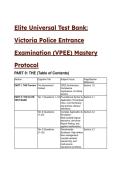
Elite Universal Test Bank:
Victoria Police Entrance
Examination (VPEE) Mastery
Protocol
PART 0: THE (Table of Contents)
Section Cognitive Tier Subject Focus Page/Section
Reference
PART I: THE Preview Pre-Assessment VPEE Architecture, Section 1.0
Context Compliance
Implications, & Critical
Axioms
PART II: THE ELITE Tier 1 (Questions 1–10) Foundational Syntax & Section 2.1
TEST BANK Application: Procedural
rules, core Numeracy,
and primary Literacy
definitions.
Tier 2 (Questions Complex Application & Section 2.2
11–20) Simulation:
Multi-variable logical
deduction, structural
Report Writing, and
applied mathematics.
Tier 3 (Questions Grandmaster Section 2.3
21–30) Synthesis: High-stakes
time management,
complex abstract
sequencing, and
multi-source
operational synthesis.
,PART I: THE Preview
Mastering this exhaustive test bank translates directly to elite cognitive performance and
error-free execution during the Victoria Police Entrance Examination (VPEE). By bridging
fundamental academic theory with high-stakes, time-constrained scenario analysis, the
candidate replaces rote memorization with the advanced, reflexive analytical judgment
demanded in rigorous policing environments.
● The Four-Pillar ACER Framework: The modernized 2026 examination strictly evaluates
four domains within a continuous 120-minute window: Literacy (30 minutes), Abstract
Reasoning (20 minutes), Report Writing (35 minutes), and Numeracy (35 minutes).
Legacy modules like Digital Literacy and Oral Communication have been reallocated or
retired.
● The Abstract Sequencing Rule: When isolating the middle shape of a five-part spatial
sequence, the absolute priority is mapping the strict rotational or additive progression
mathematically from 1 to 5 on physical scratch paper before attempting visual placement.
● The Report Architecture Mandate: A passing qualitative response must strictly adhere
to a 300-350 word limit, deploying an objective introduction, a body utilizing source facts
anchored by clear topic sentences, and a definitive conclusion that summarizes key
findings without introducing new variables.
● The Mathematical Triad & ACSF Threshold: Numeracy mastery requires seamless
contextual application of Numbers/Algebra, Measurement/Geometry, and
Statistics/Probability. Candidates must perform at the Australian Core Skills Framework
(ACSF) Exit Level 3 or higher, requiring an absolute minimum passing threshold mapped
to 60% accuracy.
● The Remote Proctoring Chain of Custody: The examination is conducted via a highly
secure, live-proctored environment (ProctorU). Candidates must utilize a single screen,
remain plugged into a power source, and understand that the examination timer does not
pause for any permitted biological breaks.
PART II: THE ELITE TEST BANK
Tier 1 - Foundational Syntax & Application
Q1: Regarding the structural evolution of the Victoria Police Entrance Examination (VPEE)
administered by ACER, a candidate is preparing their time management strategy. Based on the
current 2026 examination protocols, which framework is the MOST ACCURATE? A) Eight
independent testing sections requiring 4.5 hours of continuous assessment, including dedicated
oral communication and digital literacy components. B) Four testing sections comprising
Literacy, Abstract Reasoning, Report Writing, and Numeracy, executed within a strict 120-minute
continuous window. C) Three testing sections excluding Report Writing, requiring a total of 90
minutes to accommodate automated remote proctoring limitations. D) Four testing sections
requiring 120 minutes, where the countdown timer for each individual section automatically
begins the moment the proctor unlocks the exam portal.
● The Answer: B (Four testing sections comprising Literacy, Abstract Reasoning, Report
Writing, and Numeracy, executed within a strict 120-minute continuous window.)
● Distractor Analysis:
○ A is incorrect: This describes the outdated legacy framework. The examination was
, streamlined from eight sections and 4.5 hours down to four sections to optimize the
assessment process and remove redundancies.
○ C is incorrect: Report Writing remains a critical, mandatory 35-minute component of
the four-section structure.
○ D is incorrect: While the total exam is 120 minutes, the timer does not begin
immediately upon the proctor unlocking the portal; it strictly commences only when
the candidate clicks the green "START TEST" button after reviewing the
instructions.
The Mentor's Analysis: The underlying principle dictates that structural awareness is the
absolute foundation of pacing. When facing a timed, multi-disciplinary assessment, the
immediate priority is compartmentalizing cognitive stamina across the exact mandated domains.
By utilizing the Four-Pillar Timing Protocol, the candidate bypasses the common trap of
misallocating time based on outdated legacy exam structures. Professional/Academic
Intuition: The modern assessment prioritizes density over duration; a 120-minute gauntlet
demands ruthless time management across exactly four domains.
Q2: A candidate is undertaking a remote proctored VPEE session. Midway through the
35-minute Numeracy section, the candidate urgently requires a bathroom break. Based on strict
ACER remote proctoring regulations, which action is the MOST APPROPRIATE? A) Leave the
desk immediately, as candidates are entitled to one unannounced bathroom break per
120-minute session to comply with occupational health standards. B) Alert the proctor to secure
permission, understanding that the countdown timer will freeze until the room is re-secured
upon return. C) Alert the proctor to secure permission, understanding that the countdown timer
will continue running and no additional time will be granted. D) Wait until the Numeracy section
concludes, as bathroom breaks are strictly forbidden under all circumstances once the
120-minute exam commences.
● The Answer: C (Alert the proctor to secure permission, understanding that the
countdown timer will continue running and no additional time will be granted.)
● Distractor Analysis:
○ A is incorrect: Leaving the view of the webcam without explicit verbal or chat
permission results in the immediate and permanent closure of the examination by
the proctor.
○ B is incorrect: The testing platform does not pause. Any time spent away from the
desk during an active test section is permanently forfeited.
○ D is incorrect: While highly unadvisable during an active section, exactly one
bathroom break is permitted during the exam session, provided proper
communication protocol is followed.
The Mentor's Analysis: Standardized testing environments strictly penalize unverified
absences to maintain absolute academic integrity. When facing an unavoidable biological
interruption, the immediate priority is maintaining an unbroken chain of custody with the remote
proctor. By utilizing the Continuous Timer Acknowledgment, the candidate bypasses the novice
error of assuming technical platforms accommodate personal biological needs.
Professional/Academic Intuition: In remote proctoring, permission grants absence, but the
clock grants no mercy.
Q3: During the Report Writing component of the VPEE, a candidate must synthesize raw data
regarding e-bike regulations into a coherent body paragraph. According to formal ACER report
structures, what is the FIRST required element of this paragraph? A) A concluding sentence
that restates the overall finding of the provided source materials. B) A direct quote from the
provided source material to establish immediate legislative authority. C) A clear topic sentence
Victoria Police Entrance
Examination (VPEE) Mastery
Protocol
PART 0: THE (Table of Contents)
Section Cognitive Tier Subject Focus Page/Section
Reference
PART I: THE Preview Pre-Assessment VPEE Architecture, Section 1.0
Context Compliance
Implications, & Critical
Axioms
PART II: THE ELITE Tier 1 (Questions 1–10) Foundational Syntax & Section 2.1
TEST BANK Application: Procedural
rules, core Numeracy,
and primary Literacy
definitions.
Tier 2 (Questions Complex Application & Section 2.2
11–20) Simulation:
Multi-variable logical
deduction, structural
Report Writing, and
applied mathematics.
Tier 3 (Questions Grandmaster Section 2.3
21–30) Synthesis: High-stakes
time management,
complex abstract
sequencing, and
multi-source
operational synthesis.
,PART I: THE Preview
Mastering this exhaustive test bank translates directly to elite cognitive performance and
error-free execution during the Victoria Police Entrance Examination (VPEE). By bridging
fundamental academic theory with high-stakes, time-constrained scenario analysis, the
candidate replaces rote memorization with the advanced, reflexive analytical judgment
demanded in rigorous policing environments.
● The Four-Pillar ACER Framework: The modernized 2026 examination strictly evaluates
four domains within a continuous 120-minute window: Literacy (30 minutes), Abstract
Reasoning (20 minutes), Report Writing (35 minutes), and Numeracy (35 minutes).
Legacy modules like Digital Literacy and Oral Communication have been reallocated or
retired.
● The Abstract Sequencing Rule: When isolating the middle shape of a five-part spatial
sequence, the absolute priority is mapping the strict rotational or additive progression
mathematically from 1 to 5 on physical scratch paper before attempting visual placement.
● The Report Architecture Mandate: A passing qualitative response must strictly adhere
to a 300-350 word limit, deploying an objective introduction, a body utilizing source facts
anchored by clear topic sentences, and a definitive conclusion that summarizes key
findings without introducing new variables.
● The Mathematical Triad & ACSF Threshold: Numeracy mastery requires seamless
contextual application of Numbers/Algebra, Measurement/Geometry, and
Statistics/Probability. Candidates must perform at the Australian Core Skills Framework
(ACSF) Exit Level 3 or higher, requiring an absolute minimum passing threshold mapped
to 60% accuracy.
● The Remote Proctoring Chain of Custody: The examination is conducted via a highly
secure, live-proctored environment (ProctorU). Candidates must utilize a single screen,
remain plugged into a power source, and understand that the examination timer does not
pause for any permitted biological breaks.
PART II: THE ELITE TEST BANK
Tier 1 - Foundational Syntax & Application
Q1: Regarding the structural evolution of the Victoria Police Entrance Examination (VPEE)
administered by ACER, a candidate is preparing their time management strategy. Based on the
current 2026 examination protocols, which framework is the MOST ACCURATE? A) Eight
independent testing sections requiring 4.5 hours of continuous assessment, including dedicated
oral communication and digital literacy components. B) Four testing sections comprising
Literacy, Abstract Reasoning, Report Writing, and Numeracy, executed within a strict 120-minute
continuous window. C) Three testing sections excluding Report Writing, requiring a total of 90
minutes to accommodate automated remote proctoring limitations. D) Four testing sections
requiring 120 minutes, where the countdown timer for each individual section automatically
begins the moment the proctor unlocks the exam portal.
● The Answer: B (Four testing sections comprising Literacy, Abstract Reasoning, Report
Writing, and Numeracy, executed within a strict 120-minute continuous window.)
● Distractor Analysis:
○ A is incorrect: This describes the outdated legacy framework. The examination was
, streamlined from eight sections and 4.5 hours down to four sections to optimize the
assessment process and remove redundancies.
○ C is incorrect: Report Writing remains a critical, mandatory 35-minute component of
the four-section structure.
○ D is incorrect: While the total exam is 120 minutes, the timer does not begin
immediately upon the proctor unlocking the portal; it strictly commences only when
the candidate clicks the green "START TEST" button after reviewing the
instructions.
The Mentor's Analysis: The underlying principle dictates that structural awareness is the
absolute foundation of pacing. When facing a timed, multi-disciplinary assessment, the
immediate priority is compartmentalizing cognitive stamina across the exact mandated domains.
By utilizing the Four-Pillar Timing Protocol, the candidate bypasses the common trap of
misallocating time based on outdated legacy exam structures. Professional/Academic
Intuition: The modern assessment prioritizes density over duration; a 120-minute gauntlet
demands ruthless time management across exactly four domains.
Q2: A candidate is undertaking a remote proctored VPEE session. Midway through the
35-minute Numeracy section, the candidate urgently requires a bathroom break. Based on strict
ACER remote proctoring regulations, which action is the MOST APPROPRIATE? A) Leave the
desk immediately, as candidates are entitled to one unannounced bathroom break per
120-minute session to comply with occupational health standards. B) Alert the proctor to secure
permission, understanding that the countdown timer will freeze until the room is re-secured
upon return. C) Alert the proctor to secure permission, understanding that the countdown timer
will continue running and no additional time will be granted. D) Wait until the Numeracy section
concludes, as bathroom breaks are strictly forbidden under all circumstances once the
120-minute exam commences.
● The Answer: C (Alert the proctor to secure permission, understanding that the
countdown timer will continue running and no additional time will be granted.)
● Distractor Analysis:
○ A is incorrect: Leaving the view of the webcam without explicit verbal or chat
permission results in the immediate and permanent closure of the examination by
the proctor.
○ B is incorrect: The testing platform does not pause. Any time spent away from the
desk during an active test section is permanently forfeited.
○ D is incorrect: While highly unadvisable during an active section, exactly one
bathroom break is permitted during the exam session, provided proper
communication protocol is followed.
The Mentor's Analysis: Standardized testing environments strictly penalize unverified
absences to maintain absolute academic integrity. When facing an unavoidable biological
interruption, the immediate priority is maintaining an unbroken chain of custody with the remote
proctor. By utilizing the Continuous Timer Acknowledgment, the candidate bypasses the novice
error of assuming technical platforms accommodate personal biological needs.
Professional/Academic Intuition: In remote proctoring, permission grants absence, but the
clock grants no mercy.
Q3: During the Report Writing component of the VPEE, a candidate must synthesize raw data
regarding e-bike regulations into a coherent body paragraph. According to formal ACER report
structures, what is the FIRST required element of this paragraph? A) A concluding sentence
that restates the overall finding of the provided source materials. B) A direct quote from the
provided source material to establish immediate legislative authority. C) A clear topic sentence


