

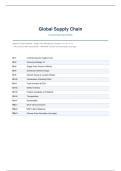
Global Supply Chain
Course Summary Notes
Based on Chopra & Meindl – Supply Chain Management (Chapters 1–5, 10–14, 17)
+ TBL sessions: MILP (Excel Solver) · MRP/BOM · Discrete Event Simulation (AnyLogic)
Ch 1 Understanding the Supply Chain
Ch 2 Achieving Strategic Fit
Ch 3 Supply Chain Drivers & Metrics
Ch 4 Distribution Network Design
Ch 5 Network Design & Location Models
Ch 10 Coordination & Bullwhip Effect
Ch 11 Cycle Inventory & EOQ
Ch 12 Safety Inventory
Ch 13 Product Availability & Profitability
Ch 14 Transportation
Ch 17 Sustainability
TBL 1 MILP with Excel Solver
TBL 2 MRP & Bill of Materials
TBL 3 Discrete Event Simulation (AnyLogic)
, Chapter 1 – Understanding the Supply Chain
1.1 What is a Supply Chain?
A supply chain consists of all parties involved, directly or indirectly, in fulfilling a customer request — suppliers,
manufacturers, transporters, warehouses, retailers, and customers themselves.
Key characteristics:
• Dynamic: constant flow of products, information, and funds — often in both directions
• Network, not a simple linear chain — multiple players at each stage
• The customer is the only source of revenue; all other flows generate costs
• Design depends on customer needs and the roles played by each stage
Typical Supply Chain Stages
Suppliers → Manufacturers → Distributors → Retailers → Customers
1.2 The Objective of a Supply Chain
Supply Chain Surplus = Customer Value – Supply Chain Cost
The higher the supply chain surplus, the more successful the supply chain. Effective SC management means growing
this total pie — benefitting all members.
1.3 Decision Phases in a Supply Chain
Phase Horizon Key Decisions
Design / Strategy Several years Facility locations, capacity,
outsourcing, technology choices. Hard
to reverse.
Planning Quarterly / Annual Demand forecasting, inventory
policies, which markets are served
from where.
Operations Daily / Weekly Individual order decisions: picking,
routing, replenishment scheduling.
1.4 Two Process Views
Divides SC into cycles at each interface: Customer Order Cycle
→ Replenishment Cycle → Manufacturing Cycle →
Cycle View Procurement Cycle. Useful for ERP and operational roles.
Pull: triggered by actual demand (known). Push: based on
forecast (uncertain). The Push/Pull boundary is a key strategic
Push / Pull View design decision.
1.5 Supply Chain Macro Processes
Acronym Name Key Activities
CRM Customer Relationship Market, price, sell, call centre, order management
Mgmt
, ISCM Internal Supply Chain Strategic & demand planning, supply planning, fulfilment, field service
Mgmt
SRM Supplier Relationship Source, negotiate, buy, design collaboration, supply collaboration
Mgmt
Integration across CRM, ISCM, and SRM is crucial for successful SC management.
Course Summary Notes
Based on Chopra & Meindl – Supply Chain Management (Chapters 1–5, 10–14, 17)
+ TBL sessions: MILP (Excel Solver) · MRP/BOM · Discrete Event Simulation (AnyLogic)
Ch 1 Understanding the Supply Chain
Ch 2 Achieving Strategic Fit
Ch 3 Supply Chain Drivers & Metrics
Ch 4 Distribution Network Design
Ch 5 Network Design & Location Models
Ch 10 Coordination & Bullwhip Effect
Ch 11 Cycle Inventory & EOQ
Ch 12 Safety Inventory
Ch 13 Product Availability & Profitability
Ch 14 Transportation
Ch 17 Sustainability
TBL 1 MILP with Excel Solver
TBL 2 MRP & Bill of Materials
TBL 3 Discrete Event Simulation (AnyLogic)
, Chapter 1 – Understanding the Supply Chain
1.1 What is a Supply Chain?
A supply chain consists of all parties involved, directly or indirectly, in fulfilling a customer request — suppliers,
manufacturers, transporters, warehouses, retailers, and customers themselves.
Key characteristics:
• Dynamic: constant flow of products, information, and funds — often in both directions
• Network, not a simple linear chain — multiple players at each stage
• The customer is the only source of revenue; all other flows generate costs
• Design depends on customer needs and the roles played by each stage
Typical Supply Chain Stages
Suppliers → Manufacturers → Distributors → Retailers → Customers
1.2 The Objective of a Supply Chain
Supply Chain Surplus = Customer Value – Supply Chain Cost
The higher the supply chain surplus, the more successful the supply chain. Effective SC management means growing
this total pie — benefitting all members.
1.3 Decision Phases in a Supply Chain
Phase Horizon Key Decisions
Design / Strategy Several years Facility locations, capacity,
outsourcing, technology choices. Hard
to reverse.
Planning Quarterly / Annual Demand forecasting, inventory
policies, which markets are served
from where.
Operations Daily / Weekly Individual order decisions: picking,
routing, replenishment scheduling.
1.4 Two Process Views
Divides SC into cycles at each interface: Customer Order Cycle
→ Replenishment Cycle → Manufacturing Cycle →
Cycle View Procurement Cycle. Useful for ERP and operational roles.
Pull: triggered by actual demand (known). Push: based on
forecast (uncertain). The Push/Pull boundary is a key strategic
Push / Pull View design decision.
1.5 Supply Chain Macro Processes
Acronym Name Key Activities
CRM Customer Relationship Market, price, sell, call centre, order management
Mgmt
, ISCM Internal Supply Chain Strategic & demand planning, supply planning, fulfilment, field service
Mgmt
SRM Supplier Relationship Source, negotiate, buy, design collaboration, supply collaboration
Mgmt
Integration across CRM, ISCM, and SRM is crucial for successful SC management.


