

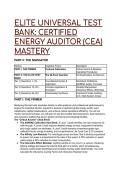
ELITE UNIVERSAL TEST
BANK: CERTIFIED
ENERGY AUDITOR (CEA)
MASTERY
PART 0: THE NAVIGATOR
Section Cognitive Focus Description
PART I: THE PRIMER Protocol Calibration Critical Axioms & Baseline
Operating Procedures
PART II: THE ELITE TEST The 60-Point Gauntlet Full Examination Architecture
BANK
Tier 1 (Questions 1–15) Foundational Syntax & Hard-Deck Definitions,
Application ASHRAE Audits, Formulas
Tier 2 (Questions 16–35) Complex Application & Variable Manipulation,
Simulation Interactive Effects, BAS Data
Tier 3 (Questions 36–60) Grandmaster Synthesis Investment Grade Auditing,
LCC, Multi-System Crises
PART I: THE PRIMER
Mastering this test bank translates directly to elite academic and professional performance by
forging the analytical intuition required to execute investment-grade energy audits, avert
catastrophic capital misallocations, and achieve radical operational efficiency. You will not
merely memorize formulas; you will learn to see the invisible thermodynamics, fluid mechanics,
and economic realities that govern global commercial and industrial facilities.
The "Critical Axioms" Cheat Sheet
● The ASHRAE Calibration Hard-Deck: A Level 1 audit identifies low-cost measures via
walk-through. A Level 2 audit requires detailed energy surveys, equipment inventories,
and rough capital cost estimates. A Level 3 audit demands investment-grade rigor,
calibrated hourly energy modeling, and comprehensive Life Cycle Cost (LCC) analysis.
● The Affinity Law Absolute: For centrifugal pumps and fans, flow is directly proportional
to speed, but power is proportional to the cube of the speed. A 20% reduction in speed
yields nearly a 50% reduction in power consumption.
● The Interactive Effect Mandate: Lighting retrofits do not occur in a vacuum. Reducing
lighting wattage decreases the internal heat gain of a facility, which simultaneously
reduces cooling loads (beneficial) and increases heating loads (detrimental). You must
calculate the Interactive Cooling Factor and Interactive Heating Factor.
, ● The LCC/NPV Superiority: Simple Payback Period (SPP) is a novice metric because it
ignores the time value of money and cash flows beyond the payback point. Elite capital
allocation relies on Net Present Value (NPV), Internal Rate of Return (IRR), and
Savings-to-Investment Ratio (SIR).
● The Compressed Air Fallacy: Compressed air is the most expensive utility in an
industrial facility (10-15% overall efficiency). Pressure reduction, leak-down remediation,
and heat-of-compression recovery (capable of reclaiming up to 90% of input energy) must
precede any capital investment in new generation.
PART II: THE ELITE TEST BANK
Tier 1: Foundational Syntax & Application
Q1: A facility manager requests an energy audit to identify low-cost/no-cost energy conservation
measures (ECMs) and benchmark the facility against similar buildings using utility bill analysis.
Based on the principles of ASHRAE Standard 211, which level of audit is MOST
APPROPRIATE? A) ASHRAE Level 3 Audit B) ASHRAE Level 2 Audit C) ASHRAE Level 1
Audit D) Investment Grade Audit (IGA)
● The Answer: C (ASHRAE Level 1 Audit)
● Distractor Analysis:
○ A is incorrect: A Level 3 audit requires comprehensive hourly energy modeling and
rigorous life cycle costing, which exceeds the scope of identifying simple low-cost
measures.
○ B is incorrect: A Level 2 audit requires a detailed equipment inventory and financial
analysis of capital-intensive measures, going beyond a basic walk-through.
○ D is incorrect: An IGA is synonymous with a Level 3 audit, utilized for performance
contracting, not baseline benchmarking.
The Mentor's Analysis: A Level 1 audit serves as the baseline triage for a facility, combining
benchmarking with a walk-through to harvest immediate, operational savings. When facing
budget constraints or initial assessments, the immediate priority is identifying low-hanging fruit
before investing in deep engineering calculations. By utilizing ASHRAE Level 1 guidelines, you
bypass the common trap of over-engineering an initial assessment. Professional/Academic
Intuition: Never authorize a Level 3 audit before the findings of a Level 1 and 2 have been
executed and evaluated.
Q2: A proposed energy efficiency project requires an initial capital investment of $150,000 and
generates annual savings of $35,000. The equipment has a useful life of 10 years, and the
discount rate is 8%. Based on the principles of Economic Analysis, which metric FIRST fails to
account for the time value of money? A) Internal Rate of Return (IRR) B) Simple Payback
Period (SPP) C) Net Present Value (NPV) D) Savings-to-Investment Ratio (SIR)
● The Answer: B (Simple Payback Period (SPP))
● Distractor Analysis:
○ A is incorrect: IRR explicitly calculates the discount rate at which the NPV of cash
flows equals zero.
○ C is incorrect: NPV discounts all future cash flows back to the present value using
the stated discount rate.
○ D is incorrect: SIR is the ratio of the present value of savings to the present value of
the investment costs.
,The Mentor's Analysis: While popular among laymen, Simple Payback Period is an inherently
flawed financial metric for long-term strategic decisions. When facing capital allocation, the
immediate priority is determining true profitability over the equipment's lifespan. By utilizing
Discounted Cash Flow techniques, you bypass the common trap of prioritizing short-term cost
recovery over long-term wealth generation. Professional/Academic Intuition: SPP measures
liquidity, not profitability. Always rely on NPV for definitive capital deployment.
Q3: During a preliminary energy use analysis, an auditor calculates the total annual energy
consumption of a 100,000 square foot commercial building to be 2,000,000 kWh of electricity
and 50,000 therms of natural gas. Based on the principles of Facility Benchmarking, which
action is the MOST ACCURATE method to determine the Energy Use Intensity (EUI)? A) Divide
the total kWh by the gross square footage. B) Convert both kWh and therms to British Thermal
Units (Btu), sum them, and divide by the gross square footage. C) Convert therms to kWh, sum
them, and divide by the number of annual occupants. D) Subtract the base load energy from the
total, convert to kBtu, and divide by the conditioned square footage.
● The Answer: B (Convert both kWh and therms to British Thermal Units (Btu), sum them,
and divide by the gross square footage.)
● Distractor Analysis:
○ A is incorrect: This ignores the thermal energy (natural gas) consumption, resulting
in an artificially low and inaccurate EUI.
○ C is incorrect: EUI is fundamentally a spatial metric (energy per square foot), not an
occupant-density metric.
○ D is incorrect: EUI must encompass the entire energy footprint of the building, not
just the weather-dependent loads.
The Mentor's Analysis: True benchmarking requires a unified energy metric to compare
disparate fuel sources accurately. When facing multiple fuel types, the immediate priority is
converting all inputs to a common denominator (typically kBtu). By utilizing Gross Square
Footage EUI calculation, you bypass the common trap of siloed utility analysis.
Professional/Academic Intuition: EUI normalizes complex energy profiles into a single,
comparative baseline metric: kBtu/sq.ft/yr.
Q4: A facility utilizes a 100-horsepower (HP) centrifugal fan operating continuously. An auditor
proposes installing a Variable Frequency Drive (VFD) to reduce the fan speed by 20%. Based
on the principles of the Affinity Laws, what is the MOST ACCURATE anticipated reduction in
power consumption, assuming no static pressure limits? A) 20% B) 40% C) 49% D) 51%
● The Answer: C (49%)
● Distractor Analysis:
○ A is incorrect: Power is not linearly proportional to speed. This is a severe novice
assumption.
○ B is incorrect: This assumes power scales to the square of the speed, which applies
to pressure, not power.
○ D is incorrect: 51% is the remaining power consumption (0.8^3 = 0.512), meaning
the reduction is actually 1 - 0.512 = 0.488, or approximately 49%.
The Mentor's Analysis: Centrifugal loads present the highest yield opportunities for energy
savings due to their non-linear power curves. When facing throttled air or water flow, the
immediate priority is eliminating mechanical restrictions in favor of speed control. By utilizing
Affinity Law calculations, you bypass the common trap of underestimating the exponential
savings generated by VFDs. Professional/Academic Intuition: Flow is linear, Pressure is
squared, Power is cubed. A 20% drop in speed yields nearly a 50% drop in power.
Q5: An industrial facility utilizes compressed air extensively. The auditor performs a leak-down
, test by isolating the system from production loads, shutting off the compressors, and timing the
pressure drop. Based on the principles of Compressed Air Systems, which variable is LEAST
relevant to calculating the system leakage rate (SCFM)? A) Total storage volume of the
compressed air system B) Drop in line pressure during the leak down C) Time taken for the
pressure to drop D) The brake horsepower (bhp) of the primary compressor
● The Answer: D (The brake horsepower (bhp) of the primary compressor)
● Distractor Analysis:
○ A is incorrect: System volume is a critical multiplier in the leak-down formula V
\times \Delta P / (Time \times 14.7) \times 1.25.
○ B is incorrect: The differential pressure (\Delta P) dictates the rate of evacuation
from the defined volume.
○ C is incorrect: The time variable determines the volumetric flow rate of the leak.
The Mentor's Analysis: Leak-down tests measure the physical escape of air from a fixed
volume, completely independent of the machine that generated the air. When facing
compressed air audits, the immediate priority is quantifying demand-side waste before
addressing supply-side efficiency. By utilizing volumetric leak formulas, you bypass the common
trap of confusing supply capacity with demand loss. Professional/Academic Intuition: Audit
the demand side (leaks, inappropriate uses) before you ever touch the supply side
(compressors, VFDs).
Q6: To evaluate the thermal efficiency of a building envelope, an auditor must assess the heat
transfer rate through a composite wall. If the total thermal resistance (R-value) of the wall is 10,
which calculation MOST ACCURATELY determines the U-value? A) U = 10 \times 3.412 B) U =
C) U = 10 / \Delta T D) U = 1 - (1/10)
● The Answer: B (U = )
● Distractor Analysis:
○ A is incorrect: This attempts to convert kW to Btu, which is entirely irrelevant to
thermal transmittance.
○ C is incorrect: Delta T is required to calculate total heat transfer (Q = U \times A
\times \Delta T), not the U-value itself.
○ D is incorrect: This is a fabricated mathematical distractor representing a common
calculation error.
The Mentor's Analysis: Thermal resistance and thermal transmittance are inversely
proportional. When facing building envelope calculations, the immediate priority is converting
R-values (additive) to U-values (multiplicative) to determine aggregate heat loss. By utilizing
reciprocal mathematics, you bypass the common trap of adding U-values directly.
Professional/Academic Intuition: R-values add. U-values multiply. U is always the
reciprocal of the total R-value.
Q7: During an economic analysis of an energy retrofit, an auditor utilizes the Net Present Value
(NPV) method. The NPV is calculated as exactly zero. Based on the principles of Corporate
Finance, what is the MOST LOGICAL conclusion? A) The project will generate no financial
savings and should be rejected. B) The project's Internal Rate of Return (IRR) is exactly equal
to the discount rate. C) The Simple Payback Period is equal to the lifespan of the equipment. D)
The Savings-to-Investment Ratio (SIR) is negative.
● The Answer: B (The project's Internal Rate of Return (IRR) is exactly equal to the
discount rate.)
● Distractor Analysis:
○ A is incorrect: An NPV of zero means the project generates savings that exactly
cover the initial investment plus the required rate of return. It is not a financial loss.
BANK: CERTIFIED
ENERGY AUDITOR (CEA)
MASTERY
PART 0: THE NAVIGATOR
Section Cognitive Focus Description
PART I: THE PRIMER Protocol Calibration Critical Axioms & Baseline
Operating Procedures
PART II: THE ELITE TEST The 60-Point Gauntlet Full Examination Architecture
BANK
Tier 1 (Questions 1–15) Foundational Syntax & Hard-Deck Definitions,
Application ASHRAE Audits, Formulas
Tier 2 (Questions 16–35) Complex Application & Variable Manipulation,
Simulation Interactive Effects, BAS Data
Tier 3 (Questions 36–60) Grandmaster Synthesis Investment Grade Auditing,
LCC, Multi-System Crises
PART I: THE PRIMER
Mastering this test bank translates directly to elite academic and professional performance by
forging the analytical intuition required to execute investment-grade energy audits, avert
catastrophic capital misallocations, and achieve radical operational efficiency. You will not
merely memorize formulas; you will learn to see the invisible thermodynamics, fluid mechanics,
and economic realities that govern global commercial and industrial facilities.
The "Critical Axioms" Cheat Sheet
● The ASHRAE Calibration Hard-Deck: A Level 1 audit identifies low-cost measures via
walk-through. A Level 2 audit requires detailed energy surveys, equipment inventories,
and rough capital cost estimates. A Level 3 audit demands investment-grade rigor,
calibrated hourly energy modeling, and comprehensive Life Cycle Cost (LCC) analysis.
● The Affinity Law Absolute: For centrifugal pumps and fans, flow is directly proportional
to speed, but power is proportional to the cube of the speed. A 20% reduction in speed
yields nearly a 50% reduction in power consumption.
● The Interactive Effect Mandate: Lighting retrofits do not occur in a vacuum. Reducing
lighting wattage decreases the internal heat gain of a facility, which simultaneously
reduces cooling loads (beneficial) and increases heating loads (detrimental). You must
calculate the Interactive Cooling Factor and Interactive Heating Factor.
, ● The LCC/NPV Superiority: Simple Payback Period (SPP) is a novice metric because it
ignores the time value of money and cash flows beyond the payback point. Elite capital
allocation relies on Net Present Value (NPV), Internal Rate of Return (IRR), and
Savings-to-Investment Ratio (SIR).
● The Compressed Air Fallacy: Compressed air is the most expensive utility in an
industrial facility (10-15% overall efficiency). Pressure reduction, leak-down remediation,
and heat-of-compression recovery (capable of reclaiming up to 90% of input energy) must
precede any capital investment in new generation.
PART II: THE ELITE TEST BANK
Tier 1: Foundational Syntax & Application
Q1: A facility manager requests an energy audit to identify low-cost/no-cost energy conservation
measures (ECMs) and benchmark the facility against similar buildings using utility bill analysis.
Based on the principles of ASHRAE Standard 211, which level of audit is MOST
APPROPRIATE? A) ASHRAE Level 3 Audit B) ASHRAE Level 2 Audit C) ASHRAE Level 1
Audit D) Investment Grade Audit (IGA)
● The Answer: C (ASHRAE Level 1 Audit)
● Distractor Analysis:
○ A is incorrect: A Level 3 audit requires comprehensive hourly energy modeling and
rigorous life cycle costing, which exceeds the scope of identifying simple low-cost
measures.
○ B is incorrect: A Level 2 audit requires a detailed equipment inventory and financial
analysis of capital-intensive measures, going beyond a basic walk-through.
○ D is incorrect: An IGA is synonymous with a Level 3 audit, utilized for performance
contracting, not baseline benchmarking.
The Mentor's Analysis: A Level 1 audit serves as the baseline triage for a facility, combining
benchmarking with a walk-through to harvest immediate, operational savings. When facing
budget constraints or initial assessments, the immediate priority is identifying low-hanging fruit
before investing in deep engineering calculations. By utilizing ASHRAE Level 1 guidelines, you
bypass the common trap of over-engineering an initial assessment. Professional/Academic
Intuition: Never authorize a Level 3 audit before the findings of a Level 1 and 2 have been
executed and evaluated.
Q2: A proposed energy efficiency project requires an initial capital investment of $150,000 and
generates annual savings of $35,000. The equipment has a useful life of 10 years, and the
discount rate is 8%. Based on the principles of Economic Analysis, which metric FIRST fails to
account for the time value of money? A) Internal Rate of Return (IRR) B) Simple Payback
Period (SPP) C) Net Present Value (NPV) D) Savings-to-Investment Ratio (SIR)
● The Answer: B (Simple Payback Period (SPP))
● Distractor Analysis:
○ A is incorrect: IRR explicitly calculates the discount rate at which the NPV of cash
flows equals zero.
○ C is incorrect: NPV discounts all future cash flows back to the present value using
the stated discount rate.
○ D is incorrect: SIR is the ratio of the present value of savings to the present value of
the investment costs.
,The Mentor's Analysis: While popular among laymen, Simple Payback Period is an inherently
flawed financial metric for long-term strategic decisions. When facing capital allocation, the
immediate priority is determining true profitability over the equipment's lifespan. By utilizing
Discounted Cash Flow techniques, you bypass the common trap of prioritizing short-term cost
recovery over long-term wealth generation. Professional/Academic Intuition: SPP measures
liquidity, not profitability. Always rely on NPV for definitive capital deployment.
Q3: During a preliminary energy use analysis, an auditor calculates the total annual energy
consumption of a 100,000 square foot commercial building to be 2,000,000 kWh of electricity
and 50,000 therms of natural gas. Based on the principles of Facility Benchmarking, which
action is the MOST ACCURATE method to determine the Energy Use Intensity (EUI)? A) Divide
the total kWh by the gross square footage. B) Convert both kWh and therms to British Thermal
Units (Btu), sum them, and divide by the gross square footage. C) Convert therms to kWh, sum
them, and divide by the number of annual occupants. D) Subtract the base load energy from the
total, convert to kBtu, and divide by the conditioned square footage.
● The Answer: B (Convert both kWh and therms to British Thermal Units (Btu), sum them,
and divide by the gross square footage.)
● Distractor Analysis:
○ A is incorrect: This ignores the thermal energy (natural gas) consumption, resulting
in an artificially low and inaccurate EUI.
○ C is incorrect: EUI is fundamentally a spatial metric (energy per square foot), not an
occupant-density metric.
○ D is incorrect: EUI must encompass the entire energy footprint of the building, not
just the weather-dependent loads.
The Mentor's Analysis: True benchmarking requires a unified energy metric to compare
disparate fuel sources accurately. When facing multiple fuel types, the immediate priority is
converting all inputs to a common denominator (typically kBtu). By utilizing Gross Square
Footage EUI calculation, you bypass the common trap of siloed utility analysis.
Professional/Academic Intuition: EUI normalizes complex energy profiles into a single,
comparative baseline metric: kBtu/sq.ft/yr.
Q4: A facility utilizes a 100-horsepower (HP) centrifugal fan operating continuously. An auditor
proposes installing a Variable Frequency Drive (VFD) to reduce the fan speed by 20%. Based
on the principles of the Affinity Laws, what is the MOST ACCURATE anticipated reduction in
power consumption, assuming no static pressure limits? A) 20% B) 40% C) 49% D) 51%
● The Answer: C (49%)
● Distractor Analysis:
○ A is incorrect: Power is not linearly proportional to speed. This is a severe novice
assumption.
○ B is incorrect: This assumes power scales to the square of the speed, which applies
to pressure, not power.
○ D is incorrect: 51% is the remaining power consumption (0.8^3 = 0.512), meaning
the reduction is actually 1 - 0.512 = 0.488, or approximately 49%.
The Mentor's Analysis: Centrifugal loads present the highest yield opportunities for energy
savings due to their non-linear power curves. When facing throttled air or water flow, the
immediate priority is eliminating mechanical restrictions in favor of speed control. By utilizing
Affinity Law calculations, you bypass the common trap of underestimating the exponential
savings generated by VFDs. Professional/Academic Intuition: Flow is linear, Pressure is
squared, Power is cubed. A 20% drop in speed yields nearly a 50% drop in power.
Q5: An industrial facility utilizes compressed air extensively. The auditor performs a leak-down
, test by isolating the system from production loads, shutting off the compressors, and timing the
pressure drop. Based on the principles of Compressed Air Systems, which variable is LEAST
relevant to calculating the system leakage rate (SCFM)? A) Total storage volume of the
compressed air system B) Drop in line pressure during the leak down C) Time taken for the
pressure to drop D) The brake horsepower (bhp) of the primary compressor
● The Answer: D (The brake horsepower (bhp) of the primary compressor)
● Distractor Analysis:
○ A is incorrect: System volume is a critical multiplier in the leak-down formula V
\times \Delta P / (Time \times 14.7) \times 1.25.
○ B is incorrect: The differential pressure (\Delta P) dictates the rate of evacuation
from the defined volume.
○ C is incorrect: The time variable determines the volumetric flow rate of the leak.
The Mentor's Analysis: Leak-down tests measure the physical escape of air from a fixed
volume, completely independent of the machine that generated the air. When facing
compressed air audits, the immediate priority is quantifying demand-side waste before
addressing supply-side efficiency. By utilizing volumetric leak formulas, you bypass the common
trap of confusing supply capacity with demand loss. Professional/Academic Intuition: Audit
the demand side (leaks, inappropriate uses) before you ever touch the supply side
(compressors, VFDs).
Q6: To evaluate the thermal efficiency of a building envelope, an auditor must assess the heat
transfer rate through a composite wall. If the total thermal resistance (R-value) of the wall is 10,
which calculation MOST ACCURATELY determines the U-value? A) U = 10 \times 3.412 B) U =
C) U = 10 / \Delta T D) U = 1 - (1/10)
● The Answer: B (U = )
● Distractor Analysis:
○ A is incorrect: This attempts to convert kW to Btu, which is entirely irrelevant to
thermal transmittance.
○ C is incorrect: Delta T is required to calculate total heat transfer (Q = U \times A
\times \Delta T), not the U-value itself.
○ D is incorrect: This is a fabricated mathematical distractor representing a common
calculation error.
The Mentor's Analysis: Thermal resistance and thermal transmittance are inversely
proportional. When facing building envelope calculations, the immediate priority is converting
R-values (additive) to U-values (multiplicative) to determine aggregate heat loss. By utilizing
reciprocal mathematics, you bypass the common trap of adding U-values directly.
Professional/Academic Intuition: R-values add. U-values multiply. U is always the
reciprocal of the total R-value.
Q7: During an economic analysis of an energy retrofit, an auditor utilizes the Net Present Value
(NPV) method. The NPV is calculated as exactly zero. Based on the principles of Corporate
Finance, what is the MOST LOGICAL conclusion? A) The project will generate no financial
savings and should be rejected. B) The project's Internal Rate of Return (IRR) is exactly equal
to the discount rate. C) The Simple Payback Period is equal to the lifespan of the equipment. D)
The Savings-to-Investment Ratio (SIR) is negative.
● The Answer: B (The project's Internal Rate of Return (IRR) is exactly equal to the
discount rate.)
● Distractor Analysis:
○ A is incorrect: An NPV of zero means the project generates savings that exactly
cover the initial investment plus the required rate of return. It is not a financial loss.


