

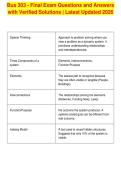
Bus 303 - Final Exam Questions and Answers
with Verified Solutions | Latest Updated 2026
System Thinking Approach to problem solving where you
view a problem as a dynamic system. It
prioritizes understanding relationships
and interdependencies.
Three Components of a Elements, Interconnections,
system Function/Purpose
Elements The easiest part to recognize because
they are often visible or tangible (People,
Buildings)
Interconnections The relationships among the elements
(Networks, Funding flows, Laws)
Function/Purpose the outcome the system produces. A
systems stated goal can be different from
real outcome.
Iceberg Model A tool used to reveal hidden structures.
Suggests that only 10% of the system is
visible.
, Iceberg Model levels 1. Events
2. Patterns/Trends
3. Systemic structures
4. Mental Models
Iceberg Model - Events What Just happened? These are
observable behaviours or one off
incidents (catching a cold)
Iceberg Model - What has been happening over time?
Patterns/Trends Identifying if an event repeats (Catching
more colds when sleeping less)
Iceberg Model - Systemic What is influencing these patterns? These
Structures include Policies, rules, power dynamics,
incentives that shape behaviour (Busy
work schedule leading to low sleep)
Iceberg Model - Mental What assumptions, beliefs and values are
Models held? These are the deepest drivers that
keep a system in place (Belief that ones
"career" is the most important piece of
identity)
Band-Aid Truth Short term solutions ("Band-Aids") may
address an immediate needs but can
compromise long-term progress or
cause new problems
Secondary Research Information gathered from existing
sources like academic papers, blogs, and
organization websites
with Verified Solutions | Latest Updated 2026
System Thinking Approach to problem solving where you
view a problem as a dynamic system. It
prioritizes understanding relationships
and interdependencies.
Three Components of a Elements, Interconnections,
system Function/Purpose
Elements The easiest part to recognize because
they are often visible or tangible (People,
Buildings)
Interconnections The relationships among the elements
(Networks, Funding flows, Laws)
Function/Purpose the outcome the system produces. A
systems stated goal can be different from
real outcome.
Iceberg Model A tool used to reveal hidden structures.
Suggests that only 10% of the system is
visible.
, Iceberg Model levels 1. Events
2. Patterns/Trends
3. Systemic structures
4. Mental Models
Iceberg Model - Events What Just happened? These are
observable behaviours or one off
incidents (catching a cold)
Iceberg Model - What has been happening over time?
Patterns/Trends Identifying if an event repeats (Catching
more colds when sleeping less)
Iceberg Model - Systemic What is influencing these patterns? These
Structures include Policies, rules, power dynamics,
incentives that shape behaviour (Busy
work schedule leading to low sleep)
Iceberg Model - Mental What assumptions, beliefs and values are
Models held? These are the deepest drivers that
keep a system in place (Belief that ones
"career" is the most important piece of
identity)
Band-Aid Truth Short term solutions ("Band-Aids") may
address an immediate needs but can
compromise long-term progress or
cause new problems
Secondary Research Information gathered from existing
sources like academic papers, blogs, and
organization websites


