

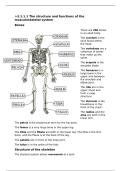
>3.1.1.1 The structure and functions of the
musculoskeletal system
Bones
There are 206 bones
in an adult body.
The cranium is the
skull found within
the head.
The vertebrae are a
collection of bones
that make up the
spine.
The scapula is the
shoulder blade.
The humerus is a
large bone in the
upper arm between
the shoulder and
elbow joint.
The ribs are in the
upper chest and
form a cage
structure.
The sternum is the
breastbone in the
front of the chest.
The radius and the
ulna are both in the
lower arm.
The pelvis is the anatomical term for the hip bone.
The femur is a very large bone in the upper leg.
The tibia and the fibula are both in the lower leg. The tibia is the shin
bone, and the fibula is at the back of the leg.
The patella sits in front of the knee joint.
The talus is in the ankle of the foot.
Structure of the skeleton
The skeletal system allows movement at a joint.
,The shape and type of the bones determine the amount of movement
(short bones enable fine and controlled movements/long bones enable
gross movement)
One of the main roles of the skeleton is to help to provide a framework for
movement.
Long bones allow limb movement and structure.
Short bones provide strength, stability, and support with little
movement.
Flat bones serve as protection for vital organs.
A joint is a connection between two or more bones that allows
movement, there are different types of joints that allow different types of
movement.
The skeleton provides a point of attachment for tendons and muscles.
When muscles contract they pull on the bones to create movement.
Functions of the skeleton
-Support
-Protection
-Movement
-Structural shape and points for attachment
-Mineral storage
-Blood cell production
Bones act as a storage for minerals such as calcium and phosphorus,
which can be released if the body has an essential need for them.
Some bones, such as the femur (long bones), have hollow openings in the
centre. These contain bone marrow.
One of the functions of bone marrow is that it is the site of blood cell
production such as red blood cells and white blood cells.
Red blood cells carry oxygen around the body for respiration and white
blood cells help to fight infection by destroying pathogens.
Muscles of the body
>Latissimus dorsi is positioned in the back and is connected to the
humerus bone in the arm, it helps to move the shoulder and the upper
arm, (Example: important in climbing)
>Deltoid is positioned over the top of the shoulder and helps to raise the
arms
, >Rotator cuffs are the group of muscles that connect to the upper arm
at the shoulder, they help to rotate and extend the shoulder, (Example:
during bowling in cricket or baseball)
>Pectorals are the group of muscles in the front of the chest that
connect to the shoulder, they assist with the movement of the shoulder
and the arm bones, (Example: throwing a ball underhand)
>Biceps are the large muscles in the front of the upper arm, connects to
the lower arm and helps to raise the lower arm causing flexion at the
elbow, (Example: important during lifting)
>Triceps are the large muscles in the back of the upper arm, connects to
the lower arm and helps to straighten the arm causing extension at the
elbow
>Abdominals are the group of muscles located in the lower front of the
body between the ribs and the pelvis bones, they help to stabilise the core
of the body and support the internal organs in that area, assists with
movements such as twisting at the waist, sitting up and bending to the
side
>Hip flexors are the group of muscles that connect around the pelvic
bone, they help to raise/lower and rotate the femur of the upper leg,
(Example: running, kicking sports such as taekwondo and football)
>Gluteals are the muscles of the buttocks, positioned around the outside
of the back of the pelvis bones, help with the movement of the upper leg
and knee joint, (Example: important in cycling and rowing)
>Hamstring group is the group of three muscles in the back of the thigh
in the upper leg, they enable flexion of the leg at the knee
>Quadriceps group is the group of muscles in the front of the thigh in
the upper leg, they straighten the leg causing extension at the knee,
(Example: moving the leg forward in football)
>Gastrocnemius is the muscle found in the calf at the back of the lower
leg, it flexes the knee and foot, essential for the activities of running and
jumping
>Tibialis anterior is the muscle found in the shin at the front of the
lower leg, helps to draw the foot up at the ankle during walking or running
The muscles are
connected to each
bone via
tendons.
musculoskeletal system
Bones
There are 206 bones
in an adult body.
The cranium is the
skull found within
the head.
The vertebrae are a
collection of bones
that make up the
spine.
The scapula is the
shoulder blade.
The humerus is a
large bone in the
upper arm between
the shoulder and
elbow joint.
The ribs are in the
upper chest and
form a cage
structure.
The sternum is the
breastbone in the
front of the chest.
The radius and the
ulna are both in the
lower arm.
The pelvis is the anatomical term for the hip bone.
The femur is a very large bone in the upper leg.
The tibia and the fibula are both in the lower leg. The tibia is the shin
bone, and the fibula is at the back of the leg.
The patella sits in front of the knee joint.
The talus is in the ankle of the foot.
Structure of the skeleton
The skeletal system allows movement at a joint.
,The shape and type of the bones determine the amount of movement
(short bones enable fine and controlled movements/long bones enable
gross movement)
One of the main roles of the skeleton is to help to provide a framework for
movement.
Long bones allow limb movement and structure.
Short bones provide strength, stability, and support with little
movement.
Flat bones serve as protection for vital organs.
A joint is a connection between two or more bones that allows
movement, there are different types of joints that allow different types of
movement.
The skeleton provides a point of attachment for tendons and muscles.
When muscles contract they pull on the bones to create movement.
Functions of the skeleton
-Support
-Protection
-Movement
-Structural shape and points for attachment
-Mineral storage
-Blood cell production
Bones act as a storage for minerals such as calcium and phosphorus,
which can be released if the body has an essential need for them.
Some bones, such as the femur (long bones), have hollow openings in the
centre. These contain bone marrow.
One of the functions of bone marrow is that it is the site of blood cell
production such as red blood cells and white blood cells.
Red blood cells carry oxygen around the body for respiration and white
blood cells help to fight infection by destroying pathogens.
Muscles of the body
>Latissimus dorsi is positioned in the back and is connected to the
humerus bone in the arm, it helps to move the shoulder and the upper
arm, (Example: important in climbing)
>Deltoid is positioned over the top of the shoulder and helps to raise the
arms
, >Rotator cuffs are the group of muscles that connect to the upper arm
at the shoulder, they help to rotate and extend the shoulder, (Example:
during bowling in cricket or baseball)
>Pectorals are the group of muscles in the front of the chest that
connect to the shoulder, they assist with the movement of the shoulder
and the arm bones, (Example: throwing a ball underhand)
>Biceps are the large muscles in the front of the upper arm, connects to
the lower arm and helps to raise the lower arm causing flexion at the
elbow, (Example: important during lifting)
>Triceps are the large muscles in the back of the upper arm, connects to
the lower arm and helps to straighten the arm causing extension at the
elbow
>Abdominals are the group of muscles located in the lower front of the
body between the ribs and the pelvis bones, they help to stabilise the core
of the body and support the internal organs in that area, assists with
movements such as twisting at the waist, sitting up and bending to the
side
>Hip flexors are the group of muscles that connect around the pelvic
bone, they help to raise/lower and rotate the femur of the upper leg,
(Example: running, kicking sports such as taekwondo and football)
>Gluteals are the muscles of the buttocks, positioned around the outside
of the back of the pelvis bones, help with the movement of the upper leg
and knee joint, (Example: important in cycling and rowing)
>Hamstring group is the group of three muscles in the back of the thigh
in the upper leg, they enable flexion of the leg at the knee
>Quadriceps group is the group of muscles in the front of the thigh in
the upper leg, they straighten the leg causing extension at the knee,
(Example: moving the leg forward in football)
>Gastrocnemius is the muscle found in the calf at the back of the lower
leg, it flexes the knee and foot, essential for the activities of running and
jumping
>Tibialis anterior is the muscle found in the shin at the front of the
lower leg, helps to draw the foot up at the ankle during walking or running
The muscles are
connected to each
bone via
tendons.


