

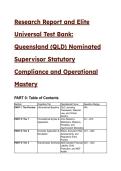
Research Report and Elite
Universal Test Bank:
Queensland (QLD) Nominated
Supervisor Statutory
Compliance and Operational
Mastery
PART 0: Table of Contents
Section Cognitive Tier Operational Focus Question Range
PART I: The Preview Informational Baseline QLD Licensing N/A
Framework, National
Law, and Critical
Axioms
PART II: Tier 1 Foundational Syntax & Core Statutory Q1 – Q10
Application Definitions, Statutory
Penalties, and
Age/Consent Mandates
PART II: Tier 2 Complex Application & Ratios, Excursion Risk Q11 – Q20
Simulation Assessments, and
Regulatory Entry
Powers
PART II: Tier 3 Grandmaster Synthesis Multi-Variable Fiduciary Q21 – Q30
Liability, Child
Protection, and NQF
Audits
,PART I: The Preview
Mastering this evaluative document ensures the direct translation of the Education and Care
Services National Law (Queensland) into elite, reflexive decision-making within early childhood
settings. The exhaustive analysis contained within this assessment forces practitioners to
transcend basic compliance, fostering an academic and operational mastery that neutralizes
complex regulatory hazards and prevents critical systemic failures within top-tier educational
frameworks.
The "Critical Axioms" Statutory Framework:
Regulatory Domain Core Statutory Mandate Operational Implication
The Consent & Age Mandate Explicit Written Consent A Nominated Supervisor must
be at least 18 years of age and
must provide explicit,
documented written consent to
the Approved Provider prior to
assuming statutory
responsibility.
Child Protection 2026 s162A Mandatory Training Effective February 27, 2026, all
Nominated Supervisors must
hold a prescribed child
protection qualification (e.g.,
CHCPRT025) or the
Foundation National Child
Safety Training.
Tripartite Liability Non-Delegable Accountability The National Law places
(s161/s165/s167) shared statutory liability on the
Approved Provider and
Nominated Supervisor for
operating without a supervisor
(s161), failing to supervise
(s165), or failing to mitigate
hazards (s167).
Regulatory Assessment NQF Knowledge Testing The Regulatory Authority
Powers retains the absolute power to
demand a formal written or oral
assessment of a Nominated
Supervisor’s knowledge
regarding the National Quality
Framework (NQF) to determine
fitness.
The Roster Transparency Immediate Public Visibility The service must display a
Rule highly visible Responsible
Person Roster at the main
entrance, definitively stating
who is in day-to-day charge at
any given exact moment.
, PART II: THE ELITE TEST BANK
Q1: An Approved Provider of an Early Childhood Education and Care (ECEC) service in
Queensland verbally appoints a highly experienced Lead Educator to the role of Nominated
Supervisor. The educator verbally accepts and immediately takes day-to-day charge of the
facility. Based on the principles of the Education and Care Services National Law (Queensland),
which conclusion regarding this appointment is the MOST ACCURATE? A) The appointment is
fully compliant provided the educator holds a minimum Diploma-level qualification and an
approved child protection course. B) The appointment is legally binding under the National
Quality Framework if the verbal agreement is witnessed by a second permanent staff member.
C) The appointment is conditionally valid for up to 30 days, pending the submission of a formal
Declaration of Fitness and Propriety to the Regulatory Authority. D) The appointment is invalid
and constitutes a statutory breach, as the individual must provide explicit written consent to the
nomination unless they are the Approved Provider.
● The Answer: D (The appointment is invalid and constitutes a statutory breach, as the
individual must provide explicit written consent to the nomination unless they are the
Approved Provider.)
● Distractor Analysis:
○ A is incorrect: While formal qualifications are necessary, the foundational legal
definition under the National Law explicitly demands documented consent;
qualifications do not override this administrative mandate.
○ B is incorrect: The National Law does not recognize verbally witnessed agreements
for this statutory role; relying on this represents a critical novice misunderstanding
of governance.
○ C is incorrect: There is no 30-day grace period for verbal appointments in the
National Law; compliance must be established prior to the individual assuming legal
responsibilities.
The Mentor's Analysis: The statutory definition of a Nominated Supervisor relies on two
absolute pillars: formal nomination by the Approved Provider and explicit written consent from
the nominee. When establishing governance structures, the immediate priority is securing
legally binding documentation that formally transfers statutory liability. By utilizing the Written
Consent Mandate, the practitioner bypasses the common trap of assuming operational
readiness equates to legal compliance. Professional/Academic Intuition: Statutory roles
require statutory proof; verbal operational agreements carry zero legal weight under the
National Law.
Q2: During a routine compliance audit in mid-March 2026, an Authorized Officer reviews the
personnel files of a Queensland service. The Nominated Supervisor, appointed in 2024,
possesses a valid Working with Children Check (Blue Card) and a Diploma in Early Childhood
Education, but lacks formal, prescribed child protection training. Based on the Queensland
Government Protocol and the National Law, what is the IMMEDIATE compliance status of this
supervisor? A) Compliant, as the individual was appointed prior to 2026 and is grandfathered
into the previous regulatory framework. B) Compliant, because a valid Blue Card supersedes
the requirement for secondary child protection coursework. C) Non-compliant, as all Nominated
Supervisors must hold a prescribed child protection qualification (e.g., CHCPRT025) or
Foundation National Child Safety Training as of February 27, 2026. D) Non-compliant, but the
supervisor is permitted a 90-day administrative waiver to finalize the required online modules
without penalty.
Universal Test Bank:
Queensland (QLD) Nominated
Supervisor Statutory
Compliance and Operational
Mastery
PART 0: Table of Contents
Section Cognitive Tier Operational Focus Question Range
PART I: The Preview Informational Baseline QLD Licensing N/A
Framework, National
Law, and Critical
Axioms
PART II: Tier 1 Foundational Syntax & Core Statutory Q1 – Q10
Application Definitions, Statutory
Penalties, and
Age/Consent Mandates
PART II: Tier 2 Complex Application & Ratios, Excursion Risk Q11 – Q20
Simulation Assessments, and
Regulatory Entry
Powers
PART II: Tier 3 Grandmaster Synthesis Multi-Variable Fiduciary Q21 – Q30
Liability, Child
Protection, and NQF
Audits
,PART I: The Preview
Mastering this evaluative document ensures the direct translation of the Education and Care
Services National Law (Queensland) into elite, reflexive decision-making within early childhood
settings. The exhaustive analysis contained within this assessment forces practitioners to
transcend basic compliance, fostering an academic and operational mastery that neutralizes
complex regulatory hazards and prevents critical systemic failures within top-tier educational
frameworks.
The "Critical Axioms" Statutory Framework:
Regulatory Domain Core Statutory Mandate Operational Implication
The Consent & Age Mandate Explicit Written Consent A Nominated Supervisor must
be at least 18 years of age and
must provide explicit,
documented written consent to
the Approved Provider prior to
assuming statutory
responsibility.
Child Protection 2026 s162A Mandatory Training Effective February 27, 2026, all
Nominated Supervisors must
hold a prescribed child
protection qualification (e.g.,
CHCPRT025) or the
Foundation National Child
Safety Training.
Tripartite Liability Non-Delegable Accountability The National Law places
(s161/s165/s167) shared statutory liability on the
Approved Provider and
Nominated Supervisor for
operating without a supervisor
(s161), failing to supervise
(s165), or failing to mitigate
hazards (s167).
Regulatory Assessment NQF Knowledge Testing The Regulatory Authority
Powers retains the absolute power to
demand a formal written or oral
assessment of a Nominated
Supervisor’s knowledge
regarding the National Quality
Framework (NQF) to determine
fitness.
The Roster Transparency Immediate Public Visibility The service must display a
Rule highly visible Responsible
Person Roster at the main
entrance, definitively stating
who is in day-to-day charge at
any given exact moment.
, PART II: THE ELITE TEST BANK
Q1: An Approved Provider of an Early Childhood Education and Care (ECEC) service in
Queensland verbally appoints a highly experienced Lead Educator to the role of Nominated
Supervisor. The educator verbally accepts and immediately takes day-to-day charge of the
facility. Based on the principles of the Education and Care Services National Law (Queensland),
which conclusion regarding this appointment is the MOST ACCURATE? A) The appointment is
fully compliant provided the educator holds a minimum Diploma-level qualification and an
approved child protection course. B) The appointment is legally binding under the National
Quality Framework if the verbal agreement is witnessed by a second permanent staff member.
C) The appointment is conditionally valid for up to 30 days, pending the submission of a formal
Declaration of Fitness and Propriety to the Regulatory Authority. D) The appointment is invalid
and constitutes a statutory breach, as the individual must provide explicit written consent to the
nomination unless they are the Approved Provider.
● The Answer: D (The appointment is invalid and constitutes a statutory breach, as the
individual must provide explicit written consent to the nomination unless they are the
Approved Provider.)
● Distractor Analysis:
○ A is incorrect: While formal qualifications are necessary, the foundational legal
definition under the National Law explicitly demands documented consent;
qualifications do not override this administrative mandate.
○ B is incorrect: The National Law does not recognize verbally witnessed agreements
for this statutory role; relying on this represents a critical novice misunderstanding
of governance.
○ C is incorrect: There is no 30-day grace period for verbal appointments in the
National Law; compliance must be established prior to the individual assuming legal
responsibilities.
The Mentor's Analysis: The statutory definition of a Nominated Supervisor relies on two
absolute pillars: formal nomination by the Approved Provider and explicit written consent from
the nominee. When establishing governance structures, the immediate priority is securing
legally binding documentation that formally transfers statutory liability. By utilizing the Written
Consent Mandate, the practitioner bypasses the common trap of assuming operational
readiness equates to legal compliance. Professional/Academic Intuition: Statutory roles
require statutory proof; verbal operational agreements carry zero legal weight under the
National Law.
Q2: During a routine compliance audit in mid-March 2026, an Authorized Officer reviews the
personnel files of a Queensland service. The Nominated Supervisor, appointed in 2024,
possesses a valid Working with Children Check (Blue Card) and a Diploma in Early Childhood
Education, but lacks formal, prescribed child protection training. Based on the Queensland
Government Protocol and the National Law, what is the IMMEDIATE compliance status of this
supervisor? A) Compliant, as the individual was appointed prior to 2026 and is grandfathered
into the previous regulatory framework. B) Compliant, because a valid Blue Card supersedes
the requirement for secondary child protection coursework. C) Non-compliant, as all Nominated
Supervisors must hold a prescribed child protection qualification (e.g., CHCPRT025) or
Foundation National Child Safety Training as of February 27, 2026. D) Non-compliant, but the
supervisor is permitted a 90-day administrative waiver to finalize the required online modules
without penalty.


