

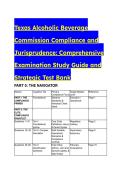
Texas Alcoholic Beverage
Commission Compliance and
Jurisprudence: Comprehensive
Examination Study Guide and
Strategic Test Bank
PART 0: THE NAVIGATOR
Section Cognitive Tier Primary Target Mastery Reference
Compliance Focus Level
PART I: THE Foundational Statutory Executive / Page 1
COMPLIANCE Standards & Operational
PRIMER Analytical Cheat
Sheet
PART II: THE - - - -
ELITE
COMPLIANCE
GAUNTLET
Questions 1–15 Tier 1: Core Code Regulatory Page 2
Foundational Definitions, Hours, Literacy
Syntax & Permit Syntax
Questions 16–35 Tier 2: Complex Multi-Variable Supervisory Page 8
Simulation Operational Autonomy
Scenarios &
Compliance
Controls
Questions 36–60 Tier 3: Dram Shop Fiduciary Page 16
Grandmaster Actions, Joint and Competence
Synthesis Several Liability, &
Safe Harbor
,PART I: THE COMPLIANCE PRIMER
Internalizing this regulatory analysis converts passive legislative knowledge into high-level
operational risk mitigation, protecting retail permits from administrative cancellation and
individual practitioners from personal criminal prosecution. The following framework synthesizes
the structural rules, hours of operation, and liability limits enforced by the Texas Alcoholic
Beverage Commission (TABC).
The "Critical Axioms" Cheat Sheet
● TABC § 106.14 (Safe Harbor Immunity): Protects a permit holder from administrative
penalties if all servers are certified within 30 days of hire, a written responsible-service
policy is actively enforced, no direct or indirect encouragement to overserve exists, and
the location incurs fewer than three violations within any consecutive 12-month period.
● SB 650 (Mandatory Electronic ID Scanning): Effective September 1, 2025, off-premises
retail sellers must electronically scan or read the barcode of any government-issued
identification card presented by an alcohol purchaser who appears to be under 30 years
of age.
● SB 650 Penalties and Exemptions: Failing to scan the ID of a buyer under 40 is a Class
A misdemeanor for the individual clerk. Administrative enforcement by the TABC against
the business's permit commences on September 1, 2027. Legally recognized defenses
include internet connectivity failure, hardware malfunction combined with visual
inspection, or a purchaser who is 40 years of age or older.
● TABC § 2.02 (The Dram Shop Standard): Commercial liability attaches if, at the exact
point of service, it is apparent to the provider that the patron is obviously intoxicated to the
extent that they present a clear danger to themselves and others, and said intoxication is
the proximate cause of the subsequent damages.
● CPRC § 33.001 (Proportionate Responsibility 51% Bar Rule): A plaintiff is completely
barred from recovering any civil damages if their own assigned percentage of negligence
for the injury-causing event is determined by a jury to be 51% or higher.
Standard and Extended Operational Hours in Texas
The table below outlines the precise statutory windows for sales, service, and public
consumption of alcoholic beverages across the state of Texas.
Permit Type / Area Monday – Friday Saturday Sales Sunday Sales Public
Sales Consumption
Prohibited Window
On-Premises 7:00 a.m. – 7:00 a.m. – 1:00 Noon – Midnight 12:15 a.m. – 7:00
Permit (Standard Midnight a.m. (Sunday (10:00 a.m. – a.m. (Sunday: 1:15
Hours Area) morning) Noon legal ONLY a.m. – Noon)
with food)
On-Premises 7:00 a.m. – 2:00 7:00 a.m. – 2:00 Noon – 2:00 a.m. 2:15 a.m. – 7:00
Permit (Late a.m. (Following a.m. (Sunday (10:00 a.m. – a.m. (Sunday: 2:15
Hours Certificate) morning) morning) Noon legal ONLY a.m. – Noon)
with food)
Off-Premises 7:00 a.m. – 7:00 a.m. – 1:00 10:00 a.m. – N/A (Not permitted
,Permit Type / Area Monday – Friday Saturday Sales Sunday Sales Public
Sales Consumption
Prohibited Window
Beer/Wine Permit Midnight a.m. (Sunday Midnight for on-premises
morning) consumption)
Package Store 10:00 a.m. – 9:00 10:00 a.m. – 9:00 Closed N/A (Closed on
Permit (Liquor p.m. p.m. Thanksgiving,
Store) Christmas, New
Year's)
PART II: THE ELITE COMPLIANCE GAUNTLET
Tier 1: Foundational Syntax & Application
Q1: Under the statutory framework of the Texas Alcoholic Beverage Code, which of the
following perfectly matches the definition of an alcoholic beverage, and the dual legal standards
for intoxication? A) Any beverage containing more than 1.0% alcohol by volume, or any person
displaying a blood alcohol concentration of 0.10% or higher. B) Any beverage containing more
than one-half of one percent of alcohol by volume, or any person lacking the normal use of
mental or physical faculties, or having a blood alcohol concentration of 0.08% or higher. C) Any
drink prepared containing distilled spirits, or any customer who cannot maintain physical
balance at a host stand. D) Any liquid fit for human consumption containing more than 3.2%
alcohol by volume, or any person who exhibits slurred speech and bloodshot eyes.
● The Answer: B (Any beverage containing more than one-half of one percent of alcohol
by volume, or any person lacking the normal use of mental or physical faculties, or having
a blood alcohol concentration of 0.08% or higher.)
● Distractor Analysis:
○ A is incorrect: The statutory threshold for an alcoholic beverage is more than 0.5%
by volume, and the legal limit for intoxication is 0.08%, not 0.10%.
○ C is incorrect: This option is restricted to distilled spirits, whereas the statutory
definition covers all products containing more than 0.5% alcohol by volume.
○ D is incorrect: The 3.2% limit is a legacy standard and does not reflect current
Texas statutes.
The Mentor's Analysis: Understanding the statutory thresholds of alcohol volume and physical
impairment is the foundation of defensive service. By utilizing the dual-standard of
intoxication—impaired faculties or a 0.08% blood alcohol concentration—the practitioner avoids
relying solely on blood chemistry. Professional/Academic Intuition: Statutory liability begins
at 0.5% alcohol by volume, and legal intoxication is triggered by the loss of normal
physical or mental faculties or a 0.08% blood alcohol concentration.
Double-space
Q2: A grocery store holds a Retail Dealer’s Off-Premise License (BF). Under Texas child labor
and alcohol service regulations, what is the minimum age required for an employee to operate
as a cashier and ring up beer and wine sales? A) 18 years of age. B) 21 years of age. C) 16
years of age. D) There is no statutory minimum age requirement.
● The Answer: D (There is no statutory minimum age requirement.)
● Distractor Analysis:
○ A is incorrect: The 18-year-old threshold applies to on-premises servers,
bartenders, and handlers, not off-premises beer and wine cashiers.
, ○ B is incorrect: The 21-year-old limit applies specifically to Package Store Permits
where liquor is sold, not grocery or convenience store off-premises permits.
○ C is incorrect: The 16-year-old limit applies to Wine-Only Package Store Permits,
whereas standard off-premises beer and wine permits have no state-mandated age
floor for cashiers.
The Mentor's Analysis: Permissive age variations are highly dependent on the category of the
TABC permit held by the business. By utilizing the complete exemption for off-premises beer
and wine retail permits, the operator avoids applying on-premises age minimums to grocery
store checkout lanes. Professional/Academic Intuition: No minimum age requirement is
imposed on employees ringing up beer or wine sales for off-premises consumption
under a standard retail dealer's license.
Double-space
Q3: A standard restaurant holds a Mixed Beverage Permit and does not possess a late-hours
certificate. During what specific hours on Sunday can the establishment legally sell and serve
mixed beverages for on-premises consumption? A) From 10:00 a.m. until midnight, provided the
beverage is served alongside food, and from noon until midnight regardless of food service. B)
From 7:00 a.m. until 1:00 a.m. the following Monday morning, with no food restrictions. C) From
noon until 2:00 a.m. the following Monday morning, provided a certified manager is on duty. D)
From 10:00 a.m. until 10:00 p.m., as long as the kitchen remains open during all hours of
service.
● The Answer: A (From 10:00 a.m. until midnight, provided the beverage is served
alongside food, and from noon until midnight regardless of food service.)
● Distractor Analysis:
○ B is incorrect: The 7:00 a.m. start time is limited to Monday through Saturday;
Sunday morning service before noon is strictly regulated.
○ C is incorrect: Late-hours operation until 2:00 a.m. requires a subordinate
late-hours certificate, which this establishment does not hold.
○ D is incorrect: The terminal hour for standard Sunday service is midnight, not 10:00
p.m., and food service is only a requirement between 10:00 a.m. and noon.
The Mentor's Analysis: Sunday morning alcohol service requires strict operational sync
between the kitchen and the bar. By utilizing the food-pairing exception between 10:00 a.m. and
noon, the establishment avoids delaying all Sunday service until midday.
Professional/Academic Intuition: Alcohol service on Sundays between 10:00 a.m. and
noon is legal if, and only if, the beverage is served alongside food ordered by the
customer.
Double-space
Q4: A package store operates under a Package Store Permit (P) in Texas. On which of the
following days is the store legally prohibited from opening its doors to sell distilled spirits? A)
Sundays, Thanksgiving Day, Christmas Day, and New Year's Day. B) Sundays and federal
holidays only, with no specific calendar exceptions. C) Sundays, Memorial Day, Christmas Day,
and New Year's Day. D) Election Days, Sundays, Thanksgiving Day, and Christmas Day.
● The Answer: A (Sundays, Thanksgiving Day, Christmas Day, and New Year's Day.)
● Distractor Analysis:
○ B is incorrect: Package stores are not closed on all federal holidays, but they are
closed on Thanksgiving, Christmas, and New Year's Day.
○ C is incorrect: Memorial Day is not a mandated closure day for package store
permits.
○ D is incorrect: Under current Texas legislation, alcohol sales are completely legal on
Commission Compliance and
Jurisprudence: Comprehensive
Examination Study Guide and
Strategic Test Bank
PART 0: THE NAVIGATOR
Section Cognitive Tier Primary Target Mastery Reference
Compliance Focus Level
PART I: THE Foundational Statutory Executive / Page 1
COMPLIANCE Standards & Operational
PRIMER Analytical Cheat
Sheet
PART II: THE - - - -
ELITE
COMPLIANCE
GAUNTLET
Questions 1–15 Tier 1: Core Code Regulatory Page 2
Foundational Definitions, Hours, Literacy
Syntax & Permit Syntax
Questions 16–35 Tier 2: Complex Multi-Variable Supervisory Page 8
Simulation Operational Autonomy
Scenarios &
Compliance
Controls
Questions 36–60 Tier 3: Dram Shop Fiduciary Page 16
Grandmaster Actions, Joint and Competence
Synthesis Several Liability, &
Safe Harbor
,PART I: THE COMPLIANCE PRIMER
Internalizing this regulatory analysis converts passive legislative knowledge into high-level
operational risk mitigation, protecting retail permits from administrative cancellation and
individual practitioners from personal criminal prosecution. The following framework synthesizes
the structural rules, hours of operation, and liability limits enforced by the Texas Alcoholic
Beverage Commission (TABC).
The "Critical Axioms" Cheat Sheet
● TABC § 106.14 (Safe Harbor Immunity): Protects a permit holder from administrative
penalties if all servers are certified within 30 days of hire, a written responsible-service
policy is actively enforced, no direct or indirect encouragement to overserve exists, and
the location incurs fewer than three violations within any consecutive 12-month period.
● SB 650 (Mandatory Electronic ID Scanning): Effective September 1, 2025, off-premises
retail sellers must electronically scan or read the barcode of any government-issued
identification card presented by an alcohol purchaser who appears to be under 30 years
of age.
● SB 650 Penalties and Exemptions: Failing to scan the ID of a buyer under 40 is a Class
A misdemeanor for the individual clerk. Administrative enforcement by the TABC against
the business's permit commences on September 1, 2027. Legally recognized defenses
include internet connectivity failure, hardware malfunction combined with visual
inspection, or a purchaser who is 40 years of age or older.
● TABC § 2.02 (The Dram Shop Standard): Commercial liability attaches if, at the exact
point of service, it is apparent to the provider that the patron is obviously intoxicated to the
extent that they present a clear danger to themselves and others, and said intoxication is
the proximate cause of the subsequent damages.
● CPRC § 33.001 (Proportionate Responsibility 51% Bar Rule): A plaintiff is completely
barred from recovering any civil damages if their own assigned percentage of negligence
for the injury-causing event is determined by a jury to be 51% or higher.
Standard and Extended Operational Hours in Texas
The table below outlines the precise statutory windows for sales, service, and public
consumption of alcoholic beverages across the state of Texas.
Permit Type / Area Monday – Friday Saturday Sales Sunday Sales Public
Sales Consumption
Prohibited Window
On-Premises 7:00 a.m. – 7:00 a.m. – 1:00 Noon – Midnight 12:15 a.m. – 7:00
Permit (Standard Midnight a.m. (Sunday (10:00 a.m. – a.m. (Sunday: 1:15
Hours Area) morning) Noon legal ONLY a.m. – Noon)
with food)
On-Premises 7:00 a.m. – 2:00 7:00 a.m. – 2:00 Noon – 2:00 a.m. 2:15 a.m. – 7:00
Permit (Late a.m. (Following a.m. (Sunday (10:00 a.m. – a.m. (Sunday: 2:15
Hours Certificate) morning) morning) Noon legal ONLY a.m. – Noon)
with food)
Off-Premises 7:00 a.m. – 7:00 a.m. – 1:00 10:00 a.m. – N/A (Not permitted
,Permit Type / Area Monday – Friday Saturday Sales Sunday Sales Public
Sales Consumption
Prohibited Window
Beer/Wine Permit Midnight a.m. (Sunday Midnight for on-premises
morning) consumption)
Package Store 10:00 a.m. – 9:00 10:00 a.m. – 9:00 Closed N/A (Closed on
Permit (Liquor p.m. p.m. Thanksgiving,
Store) Christmas, New
Year's)
PART II: THE ELITE COMPLIANCE GAUNTLET
Tier 1: Foundational Syntax & Application
Q1: Under the statutory framework of the Texas Alcoholic Beverage Code, which of the
following perfectly matches the definition of an alcoholic beverage, and the dual legal standards
for intoxication? A) Any beverage containing more than 1.0% alcohol by volume, or any person
displaying a blood alcohol concentration of 0.10% or higher. B) Any beverage containing more
than one-half of one percent of alcohol by volume, or any person lacking the normal use of
mental or physical faculties, or having a blood alcohol concentration of 0.08% or higher. C) Any
drink prepared containing distilled spirits, or any customer who cannot maintain physical
balance at a host stand. D) Any liquid fit for human consumption containing more than 3.2%
alcohol by volume, or any person who exhibits slurred speech and bloodshot eyes.
● The Answer: B (Any beverage containing more than one-half of one percent of alcohol
by volume, or any person lacking the normal use of mental or physical faculties, or having
a blood alcohol concentration of 0.08% or higher.)
● Distractor Analysis:
○ A is incorrect: The statutory threshold for an alcoholic beverage is more than 0.5%
by volume, and the legal limit for intoxication is 0.08%, not 0.10%.
○ C is incorrect: This option is restricted to distilled spirits, whereas the statutory
definition covers all products containing more than 0.5% alcohol by volume.
○ D is incorrect: The 3.2% limit is a legacy standard and does not reflect current
Texas statutes.
The Mentor's Analysis: Understanding the statutory thresholds of alcohol volume and physical
impairment is the foundation of defensive service. By utilizing the dual-standard of
intoxication—impaired faculties or a 0.08% blood alcohol concentration—the practitioner avoids
relying solely on blood chemistry. Professional/Academic Intuition: Statutory liability begins
at 0.5% alcohol by volume, and legal intoxication is triggered by the loss of normal
physical or mental faculties or a 0.08% blood alcohol concentration.
Double-space
Q2: A grocery store holds a Retail Dealer’s Off-Premise License (BF). Under Texas child labor
and alcohol service regulations, what is the minimum age required for an employee to operate
as a cashier and ring up beer and wine sales? A) 18 years of age. B) 21 years of age. C) 16
years of age. D) There is no statutory minimum age requirement.
● The Answer: D (There is no statutory minimum age requirement.)
● Distractor Analysis:
○ A is incorrect: The 18-year-old threshold applies to on-premises servers,
bartenders, and handlers, not off-premises beer and wine cashiers.
, ○ B is incorrect: The 21-year-old limit applies specifically to Package Store Permits
where liquor is sold, not grocery or convenience store off-premises permits.
○ C is incorrect: The 16-year-old limit applies to Wine-Only Package Store Permits,
whereas standard off-premises beer and wine permits have no state-mandated age
floor for cashiers.
The Mentor's Analysis: Permissive age variations are highly dependent on the category of the
TABC permit held by the business. By utilizing the complete exemption for off-premises beer
and wine retail permits, the operator avoids applying on-premises age minimums to grocery
store checkout lanes. Professional/Academic Intuition: No minimum age requirement is
imposed on employees ringing up beer or wine sales for off-premises consumption
under a standard retail dealer's license.
Double-space
Q3: A standard restaurant holds a Mixed Beverage Permit and does not possess a late-hours
certificate. During what specific hours on Sunday can the establishment legally sell and serve
mixed beverages for on-premises consumption? A) From 10:00 a.m. until midnight, provided the
beverage is served alongside food, and from noon until midnight regardless of food service. B)
From 7:00 a.m. until 1:00 a.m. the following Monday morning, with no food restrictions. C) From
noon until 2:00 a.m. the following Monday morning, provided a certified manager is on duty. D)
From 10:00 a.m. until 10:00 p.m., as long as the kitchen remains open during all hours of
service.
● The Answer: A (From 10:00 a.m. until midnight, provided the beverage is served
alongside food, and from noon until midnight regardless of food service.)
● Distractor Analysis:
○ B is incorrect: The 7:00 a.m. start time is limited to Monday through Saturday;
Sunday morning service before noon is strictly regulated.
○ C is incorrect: Late-hours operation until 2:00 a.m. requires a subordinate
late-hours certificate, which this establishment does not hold.
○ D is incorrect: The terminal hour for standard Sunday service is midnight, not 10:00
p.m., and food service is only a requirement between 10:00 a.m. and noon.
The Mentor's Analysis: Sunday morning alcohol service requires strict operational sync
between the kitchen and the bar. By utilizing the food-pairing exception between 10:00 a.m. and
noon, the establishment avoids delaying all Sunday service until midday.
Professional/Academic Intuition: Alcohol service on Sundays between 10:00 a.m. and
noon is legal if, and only if, the beverage is served alongside food ordered by the
customer.
Double-space
Q4: A package store operates under a Package Store Permit (P) in Texas. On which of the
following days is the store legally prohibited from opening its doors to sell distilled spirits? A)
Sundays, Thanksgiving Day, Christmas Day, and New Year's Day. B) Sundays and federal
holidays only, with no specific calendar exceptions. C) Sundays, Memorial Day, Christmas Day,
and New Year's Day. D) Election Days, Sundays, Thanksgiving Day, and Christmas Day.
● The Answer: A (Sundays, Thanksgiving Day, Christmas Day, and New Year's Day.)
● Distractor Analysis:
○ B is incorrect: Package stores are not closed on all federal holidays, but they are
closed on Thanksgiving, Christmas, and New Year's Day.
○ C is incorrect: Memorial Day is not a mandated closure day for package store
permits.
○ D is incorrect: Under current Texas legislation, alcohol sales are completely legal on


