

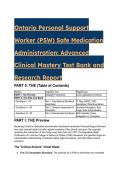
Ontario Personal Support
Worker (PSW) Safe Medication
Administration: Advanced
Clinical Mastery Test Bank and
Research Report
PART 0: THE (Table of Contents)
Section Cognitive Tier Page/Focus
PART I: The Preview Strategic Framework Core Legislation & Axioms
PART II: The Elite Test Bank
- Questions 1–10 Tier 1: Foundational Syntax & O. Reg 246/22, CNO
Application Guidelines, Role Boundaries
- Questions 11–20 Tier 2: Complex Application & Scenario Navigation, Red
Simulation Flags, Safe Administration
- Questions 21–30 Tier 3: Grandmaster Synthesis Multi-Variable Crises,
Delegation vs. Exception
PART I: THE Preview
Mastering Ontario's medication administration framework transforms Personal Support Workers
from task-oriented aides into elite, vigilant members of the clinical care team. By surgically
analyzing the intersection of the Fixing Long-Term Care Act, 2021, the Regulated Health
Professions Act, and the College of Nurses of Ontario (CNO) standards, this gauntlet forges an
impenetrable understanding of systemic safety, legal boundaries, and high-stakes clinical
execution.
The "Critical Axioms" Cheat Sheet
● The LTC Geographic Boundary: The authority for a PSW to administer non-controlled
, medications is strictly confined to Long-Term Care (LTC) homes under O. Reg 246/22. In
community or home-care settings, the role reverts entirely to medication assistance.
● The "Controlled Act" Hard Stop: A PSW is strictly prohibited from administering
medications via injection (e.g., insulin) or inhalation (e.g., oxygen). These are controlled
acts under the Regulated Health Professions Act, 1991 and are explicitly barred from
PSW administration by Ministry of Long-Term Care (MLTC) directives.
● The Controlled Substance Ban: PSWs cannot, under any circumstances, administer
narcotics, opioids, or designated high-alert medications. These remain the exclusive
jurisdiction of regulated health professionals.
● The Shield of Accountability: When a Registered Nurse (RN) or Registered Practical
Nurse (RPN) assigns a medication task, the nurse retains accountability for the
assessment and evaluation. The PSW is accountable exclusively for safely executing the
assigned task, documenting it, and reporting deviations.
● The Right of Refusal: A resident possesses the absolute right to refuse medication. The
PSW's mandate is never to coerce, but to immediately document the refusal and report it
to the supervising nurse.
Framework Synthesis: Assistance vs. Administration
To eliminate ambiguity, the following table delineates the absolute boundaries between
supporting self-care and performing a regulated health intervention under current Ontario
guidelines.
Clinical Action Medication Assistance (All Medication Administration (LTC
Settings) Exception Only)
Preparation Handing a pre-packaged Obtaining the dose from a
dosette to the client. monitored dosage system.
Physical Delivery Client places the pill in their PSW places the pill into the
own mouth. resident's mouth.
Documentation Documenting the assistance Signing the formal Medication
provided. Administration Record (MAR).
Topical Agents Reminding client to apply their PSW physically applying
own cream. prescribed medicinal creams.
Legal Authority Unregulated standard of care. Explicitly assigned by an
RN/RPN under O. Reg 246/22.
PART II: THE ELITE TEST BANK
Tier 1: Foundational Syntax & Application
Q1: A PSW is hired to work in a client's private residence through a community home-care
agency. The client’s daughter asks the PSW to dispense her father's daily dose of Ramipril
directly from the pharmacy's prescription bottle. Based on the General Scope of PSW Practice,
which action is the MOST ACCURATE? A) Dispense the medication into a small cup, ensure
the client swallows it, and document the administration. B) Dispense the medication into a
dosette box for the week to ensure the client does not miss future doses. C) Refuse to dispense
the medication, as PSWs in the community may only assist with pre-packaged medications
prepared by a family member or regulated professional. D) Administer the medication, provided
the PSW has completed an employer-sponsored pharmacology training course.
, ● The Answer: C (Refuse to dispense the medication, as PSWs in the community may only
assist with pre-packaged medications prepared by a family member or regulated
professional.)
● Distractor Analysis:
○ A is incorrect: Dispensing directly from a prescription bottle constitutes medication
administration, which is prohibited for PSWs in community settings.
○ B is incorrect: Placing medications into a dosette or preparing them for future use is
strictly outside the unregulated provider scope of practice.
○ D is incorrect: Employer training does not override provincial legislation; the O. Reg
246/22 exception applies exclusively to Long-Term Care homes, not private
residences.
The Mentor's Analysis: The legislative origin of this boundary stems from the inherent lack of
systemic oversight in isolated home environments. Unlike an LTC facility with a closed-loop
pharmacy and on-site RN supervision, community settings rely on the family or community
nursing network to prepare dosages. The mechanism of medication assistance is designed
purely to support physical dexterity and memory, not to engage in pharmacological dispensing.
As the aging-in-place movement expands, the future outlook will likely see more pressure on
community PSWs, making this boundary even more critical. When operating in the community,
the immediate priority is maintaining the boundary of medication assistance. By utilizing
pre-packaged monitored dosage systems, you bypass the common trap of accidental
dispensing. Professional/Academic Intuition: In the community, you assist; you do not
dispense, prepare, or administer.
Q2: Under the Fixing Long-Term Care Act, 2021 (O. Reg 246/22), a Long-Term Care facility
authorizes trained PSWs to administer medications. Which of the following medications is a
PSW legally permitted to administer under this regulation? A) Subcutaneous Insulin (Humalog)
for a stable diabetic resident. B) Oral Acetaminophen (Tylenol) for mild joint pain, as assigned
by an RPN. C) Liquid Morphine (Statex) for a palliative resident experiencing breakthrough pain.
D) Aerosolized Salbutamol (Ventolin) via a metered-dose inhaler for a resident with asthma.
● The Answer: B (Oral Acetaminophen (Tylenol) for mild joint pain, as assigned by an
RPN.)
● Distractor Analysis:
○ A is incorrect: Injections are a controlled act under the RHPA and are strictly
prohibited for PSW administration by MLTC directives, regardless of resident
stability.
○ C is incorrect: Morphine is a controlled substance (narcotic). PSWs are forbidden
from administering narcotics, opioids, or high-alert medications.
○ D is incorrect: Administering a substance by inhalation is a controlled act and is
explicitly prohibited.
The Mentor's Analysis: The legal architecture of O. Reg 246/22 was designed to alleviate
nursing shortages by authorizing UCPs to handle low-risk, high-volume tasks, while strictly
firewalling high-risk interventions. The mechanism of restriction targets both the route of
administration (breaching the dermis or airway) and the chemical classification (narcotics). The
future outlook indicates that while PSW responsibilities will grow, the barrier against controlled
acts will remain absolute to protect public safety. When identifying authorized tasks, the
immediate priority is ruling out controlled acts and controlled substances. By utilizing the
non-controlled oral/topical rule, you bypass the common trap of assuming general
pharmacology training grants universal administration rights. Professional/Academic Intuition:
No needles, no inhalers, no narcotics. Ever.
Worker (PSW) Safe Medication
Administration: Advanced
Clinical Mastery Test Bank and
Research Report
PART 0: THE (Table of Contents)
Section Cognitive Tier Page/Focus
PART I: The Preview Strategic Framework Core Legislation & Axioms
PART II: The Elite Test Bank
- Questions 1–10 Tier 1: Foundational Syntax & O. Reg 246/22, CNO
Application Guidelines, Role Boundaries
- Questions 11–20 Tier 2: Complex Application & Scenario Navigation, Red
Simulation Flags, Safe Administration
- Questions 21–30 Tier 3: Grandmaster Synthesis Multi-Variable Crises,
Delegation vs. Exception
PART I: THE Preview
Mastering Ontario's medication administration framework transforms Personal Support Workers
from task-oriented aides into elite, vigilant members of the clinical care team. By surgically
analyzing the intersection of the Fixing Long-Term Care Act, 2021, the Regulated Health
Professions Act, and the College of Nurses of Ontario (CNO) standards, this gauntlet forges an
impenetrable understanding of systemic safety, legal boundaries, and high-stakes clinical
execution.
The "Critical Axioms" Cheat Sheet
● The LTC Geographic Boundary: The authority for a PSW to administer non-controlled
, medications is strictly confined to Long-Term Care (LTC) homes under O. Reg 246/22. In
community or home-care settings, the role reverts entirely to medication assistance.
● The "Controlled Act" Hard Stop: A PSW is strictly prohibited from administering
medications via injection (e.g., insulin) or inhalation (e.g., oxygen). These are controlled
acts under the Regulated Health Professions Act, 1991 and are explicitly barred from
PSW administration by Ministry of Long-Term Care (MLTC) directives.
● The Controlled Substance Ban: PSWs cannot, under any circumstances, administer
narcotics, opioids, or designated high-alert medications. These remain the exclusive
jurisdiction of regulated health professionals.
● The Shield of Accountability: When a Registered Nurse (RN) or Registered Practical
Nurse (RPN) assigns a medication task, the nurse retains accountability for the
assessment and evaluation. The PSW is accountable exclusively for safely executing the
assigned task, documenting it, and reporting deviations.
● The Right of Refusal: A resident possesses the absolute right to refuse medication. The
PSW's mandate is never to coerce, but to immediately document the refusal and report it
to the supervising nurse.
Framework Synthesis: Assistance vs. Administration
To eliminate ambiguity, the following table delineates the absolute boundaries between
supporting self-care and performing a regulated health intervention under current Ontario
guidelines.
Clinical Action Medication Assistance (All Medication Administration (LTC
Settings) Exception Only)
Preparation Handing a pre-packaged Obtaining the dose from a
dosette to the client. monitored dosage system.
Physical Delivery Client places the pill in their PSW places the pill into the
own mouth. resident's mouth.
Documentation Documenting the assistance Signing the formal Medication
provided. Administration Record (MAR).
Topical Agents Reminding client to apply their PSW physically applying
own cream. prescribed medicinal creams.
Legal Authority Unregulated standard of care. Explicitly assigned by an
RN/RPN under O. Reg 246/22.
PART II: THE ELITE TEST BANK
Tier 1: Foundational Syntax & Application
Q1: A PSW is hired to work in a client's private residence through a community home-care
agency. The client’s daughter asks the PSW to dispense her father's daily dose of Ramipril
directly from the pharmacy's prescription bottle. Based on the General Scope of PSW Practice,
which action is the MOST ACCURATE? A) Dispense the medication into a small cup, ensure
the client swallows it, and document the administration. B) Dispense the medication into a
dosette box for the week to ensure the client does not miss future doses. C) Refuse to dispense
the medication, as PSWs in the community may only assist with pre-packaged medications
prepared by a family member or regulated professional. D) Administer the medication, provided
the PSW has completed an employer-sponsored pharmacology training course.
, ● The Answer: C (Refuse to dispense the medication, as PSWs in the community may only
assist with pre-packaged medications prepared by a family member or regulated
professional.)
● Distractor Analysis:
○ A is incorrect: Dispensing directly from a prescription bottle constitutes medication
administration, which is prohibited for PSWs in community settings.
○ B is incorrect: Placing medications into a dosette or preparing them for future use is
strictly outside the unregulated provider scope of practice.
○ D is incorrect: Employer training does not override provincial legislation; the O. Reg
246/22 exception applies exclusively to Long-Term Care homes, not private
residences.
The Mentor's Analysis: The legislative origin of this boundary stems from the inherent lack of
systemic oversight in isolated home environments. Unlike an LTC facility with a closed-loop
pharmacy and on-site RN supervision, community settings rely on the family or community
nursing network to prepare dosages. The mechanism of medication assistance is designed
purely to support physical dexterity and memory, not to engage in pharmacological dispensing.
As the aging-in-place movement expands, the future outlook will likely see more pressure on
community PSWs, making this boundary even more critical. When operating in the community,
the immediate priority is maintaining the boundary of medication assistance. By utilizing
pre-packaged monitored dosage systems, you bypass the common trap of accidental
dispensing. Professional/Academic Intuition: In the community, you assist; you do not
dispense, prepare, or administer.
Q2: Under the Fixing Long-Term Care Act, 2021 (O. Reg 246/22), a Long-Term Care facility
authorizes trained PSWs to administer medications. Which of the following medications is a
PSW legally permitted to administer under this regulation? A) Subcutaneous Insulin (Humalog)
for a stable diabetic resident. B) Oral Acetaminophen (Tylenol) for mild joint pain, as assigned
by an RPN. C) Liquid Morphine (Statex) for a palliative resident experiencing breakthrough pain.
D) Aerosolized Salbutamol (Ventolin) via a metered-dose inhaler for a resident with asthma.
● The Answer: B (Oral Acetaminophen (Tylenol) for mild joint pain, as assigned by an
RPN.)
● Distractor Analysis:
○ A is incorrect: Injections are a controlled act under the RHPA and are strictly
prohibited for PSW administration by MLTC directives, regardless of resident
stability.
○ C is incorrect: Morphine is a controlled substance (narcotic). PSWs are forbidden
from administering narcotics, opioids, or high-alert medications.
○ D is incorrect: Administering a substance by inhalation is a controlled act and is
explicitly prohibited.
The Mentor's Analysis: The legal architecture of O. Reg 246/22 was designed to alleviate
nursing shortages by authorizing UCPs to handle low-risk, high-volume tasks, while strictly
firewalling high-risk interventions. The mechanism of restriction targets both the route of
administration (breaching the dermis or airway) and the chemical classification (narcotics). The
future outlook indicates that while PSW responsibilities will grow, the barrier against controlled
acts will remain absolute to protect public safety. When identifying authorized tasks, the
immediate priority is ruling out controlled acts and controlled substances. By utilizing the
non-controlled oral/topical rule, you bypass the common trap of assuming general
pharmacology training grants universal administration rights. Professional/Academic Intuition:
No needles, no inhalers, no narcotics. Ever.


