

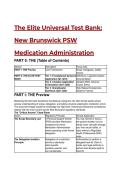
The Elite Universal Test Bank:
New Brunswick PSW
Medication Administration
PART 0: THE (Table of Contents)
Section Description Focus Area
PART I: THE Preview Core Frameworks Scope, Delegation, Safety
Axioms
PART II: THE ELITE TEST Tier 1: Foundational Syntax & Definitions, Legal Boundaries,
BANK Application (Q1–Q10) Documentation
Tier 2: Complex Application Variable Shifts, Adverse
& Simulation (Q11–Q20) Events, Ethics
Tier 3: Grandmaster High-Stakes Emergencies,
Synthesis (Q21–Q30) Systemic Failures
PART I: THE Preview
Mastering this test bank transforms foundational caregivers into elite clinical assets whose
precise understanding of scope, delegation, and safety prevents catastrophic medication errors.
This document forges academic knowledge into high-level, instinctual professional competence
aligned with the most current top-tier New Brunswick regulatory standards.
The "Critical Axioms" Cheat Sheet
Axiom Regulatory Principle Clinical Application
The Scope Boundary Law A Personal Support Worker You may remind or hand a
(PSW) provides Medication pre-poured dosette, but you
Assistance but never strictly never calculate dosage,
Medication Administration pour from stock bottles, or
unless operating under formal inject without a Regulated
delegation. Health Professional (RHP)
order.
The Delegation Isolation Delegation of a restricted Authorization to perform a
Principle activity is absolutely delegated task for Client A
client-specific, grants zero legal authority to
condition-specific, and perform that identical task for
non-transferable. Client B.
,Axiom Regulatory Principle Clinical Application
The "Three Checks & Ten While RHPs own the clinical You must verify Right Client,
Rights" assessment, the PSW is legally Right Medication, Right Time,
accountable for verifying the Right Route, and Right Dose
administration rights before against the Medication
facilitating intake. Administration Record (MAR).
The Anti-Alteration Mandate An Unregulated Care Provider Crushing tablets, opening
(UCP) must never alter the capsules, or cutting patches
form of a medication without destroys pharmacokinetic
explicit, documented RHP design and is strictly prohibited
authorization. without a matching MAR
directive.
PART II: THE ELITE TEST BANK
Tier 1: Foundational Syntax & Application
Q1: A Personal Support Worker (PSW) is providing home support to an elderly client under the
New Brunswick Social Development guidelines. The client’s daughter has left a combination of
loose, unidentified tablets in a generic plastic cup on the kitchen counter and asks the PSW to
give them to the client after breakfast. Based on the principles of Medication Assistance, which
action is the MOST APPROPRIATE? A) Administer the medications, ensuring to document the
daughter's verbal authorization meticulously in the client's care record to maintain liability
protection. B) Compare the loose tablets visually against a verified pill identification chart before
assisting the client with intake to ensure pharmacological accuracy. C) Refuse to hand the cup
to the client, as PSWs may only assist with medications prepared in a properly scheduled
receptacle by a family member or pharmacist. D) Ask the client to identify the pills; if the client is
cognitively intact and confirms their identity, provide verbal prompting to take them.
● The Answer: C (Refuse to hand the cup to the client, as PSWs may only assist with
medications prepared in a properly scheduled receptacle by a family member or
pharmacist.)
● Distractor Analysis:
○ A is incorrect: Verbal authorization from a family member does not override the
strict regulatory prohibition against assisting with unverified, improperly stored
medications, as this falls outside the legal framework of the Regulated Health
Professions Act (RHPA).
○ B is incorrect: Visual identification of loose pills constitutes a pharmacological
assessment, which is entirely outside the Unregulated Care Provider (UCP) scope
of practice.
○ D is incorrect: Relying on a client's visual identification of unsealed, unscheduled
medications introduces extreme risk and violates standard handling protocols,
regardless of the client's cognitive baseline.
The Mentor's Analysis: Medication assistance requires absolute certainty of origin. When
facing unidentified drugs, the immediate priority is protecting the client from accidental poisoning
or contraindications. By utilizing properly scheduled receptacles (like a dosette or blister pack),
you bypass the common trap of blindly trusting informal family instructions.
Professional/Academic Intuition: If the medication is not locked in a verified, scheduled
matrix, the UCP's hands do not touch it.
, Q2: A Registered Nurse (RN) delegates the administration of a routine, stable subcutaneous
insulin injection to a PSW for a specific long-term care resident. The next day, a different
resident with the exact same condition requires an identical insulin dosage, but the RN is on
break. Based on the NANB/ANBLPN Practice Guidelines for Delegation, which action is the
MOST ACCURATE? A) Administer the insulin to the second resident, as the PSW has already
been deemed clinically competent in this specific subcutaneous skill. B) Delay the
administration until the RN returns, as delegation is strictly client-specific and non-transferable
under all circumstances. C) Administer the insulin but require a second PSW to provide an
independent double-check of the dosage to satisfy safety requirements. D) Contact the
pharmacy for a verbal order to proceed with the administration for the second resident to avoid
disrupting the glycemic schedule.
● The Answer: B (Delay the administration until the RN returns, as delegation is strictly
client-specific and non-transferable under all circumstances.)
● Distractor Analysis:
○ A is incorrect: Competency in a physical skill does not grant blanket clinical
authorization. Delegation is based on a specific client's health stability and
predictability of outcomes, not just the UCP's mechanical ability.
○ C is incorrect: Two UCPs cannot bypass the legal requirement for RHP delegation.
An independent double-check by an unauthorized provider holds no legal weight in
New Brunswick jurisprudence.
○ D is incorrect: Pharmacists dispense medications and can prescribe in specific
scopes, but they do not delegate nursing acts to facility UCPs over the phone.
The Mentor's Analysis: Authority in healthcare is highly individualized. When operating under
a delegated act, the immediate priority is restricting interventions to the exact parameters of that
specific contract. By understanding that delegation is non-transferable, you bypass the common
trap of assuming technical skill equals broad legal authorization. Professional/Academic
Intuition: Delegation belongs to the client's unique care plan, not to the caregiver's general
resume.
Q3: During a morning shift, a client requests an over-the-counter (OTC) mild analgesic for a
headache. The medication is in its original, factory-sealed bottle but is NOT listed on the client's
Medication Administration Record (MAR). Based on the General Scope of PSW Practice, which
action is the FIRST appropriate response? A) Assist the client in opening the bottle, as OTC
medications are inherently exempt from MAR requirements due to their public availability. B)
Deny the request entirely and inform the client that they must wait for a physician's visit to obtain
a prescription. C) Withhold the medication and immediately contact the supervising RN or LPN
for assessment and clinical direction. D) Dispense one standard dose to the client but leave a
written note for the RN to update the MAR retroactively.
● The Answer: C (Withhold the medication and immediately contact the supervising RN or
LPN for assessment and clinical direction.)
● Distractor Analysis:
○ A is incorrect: OTC medications are still classified as pharmacological substances
and can cause severe interactions; they are never exempt from proper
documentation and RHP oversight in a formal care setting.
○ B is incorrect: Outright denial without seeking RHP consultation fails to advocate for
the client's comfort and ignores the RN's role in symptom management.
○ D is incorrect: A PSW is legally forbidden from dispensing medication directly from
a stock or prescription bottle, regardless of whether the drug is OTC, and
retroactive charting is an invalid practice.
New Brunswick PSW
Medication Administration
PART 0: THE (Table of Contents)
Section Description Focus Area
PART I: THE Preview Core Frameworks Scope, Delegation, Safety
Axioms
PART II: THE ELITE TEST Tier 1: Foundational Syntax & Definitions, Legal Boundaries,
BANK Application (Q1–Q10) Documentation
Tier 2: Complex Application Variable Shifts, Adverse
& Simulation (Q11–Q20) Events, Ethics
Tier 3: Grandmaster High-Stakes Emergencies,
Synthesis (Q21–Q30) Systemic Failures
PART I: THE Preview
Mastering this test bank transforms foundational caregivers into elite clinical assets whose
precise understanding of scope, delegation, and safety prevents catastrophic medication errors.
This document forges academic knowledge into high-level, instinctual professional competence
aligned with the most current top-tier New Brunswick regulatory standards.
The "Critical Axioms" Cheat Sheet
Axiom Regulatory Principle Clinical Application
The Scope Boundary Law A Personal Support Worker You may remind or hand a
(PSW) provides Medication pre-poured dosette, but you
Assistance but never strictly never calculate dosage,
Medication Administration pour from stock bottles, or
unless operating under formal inject without a Regulated
delegation. Health Professional (RHP)
order.
The Delegation Isolation Delegation of a restricted Authorization to perform a
Principle activity is absolutely delegated task for Client A
client-specific, grants zero legal authority to
condition-specific, and perform that identical task for
non-transferable. Client B.
,Axiom Regulatory Principle Clinical Application
The "Three Checks & Ten While RHPs own the clinical You must verify Right Client,
Rights" assessment, the PSW is legally Right Medication, Right Time,
accountable for verifying the Right Route, and Right Dose
administration rights before against the Medication
facilitating intake. Administration Record (MAR).
The Anti-Alteration Mandate An Unregulated Care Provider Crushing tablets, opening
(UCP) must never alter the capsules, or cutting patches
form of a medication without destroys pharmacokinetic
explicit, documented RHP design and is strictly prohibited
authorization. without a matching MAR
directive.
PART II: THE ELITE TEST BANK
Tier 1: Foundational Syntax & Application
Q1: A Personal Support Worker (PSW) is providing home support to an elderly client under the
New Brunswick Social Development guidelines. The client’s daughter has left a combination of
loose, unidentified tablets in a generic plastic cup on the kitchen counter and asks the PSW to
give them to the client after breakfast. Based on the principles of Medication Assistance, which
action is the MOST APPROPRIATE? A) Administer the medications, ensuring to document the
daughter's verbal authorization meticulously in the client's care record to maintain liability
protection. B) Compare the loose tablets visually against a verified pill identification chart before
assisting the client with intake to ensure pharmacological accuracy. C) Refuse to hand the cup
to the client, as PSWs may only assist with medications prepared in a properly scheduled
receptacle by a family member or pharmacist. D) Ask the client to identify the pills; if the client is
cognitively intact and confirms their identity, provide verbal prompting to take them.
● The Answer: C (Refuse to hand the cup to the client, as PSWs may only assist with
medications prepared in a properly scheduled receptacle by a family member or
pharmacist.)
● Distractor Analysis:
○ A is incorrect: Verbal authorization from a family member does not override the
strict regulatory prohibition against assisting with unverified, improperly stored
medications, as this falls outside the legal framework of the Regulated Health
Professions Act (RHPA).
○ B is incorrect: Visual identification of loose pills constitutes a pharmacological
assessment, which is entirely outside the Unregulated Care Provider (UCP) scope
of practice.
○ D is incorrect: Relying on a client's visual identification of unsealed, unscheduled
medications introduces extreme risk and violates standard handling protocols,
regardless of the client's cognitive baseline.
The Mentor's Analysis: Medication assistance requires absolute certainty of origin. When
facing unidentified drugs, the immediate priority is protecting the client from accidental poisoning
or contraindications. By utilizing properly scheduled receptacles (like a dosette or blister pack),
you bypass the common trap of blindly trusting informal family instructions.
Professional/Academic Intuition: If the medication is not locked in a verified, scheduled
matrix, the UCP's hands do not touch it.
, Q2: A Registered Nurse (RN) delegates the administration of a routine, stable subcutaneous
insulin injection to a PSW for a specific long-term care resident. The next day, a different
resident with the exact same condition requires an identical insulin dosage, but the RN is on
break. Based on the NANB/ANBLPN Practice Guidelines for Delegation, which action is the
MOST ACCURATE? A) Administer the insulin to the second resident, as the PSW has already
been deemed clinically competent in this specific subcutaneous skill. B) Delay the
administration until the RN returns, as delegation is strictly client-specific and non-transferable
under all circumstances. C) Administer the insulin but require a second PSW to provide an
independent double-check of the dosage to satisfy safety requirements. D) Contact the
pharmacy for a verbal order to proceed with the administration for the second resident to avoid
disrupting the glycemic schedule.
● The Answer: B (Delay the administration until the RN returns, as delegation is strictly
client-specific and non-transferable under all circumstances.)
● Distractor Analysis:
○ A is incorrect: Competency in a physical skill does not grant blanket clinical
authorization. Delegation is based on a specific client's health stability and
predictability of outcomes, not just the UCP's mechanical ability.
○ C is incorrect: Two UCPs cannot bypass the legal requirement for RHP delegation.
An independent double-check by an unauthorized provider holds no legal weight in
New Brunswick jurisprudence.
○ D is incorrect: Pharmacists dispense medications and can prescribe in specific
scopes, but they do not delegate nursing acts to facility UCPs over the phone.
The Mentor's Analysis: Authority in healthcare is highly individualized. When operating under
a delegated act, the immediate priority is restricting interventions to the exact parameters of that
specific contract. By understanding that delegation is non-transferable, you bypass the common
trap of assuming technical skill equals broad legal authorization. Professional/Academic
Intuition: Delegation belongs to the client's unique care plan, not to the caregiver's general
resume.
Q3: During a morning shift, a client requests an over-the-counter (OTC) mild analgesic for a
headache. The medication is in its original, factory-sealed bottle but is NOT listed on the client's
Medication Administration Record (MAR). Based on the General Scope of PSW Practice, which
action is the FIRST appropriate response? A) Assist the client in opening the bottle, as OTC
medications are inherently exempt from MAR requirements due to their public availability. B)
Deny the request entirely and inform the client that they must wait for a physician's visit to obtain
a prescription. C) Withhold the medication and immediately contact the supervising RN or LPN
for assessment and clinical direction. D) Dispense one standard dose to the client but leave a
written note for the RN to update the MAR retroactively.
● The Answer: C (Withhold the medication and immediately contact the supervising RN or
LPN for assessment and clinical direction.)
● Distractor Analysis:
○ A is incorrect: OTC medications are still classified as pharmacological substances
and can cause severe interactions; they are never exempt from proper
documentation and RHP oversight in a formal care setting.
○ B is incorrect: Outright denial without seeking RHP consultation fails to advocate for
the client's comfort and ignores the RN's role in symptom management.
○ D is incorrect: A PSW is legally forbidden from dispensing medication directly from
a stock or prescription bottle, regardless of whether the drug is OTC, and
retroactive charting is an invalid practice.


