

Human Anatomy and Physiology
Study online at https://quizlet.com/_jpblsy
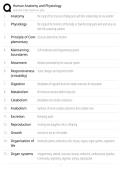
1. Anatomy the study of the structure of body parts and their relationships to one another
2. Physiology the study of the functions of the body, or how the body parts work and carry out
their life sustaining activities
3. Principle of Com- Structure determines function
plementary
4. Maintaining Cell membrane and integumentary system
boundaries
5. Movement Activities promoted by the muscular system
6. Responsiveness Sense changes and respond to them
(irritability)
7. Digestion Breakdown of ingested food into simple molecules for absorption
8. Metabolism All chemical reactions within body cells
9. Catabolism Breakdown into simpler substances
10. Anabolism Synthesis of more complex substances from simpler ones
11. Excretion Removing waste
12. Reproduction Creating new daughter cells or offspring
13. Growth Increase in size or cell number
14. Organization of chemicals (atoms, molecules), cells, tissues, organs, organ systems, organisms
life
15. Organ systems integumentary, skeletal, muscular, nervous, endocrine, cardiovascular, lymphat-
ic/immunity, respiratory, digestive, urinary, reproductive
, Human Anatomy and Physiology
Study online at https://quizlet.com/_jpblsy
16. Anatomical posi- body erect, arms at sides, legs together, palms face up. This allows proper
tion orientation of the parts of the body and gives us a directional reference point,
regardless of the position of the body
17. Frontal (coronal) divides into front and back halves (like a CT scan)
plane
18. Sagittal plane divides into left and right halves (midsagittal divides into equal left and right
halves
19. Transverse (axial) divides into top and bottom halves
plane
20. Direction terms allows us to explain where one body structure is in relation to another
21. Superior Above
22. Inferior Below
23. Medial Toward the midline
24. Lateral Away from the midline (sides or edges)
25. Anterior In front of
26. Proximal Closer to the main part of the body (used with appendages)
27. Posterior Behind
28. Distal Farther away from the main part of the body (appendages)
29. Superficial (ex- Towards surface
ternal)
30. Deep (internal) Away from the surface
, Human Anatomy and Physiology
Study online at https://quizlet.com/_jpblsy
31. Spinal cavity Contains spine
32. Dorsal cavity Made of cranial and spinal cavities
33. Cranial cavity Contains brain
34. Ventral cavity Made of thoracic, abdominal and pelvic cavities
35. Thoracic cavity Contains lungs and heart, bounded posteriorly by diaphragm
36. Abdominal cavity Contains digestive organs and spleen
37. Pelvic cavity Contains urinary bladder, reproductive organs, and some digestive organs
38. Serous mem- like a fist in a balloon. A double layered membrane with fluid in the cavity between
brane layers. Allows organs to move without friction (heart and lungs)
39. Partial pleura Lines the walls of the thoracic cavity
40. Visceral pleura covers lungs, pleural cavity is found between parietal and visceral pleura
41. Parietal peri- Sac around heart
cardium
42. Visceral peri- also called epicardium, covers heart with pericardial cavity in between
cardium
43. Parietal peri- Lined walls of abdominal cavity
toneum
44. Visceral peri- Covers abdominal organs
toneum
45. Body quadrants
Study online at https://quizlet.com/_jpblsy
1. Anatomy the study of the structure of body parts and their relationships to one another
2. Physiology the study of the functions of the body, or how the body parts work and carry out
their life sustaining activities
3. Principle of Com- Structure determines function
plementary
4. Maintaining Cell membrane and integumentary system
boundaries
5. Movement Activities promoted by the muscular system
6. Responsiveness Sense changes and respond to them
(irritability)
7. Digestion Breakdown of ingested food into simple molecules for absorption
8. Metabolism All chemical reactions within body cells
9. Catabolism Breakdown into simpler substances
10. Anabolism Synthesis of more complex substances from simpler ones
11. Excretion Removing waste
12. Reproduction Creating new daughter cells or offspring
13. Growth Increase in size or cell number
14. Organization of chemicals (atoms, molecules), cells, tissues, organs, organ systems, organisms
life
15. Organ systems integumentary, skeletal, muscular, nervous, endocrine, cardiovascular, lymphat-
ic/immunity, respiratory, digestive, urinary, reproductive
, Human Anatomy and Physiology
Study online at https://quizlet.com/_jpblsy
16. Anatomical posi- body erect, arms at sides, legs together, palms face up. This allows proper
tion orientation of the parts of the body and gives us a directional reference point,
regardless of the position of the body
17. Frontal (coronal) divides into front and back halves (like a CT scan)
plane
18. Sagittal plane divides into left and right halves (midsagittal divides into equal left and right
halves
19. Transverse (axial) divides into top and bottom halves
plane
20. Direction terms allows us to explain where one body structure is in relation to another
21. Superior Above
22. Inferior Below
23. Medial Toward the midline
24. Lateral Away from the midline (sides or edges)
25. Anterior In front of
26. Proximal Closer to the main part of the body (used with appendages)
27. Posterior Behind
28. Distal Farther away from the main part of the body (appendages)
29. Superficial (ex- Towards surface
ternal)
30. Deep (internal) Away from the surface
, Human Anatomy and Physiology
Study online at https://quizlet.com/_jpblsy
31. Spinal cavity Contains spine
32. Dorsal cavity Made of cranial and spinal cavities
33. Cranial cavity Contains brain
34. Ventral cavity Made of thoracic, abdominal and pelvic cavities
35. Thoracic cavity Contains lungs and heart, bounded posteriorly by diaphragm
36. Abdominal cavity Contains digestive organs and spleen
37. Pelvic cavity Contains urinary bladder, reproductive organs, and some digestive organs
38. Serous mem- like a fist in a balloon. A double layered membrane with fluid in the cavity between
brane layers. Allows organs to move without friction (heart and lungs)
39. Partial pleura Lines the walls of the thoracic cavity
40. Visceral pleura covers lungs, pleural cavity is found between parietal and visceral pleura
41. Parietal peri- Sac around heart
cardium
42. Visceral peri- also called epicardium, covers heart with pericardial cavity in between
cardium
43. Parietal peri- Lined walls of abdominal cavity
toneum
44. Visceral peri- Covers abdominal organs
toneum
45. Body quadrants


