

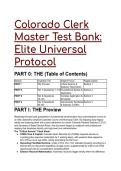
Colorado Clerk
Master Test Bank:
Elite Universal
Protocol
PART 0: THE (Table of Contents)
Section Cognitive Tier Subject Focus Page/Location
PART I The Preview Critical Axioms & Section 1
Statutory Hard Decks
PART II Tier 1 (Questions 1–15) Foundational Syntax & Section 2
Application
PART II Tier 2 (Questions Complex Application & Section 3
16–35) Simulation
PART II Tier 3 (Questions Grandmaster Synthesis Section 4
36–60) & Statutory Conflict
PART I: THE Preview
Mastering this test bank guarantees a fundamental transformation from administrative novice to
an elite, statutorily compliant Colorado County and Municipal Clerk. By stripping away legacy
habits and replacing them with a strict adherence to current Colorado Revised Statutes (C.R.S.)
and Secretary of State Election Rules, this document forges an academic and professional
mastery that translates directly into high-level civic administration.
The "Critical Axioms" Cheat Sheet
● CORA Time & Capital: Colorado Open Records Act (CORA) requests demand a
3-working-day response (extensible by 7 working days), with research fees capped at
$41.37/hour as of July 2024, strictly exempting the first hour.
● Recording Flat-Rate Doctrine: Under C.R.S. 30-1-103, standard property recording is a
$43 flat fee per document regardless of page count, supplemented by a $0.01 per $100
documentary fee for consideration exceeding $500.
● Election Recount Mathematics: Automatic recounts trigger strictly when the difference
, between the winning candidate with the least votes and the losing candidate with the most
votes is less than or equal to 0.5% of the votes cast for that winning candidate.
● Signature Cure Window: Deficient ballot signatures require the clerk to dispatch a notice
within 3 days, granting the elector exactly until 11:59 PM MT on the 8th day after the
election to return the cure form.
● Proxy Marriage Limitations: Under C.R.S. 14-2-109, marriage by proxy in Colorado is
exclusively restricted to members of the armed forces stationed away in support of
combat/operations, or deployed government contractors.
PART II: THE ELITE TEST BANK
Tier 1: Foundational Syntax & Application
Q1: A citizen submits a formal Colorado Open Records Act (CORA) request via email to the
County Clerk's office on Tuesday at 4:45 PM. The request does not involve extenuating
circumstances. Based on the principles of C.R.S. 24-72-203, which action represents the MOST
ACCURATE statutory response deadline? A) The clerk must provide the records by 5:00 PM on
Friday. B) The clerk must provide the records by 5:00 PM on the following Monday. C) The clerk
must provide the records by 4:45 PM on Friday. D) The clerk must provide the records within 10
working days, as email requests automatically trigger an extension.
● The Answer: B (The clerk must provide the records by 5:00 PM on the following
Monday.)
● Distractor Analysis:
○ A is incorrect: A request received after business hours (e.g., after 4:30 PM or 3:00
PM depending on specific department rules, but universally treated as the next day)
begins its 3-working-day clock on the following business day. Starting the clock on
Wednesday means the 3-day window ends Monday at 5:00 PM.
○ C is incorrect: Statutory deadlines for CORA are measured in working days
concluding at the close of business, not down to the exact minute of transmission.
○ D is incorrect: Extensions of 7 working days (totaling 10) require a written
explanation of extenuating circumstances; email transmission alone is not an
extenuating circumstance.
The Mentor's Analysis: Statutory clocks do not run backward or honor after-hours
submissions. When receiving a CORA request, the immediate priority is determining the legal
date of receipt. By utilizing the next working day as the official start point for after-hours
communications, the clerk bypasses the common trap of artificially shortening their legal
response window. Professional/Academic Intuition: A document submitted after close of
business legally arrives at sunrise the next working day.
Q2: A Title Company submits a 14-page Warranty Deed conveying commercial real estate for a
purchase price of $1,000,000. Based on the principles of C.R.S. 30-1-103 and C.R.S.
39-13-102, what is the MOST ACCURATE total fee the Recording Clerk must collect? A)
$143.00 B) $100.00 C) $143.00 plus a $13 base fee D) $143.00 total, representing a $43
recording fee and a $100 documentary fee
● The Answer: D ($143.00 total, representing a $43 recording fee and a $100 documentary
fee)
● Distractor Analysis:
, ○ A is incorrect: While the numerical total is $143, omitting the statutory breakdown
fails the rigor of financial auditing required for county treasuries. Option D is
unequivocally superior due to specificity.
○ B is incorrect: This calculates only the Documentary Fee ($0.01 per $100 on
$1,000,000 = $100) and unlawfully omits the statutory recording fee.
○ C is incorrect: This incorrectly applies the pre-2017 legacy formula ($13 for the first
page + $5 for additional pages). C.R.S. 30-1-103 dictates a flat $43 fee regardless
of page count.
The Mentor's Analysis: Modern recording economics favor the flat fee over page counting.
When processing real estate conveyances, the immediate priority is separating the
administrative cost from the state taxation cost. By utilizing the $43 Flat Fee alongside the
Documentary Fee, the clerk bypasses the common trap of using outdated, page-by-page pricing
models. Professional/Academic Intuition: Page counts dictate file sizes, but the flat fee
dictates the recording cost.
Q3: The canvass board completes its certification of a municipal election. Candidate X wins a
city council seat with 4,000 votes. Candidate Y loses with 3,981 votes. Based on the principles
of C.R.S. 1-10.5-101, which conclusion regarding an automatic recount is MOST ACCURATE?
A) A recount is mandatory because the margin of victory is exactly 19 votes, which is less than
0.5% of the winning candidate's total votes. B) A recount is prohibited because municipal
elections require a 1.0% threshold. C) A recount is mandatory because the margin is less than
0.5% of the total combined votes cast in the election. D) A recount is discretionary and must be
formally requested and paid for by Candidate Y.
● The Answer: A (A recount is mandatory because the margin of victory is exactly 19
votes, which is less than 0.5% of the winning candidate's total votes.)
● Distractor Analysis:
○ B is incorrect: The 0.5% threshold applies uniformly across Colorado elections
under the statutory recount framework.
○ C is incorrect: The statutory formula is not based on the "total combined votes." It is
strictly calculated as 0.5% of the votes cast for the winning candidate with the least
votes. (0.5% of 4,000 = 20 votes. The margin of 19 is less than 20).
○ D is incorrect: Because the margin falls below the statutory threshold, the recount is
automatic and state/county funded, not requested or paid for by the loser.
The Mentor's Analysis: Recount triggers are based on the winner's volume, not the overall
turnout. When assessing narrow margins, the immediate priority is identifying the mathematical
anchor. By utilizing the winner's total as the baseline multiplier, the election official bypasses the
common trap of calculating percentages against the entire electorate. Professional/Academic
Intuition: The automatic recount threshold is always half a percent of the victor's haul.
Q4: An 18-year-old resident of Colorado and their 19-year-old partner, who is currently an
active-duty member of the U.S. Army stationed in Germany for combat support, wish to marry.
Based on the principles of C.R.S. 14-2-109, which action by the county clerk is the MOST
ACCURATE? A) Issue a marriage license via an online tele-conference portal, as both parties
are over 18. B) Deny the marriage license because both parties must be physically present at
the clerk's office simultaneously. C) Issue the license for a proxy marriage, provided the resident
appears in person, signs the application, and provides a notarized absentee affidavit and ID
from the deployed partner. D) Deny the license because proxy marriages are only legal if the
absent party is incarcerated or facing severe travel restrictions due to pandemic regulations.
● The Answer: C (Issue the license for a proxy marriage, provided the resident appears in
person, signs the application, and provides a notarized absentee affidavit and ID from the
Master Test Bank:
Elite Universal
Protocol
PART 0: THE (Table of Contents)
Section Cognitive Tier Subject Focus Page/Location
PART I The Preview Critical Axioms & Section 1
Statutory Hard Decks
PART II Tier 1 (Questions 1–15) Foundational Syntax & Section 2
Application
PART II Tier 2 (Questions Complex Application & Section 3
16–35) Simulation
PART II Tier 3 (Questions Grandmaster Synthesis Section 4
36–60) & Statutory Conflict
PART I: THE Preview
Mastering this test bank guarantees a fundamental transformation from administrative novice to
an elite, statutorily compliant Colorado County and Municipal Clerk. By stripping away legacy
habits and replacing them with a strict adherence to current Colorado Revised Statutes (C.R.S.)
and Secretary of State Election Rules, this document forges an academic and professional
mastery that translates directly into high-level civic administration.
The "Critical Axioms" Cheat Sheet
● CORA Time & Capital: Colorado Open Records Act (CORA) requests demand a
3-working-day response (extensible by 7 working days), with research fees capped at
$41.37/hour as of July 2024, strictly exempting the first hour.
● Recording Flat-Rate Doctrine: Under C.R.S. 30-1-103, standard property recording is a
$43 flat fee per document regardless of page count, supplemented by a $0.01 per $100
documentary fee for consideration exceeding $500.
● Election Recount Mathematics: Automatic recounts trigger strictly when the difference
, between the winning candidate with the least votes and the losing candidate with the most
votes is less than or equal to 0.5% of the votes cast for that winning candidate.
● Signature Cure Window: Deficient ballot signatures require the clerk to dispatch a notice
within 3 days, granting the elector exactly until 11:59 PM MT on the 8th day after the
election to return the cure form.
● Proxy Marriage Limitations: Under C.R.S. 14-2-109, marriage by proxy in Colorado is
exclusively restricted to members of the armed forces stationed away in support of
combat/operations, or deployed government contractors.
PART II: THE ELITE TEST BANK
Tier 1: Foundational Syntax & Application
Q1: A citizen submits a formal Colorado Open Records Act (CORA) request via email to the
County Clerk's office on Tuesday at 4:45 PM. The request does not involve extenuating
circumstances. Based on the principles of C.R.S. 24-72-203, which action represents the MOST
ACCURATE statutory response deadline? A) The clerk must provide the records by 5:00 PM on
Friday. B) The clerk must provide the records by 5:00 PM on the following Monday. C) The clerk
must provide the records by 4:45 PM on Friday. D) The clerk must provide the records within 10
working days, as email requests automatically trigger an extension.
● The Answer: B (The clerk must provide the records by 5:00 PM on the following
Monday.)
● Distractor Analysis:
○ A is incorrect: A request received after business hours (e.g., after 4:30 PM or 3:00
PM depending on specific department rules, but universally treated as the next day)
begins its 3-working-day clock on the following business day. Starting the clock on
Wednesday means the 3-day window ends Monday at 5:00 PM.
○ C is incorrect: Statutory deadlines for CORA are measured in working days
concluding at the close of business, not down to the exact minute of transmission.
○ D is incorrect: Extensions of 7 working days (totaling 10) require a written
explanation of extenuating circumstances; email transmission alone is not an
extenuating circumstance.
The Mentor's Analysis: Statutory clocks do not run backward or honor after-hours
submissions. When receiving a CORA request, the immediate priority is determining the legal
date of receipt. By utilizing the next working day as the official start point for after-hours
communications, the clerk bypasses the common trap of artificially shortening their legal
response window. Professional/Academic Intuition: A document submitted after close of
business legally arrives at sunrise the next working day.
Q2: A Title Company submits a 14-page Warranty Deed conveying commercial real estate for a
purchase price of $1,000,000. Based on the principles of C.R.S. 30-1-103 and C.R.S.
39-13-102, what is the MOST ACCURATE total fee the Recording Clerk must collect? A)
$143.00 B) $100.00 C) $143.00 plus a $13 base fee D) $143.00 total, representing a $43
recording fee and a $100 documentary fee
● The Answer: D ($143.00 total, representing a $43 recording fee and a $100 documentary
fee)
● Distractor Analysis:
, ○ A is incorrect: While the numerical total is $143, omitting the statutory breakdown
fails the rigor of financial auditing required for county treasuries. Option D is
unequivocally superior due to specificity.
○ B is incorrect: This calculates only the Documentary Fee ($0.01 per $100 on
$1,000,000 = $100) and unlawfully omits the statutory recording fee.
○ C is incorrect: This incorrectly applies the pre-2017 legacy formula ($13 for the first
page + $5 for additional pages). C.R.S. 30-1-103 dictates a flat $43 fee regardless
of page count.
The Mentor's Analysis: Modern recording economics favor the flat fee over page counting.
When processing real estate conveyances, the immediate priority is separating the
administrative cost from the state taxation cost. By utilizing the $43 Flat Fee alongside the
Documentary Fee, the clerk bypasses the common trap of using outdated, page-by-page pricing
models. Professional/Academic Intuition: Page counts dictate file sizes, but the flat fee
dictates the recording cost.
Q3: The canvass board completes its certification of a municipal election. Candidate X wins a
city council seat with 4,000 votes. Candidate Y loses with 3,981 votes. Based on the principles
of C.R.S. 1-10.5-101, which conclusion regarding an automatic recount is MOST ACCURATE?
A) A recount is mandatory because the margin of victory is exactly 19 votes, which is less than
0.5% of the winning candidate's total votes. B) A recount is prohibited because municipal
elections require a 1.0% threshold. C) A recount is mandatory because the margin is less than
0.5% of the total combined votes cast in the election. D) A recount is discretionary and must be
formally requested and paid for by Candidate Y.
● The Answer: A (A recount is mandatory because the margin of victory is exactly 19
votes, which is less than 0.5% of the winning candidate's total votes.)
● Distractor Analysis:
○ B is incorrect: The 0.5% threshold applies uniformly across Colorado elections
under the statutory recount framework.
○ C is incorrect: The statutory formula is not based on the "total combined votes." It is
strictly calculated as 0.5% of the votes cast for the winning candidate with the least
votes. (0.5% of 4,000 = 20 votes. The margin of 19 is less than 20).
○ D is incorrect: Because the margin falls below the statutory threshold, the recount is
automatic and state/county funded, not requested or paid for by the loser.
The Mentor's Analysis: Recount triggers are based on the winner's volume, not the overall
turnout. When assessing narrow margins, the immediate priority is identifying the mathematical
anchor. By utilizing the winner's total as the baseline multiplier, the election official bypasses the
common trap of calculating percentages against the entire electorate. Professional/Academic
Intuition: The automatic recount threshold is always half a percent of the victor's haul.
Q4: An 18-year-old resident of Colorado and their 19-year-old partner, who is currently an
active-duty member of the U.S. Army stationed in Germany for combat support, wish to marry.
Based on the principles of C.R.S. 14-2-109, which action by the county clerk is the MOST
ACCURATE? A) Issue a marriage license via an online tele-conference portal, as both parties
are over 18. B) Deny the marriage license because both parties must be physically present at
the clerk's office simultaneously. C) Issue the license for a proxy marriage, provided the resident
appears in person, signs the application, and provides a notarized absentee affidavit and ID
from the deployed partner. D) Deny the license because proxy marriages are only legal if the
absent party is incarcerated or facing severe travel restrictions due to pandemic regulations.
● The Answer: C (Issue the license for a proxy marriage, provided the resident appears in
person, signs the application, and provides a notarized absentee affidavit and ID from the


