

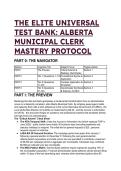
THE ELITE UNIVERSAL
TEST BANK: ALBERTA
MUNICIPAL CLERK
MASTERY PROTOCOL
PART 0: THE NAVIGATOR
Section Cognitive Tier Subject Focus Page/Location
PART I The Preview Critical Axioms & Section 1
Statutory Hard Decks
PART II Tier 1 (Questions 1–10) Foundational Syntax & Section 2
Application
PART II Tier 2 (Questions Complex Application & Section 3
11–20) Simulation
PART II Tier 3 (Questions Grandmaster Synthesis Section 4
21–30) & Statutory Conflict
PART I: THE PREVIEW
Mastering this elite test bank guarantees a fundamental transformation from an administrative
novice to a statutorily compliant, elite Alberta Municipal Clerk. By stripping away legacy habits
and replacing them with a strict adherence to the current Municipal Government Act (MGA) , the
Local Authorities Election Act (LAEA) as modernized by Bill 20 , and the Access to Information
Act (ATIA) , this document forges an academic and professional mastery that translates directly
into high-level civic administration.
The "Critical Axioms" Cheat Sheet
● The ATIA Temporal Shift: Under the Access to Information Act (which replaced FOIP in
June 2025) , public bodies have strictly 30 business days (excluding weekends and
statutory holidays) to respond. The initial fee for general requests is $25 ; personal
requests require no initial fee.
● LAEA Bill 20 Financial Doctrine: The campaign period now spans from January 1
following a general election to December 31 following the next general election.
Alberta-based corporations and trade unions are now permitted to contribute a maximum
of $5,000 per campaign period in aggregate per municipality. Individuals may contribute
$5,000 per calendar year per municipality.
● The MGA Petition Matrix: General bylaw petitions require signatures equaling 10% of
the municipality's population. Financial administration bylaw petitions strictly demand filing
within 15 days of the last advertising date, whereas other advertised bylaws allow 60
, days. The Chief Administrative Officer (CAO) must declare sufficiency within 45 days.
● Tribunal Disclosure Asymmetry: Composite Assessment Review Board (CARB)
disclosures follow a 42-14-7 day timeline (Complainant-Respondent-Rebuttal). Local
Assessment Review Board (LARB) disclosures follow a 21-7-3 day timeline.
● SDAB Adjudicative Boundaries: Subdivision and Development Appeal Board (SDAB)
hearings must commence within 30 days of the appeal receipt. Written decisions must be
issued within 15 days of the hearing's conclusion. Appeals of an SDAB decision are
directed to the Court of Appeal within 30 days, strictly on questions of law or jurisdiction.
Alberta Municipal Clerk Regulatory Matrix
Regulatory Domain Tribunal / Act Core Statutory Metric /
Constraint
Electoral Residency LAEA Candidate must reside in the
municipality for 6 consecutive
months prior to Nomination
Day.
Campaign Withdrawal LAEA Candidates possess exactly 24
hours after the close of
nominations to legally withdraw.
Council Minutes MGA Must be signed by the presiding
person and a designated
officer.
Councillor Orientation MGA Part A (Roles, Code of
Conduct) must be offered
before or on the organizational
meeting.
ARB Preliminary Hearing MRAC 15 days notice required; parties
execute mutual disclosure 7
days before the hearing.
Recall Petitions MGA Requires 40% of the
population; strict 60-day
signature gathering window.
PART II: THE ELITE TEST BANK
Tier 1: Foundational Syntax & Application
Q1: A municipal councillor realizes during a regular council meeting that a proposed zoning
bylaw directly impacts a commercial property owned by their spouse. Based on the principles of
the Municipal Government Act (MGA) regarding pecuniary interest, which sequence of actions is
the FIRST and MOST APPROPRIATE requirement for the councillor? A) Declare the conflict of
interest, remain seated in the chamber, but abstain from voting on the bylaw. B) Disclose the
general nature of the pecuniary interest, ensure the disclosure is recorded in the minutes,
abstain from voting, and immediately leave the room until the matter is concluded. C) Request
an in-camera session to privately disclose the financial details to the Chief Administrative Officer
before proceeding with the public vote. D) Transfer ownership of the property to a blind trust
, within 90 days to cure the pecuniary interest and vote on the bylaw.
● The Answer: B (Disclose the general nature of the pecuniary interest, ensure the
disclosure is recorded in the minutes, abstain from voting, and immediately leave the
room until the matter is concluded.)
● Distractor Analysis:
○ A is incorrect: The MGA strictly prohibits a councillor with a pecuniary interest from
remaining in the room during the discussion and voting phases, preventing any
non-verbal influence.
○ C is incorrect: Pecuniary interest disclosures must be made on the public record
and recorded in the open meeting minutes, not shielded in a closed session.
○ D is incorrect: While blind trusts are a valid asset management strategy, they do not
retroactively cure an immediate conflict requiring recusal at the exact moment the
matter is before council.
The Mentor's Analysis: Statutory compliance regarding financial conflicts relies on absolute
transparency and physical recusal. When facing a pecuniary interest, the immediate priority is
removing the conflicted official from the decision-making environment entirely. By utilizing the
leave the room mandate, the practitioner bypasses the common trap of perceived undue
influence via physical presence. Professional/Academic Intuition: A disclosure without a
physical exit is a statutory violation; the minutes must reflect both the declaration and the
departure.
Q2: A prospective candidate wishes to run for the office of Mayor in a major Alberta city during
the October 2025 general municipal election. Based on the eligibility parameters of the Local
Authorities Election Act (LAEA), which residency condition is the MOST ACCURATE
prerequisite? A) The candidate must have resided in the specific ward they are contesting for
exactly 12 consecutive months immediately preceding election day. B) The candidate must own
commercial or residential property within the municipal boundaries for at least one year. C) The
candidate must be a resident of the municipality for six consecutive months immediately
preceding Nomination Day. D) The candidate must be a resident of Alberta for six months and
have a registered business within the municipality.
● The Answer: C (The candidate must be a resident of the municipality for six consecutive
months immediately preceding Nomination Day.)
● Distractor Analysis:
○ A is incorrect: Ward-specific residency is a common misconception; the candidate
must reside in the municipality, but not necessarily the specific ward. Furthermore,
the timeline is six months, not twelve.
○ B is incorrect: Property ownership is an outdated, legacy requirement that no longer
dictates municipal election eligibility in Alberta.
○ D is incorrect: Having a registered business does not fulfill the statutory requirement
of primary residential domicile within the local jurisdiction.
The Mentor's Analysis: Democratic access in Alberta requires a verified, temporal connection
to the community, not financial investment. When verifying candidate eligibility, the immediate
priority is establishing the six-month continuous domicile benchmark. By utilizing Nomination
Day as the anchor point, the practitioner bypasses the common trap of miscalculating residency
up to Election Day. Professional/Academic Intuition: Residency is anchored to Nomination
Day, not Election Day; six months continuous domicile is the immutable threshold.
Q3: Following an assessment notice mailing, a commercial property owner files a formal
complaint to the Composite Assessment Review Board (CARB). Based on the Matters Relating
to Assessment Complaints Regulation, which disclosure timeline is the UNEQUIVOCALLY
TEST BANK: ALBERTA
MUNICIPAL CLERK
MASTERY PROTOCOL
PART 0: THE NAVIGATOR
Section Cognitive Tier Subject Focus Page/Location
PART I The Preview Critical Axioms & Section 1
Statutory Hard Decks
PART II Tier 1 (Questions 1–10) Foundational Syntax & Section 2
Application
PART II Tier 2 (Questions Complex Application & Section 3
11–20) Simulation
PART II Tier 3 (Questions Grandmaster Synthesis Section 4
21–30) & Statutory Conflict
PART I: THE PREVIEW
Mastering this elite test bank guarantees a fundamental transformation from an administrative
novice to a statutorily compliant, elite Alberta Municipal Clerk. By stripping away legacy habits
and replacing them with a strict adherence to the current Municipal Government Act (MGA) , the
Local Authorities Election Act (LAEA) as modernized by Bill 20 , and the Access to Information
Act (ATIA) , this document forges an academic and professional mastery that translates directly
into high-level civic administration.
The "Critical Axioms" Cheat Sheet
● The ATIA Temporal Shift: Under the Access to Information Act (which replaced FOIP in
June 2025) , public bodies have strictly 30 business days (excluding weekends and
statutory holidays) to respond. The initial fee for general requests is $25 ; personal
requests require no initial fee.
● LAEA Bill 20 Financial Doctrine: The campaign period now spans from January 1
following a general election to December 31 following the next general election.
Alberta-based corporations and trade unions are now permitted to contribute a maximum
of $5,000 per campaign period in aggregate per municipality. Individuals may contribute
$5,000 per calendar year per municipality.
● The MGA Petition Matrix: General bylaw petitions require signatures equaling 10% of
the municipality's population. Financial administration bylaw petitions strictly demand filing
within 15 days of the last advertising date, whereas other advertised bylaws allow 60
, days. The Chief Administrative Officer (CAO) must declare sufficiency within 45 days.
● Tribunal Disclosure Asymmetry: Composite Assessment Review Board (CARB)
disclosures follow a 42-14-7 day timeline (Complainant-Respondent-Rebuttal). Local
Assessment Review Board (LARB) disclosures follow a 21-7-3 day timeline.
● SDAB Adjudicative Boundaries: Subdivision and Development Appeal Board (SDAB)
hearings must commence within 30 days of the appeal receipt. Written decisions must be
issued within 15 days of the hearing's conclusion. Appeals of an SDAB decision are
directed to the Court of Appeal within 30 days, strictly on questions of law or jurisdiction.
Alberta Municipal Clerk Regulatory Matrix
Regulatory Domain Tribunal / Act Core Statutory Metric /
Constraint
Electoral Residency LAEA Candidate must reside in the
municipality for 6 consecutive
months prior to Nomination
Day.
Campaign Withdrawal LAEA Candidates possess exactly 24
hours after the close of
nominations to legally withdraw.
Council Minutes MGA Must be signed by the presiding
person and a designated
officer.
Councillor Orientation MGA Part A (Roles, Code of
Conduct) must be offered
before or on the organizational
meeting.
ARB Preliminary Hearing MRAC 15 days notice required; parties
execute mutual disclosure 7
days before the hearing.
Recall Petitions MGA Requires 40% of the
population; strict 60-day
signature gathering window.
PART II: THE ELITE TEST BANK
Tier 1: Foundational Syntax & Application
Q1: A municipal councillor realizes during a regular council meeting that a proposed zoning
bylaw directly impacts a commercial property owned by their spouse. Based on the principles of
the Municipal Government Act (MGA) regarding pecuniary interest, which sequence of actions is
the FIRST and MOST APPROPRIATE requirement for the councillor? A) Declare the conflict of
interest, remain seated in the chamber, but abstain from voting on the bylaw. B) Disclose the
general nature of the pecuniary interest, ensure the disclosure is recorded in the minutes,
abstain from voting, and immediately leave the room until the matter is concluded. C) Request
an in-camera session to privately disclose the financial details to the Chief Administrative Officer
before proceeding with the public vote. D) Transfer ownership of the property to a blind trust
, within 90 days to cure the pecuniary interest and vote on the bylaw.
● The Answer: B (Disclose the general nature of the pecuniary interest, ensure the
disclosure is recorded in the minutes, abstain from voting, and immediately leave the
room until the matter is concluded.)
● Distractor Analysis:
○ A is incorrect: The MGA strictly prohibits a councillor with a pecuniary interest from
remaining in the room during the discussion and voting phases, preventing any
non-verbal influence.
○ C is incorrect: Pecuniary interest disclosures must be made on the public record
and recorded in the open meeting minutes, not shielded in a closed session.
○ D is incorrect: While blind trusts are a valid asset management strategy, they do not
retroactively cure an immediate conflict requiring recusal at the exact moment the
matter is before council.
The Mentor's Analysis: Statutory compliance regarding financial conflicts relies on absolute
transparency and physical recusal. When facing a pecuniary interest, the immediate priority is
removing the conflicted official from the decision-making environment entirely. By utilizing the
leave the room mandate, the practitioner bypasses the common trap of perceived undue
influence via physical presence. Professional/Academic Intuition: A disclosure without a
physical exit is a statutory violation; the minutes must reflect both the declaration and the
departure.
Q2: A prospective candidate wishes to run for the office of Mayor in a major Alberta city during
the October 2025 general municipal election. Based on the eligibility parameters of the Local
Authorities Election Act (LAEA), which residency condition is the MOST ACCURATE
prerequisite? A) The candidate must have resided in the specific ward they are contesting for
exactly 12 consecutive months immediately preceding election day. B) The candidate must own
commercial or residential property within the municipal boundaries for at least one year. C) The
candidate must be a resident of the municipality for six consecutive months immediately
preceding Nomination Day. D) The candidate must be a resident of Alberta for six months and
have a registered business within the municipality.
● The Answer: C (The candidate must be a resident of the municipality for six consecutive
months immediately preceding Nomination Day.)
● Distractor Analysis:
○ A is incorrect: Ward-specific residency is a common misconception; the candidate
must reside in the municipality, but not necessarily the specific ward. Furthermore,
the timeline is six months, not twelve.
○ B is incorrect: Property ownership is an outdated, legacy requirement that no longer
dictates municipal election eligibility in Alberta.
○ D is incorrect: Having a registered business does not fulfill the statutory requirement
of primary residential domicile within the local jurisdiction.
The Mentor's Analysis: Democratic access in Alberta requires a verified, temporal connection
to the community, not financial investment. When verifying candidate eligibility, the immediate
priority is establishing the six-month continuous domicile benchmark. By utilizing Nomination
Day as the anchor point, the practitioner bypasses the common trap of miscalculating residency
up to Election Day. Professional/Academic Intuition: Residency is anchored to Nomination
Day, not Election Day; six months continuous domicile is the immutable threshold.
Q3: Following an assessment notice mailing, a commercial property owner files a formal
complaint to the Composite Assessment Review Board (CARB). Based on the Matters Relating
to Assessment Complaints Regulation, which disclosure timeline is the UNEQUIVOCALLY


