

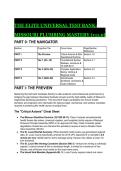
THE ELITE UNIVERSAL TEST BANK:
MISSOURI PLUMBING MASTERY (v11.0)
PART 0: THE NAVIGATOR
Section Cognitive Tier Focus Area Page/Section
Reference
PART I The Preview Critical Axioms & Elite Section 1.0
Operational Doctrine
PART II Tier 1 (Q1–15) Foundational Syntax: Section 2.1
Statutes, Licensure &
10 CSR 60-11
PART II Tier 2 (Q16–35) Complex Application: Section 2.2
Sizing, Venting &
Regional Code
PART II Tier 3 (Q36–60) Grandmaster Section 2.3
Synthesis: Isometrics &
Code Collisions
PART I: THE PREVIEW
Mastering this test bank translates directly to elite academic and professional performance by
bridging the gap between theoretical hydraulic physics and the high-liability reality of Missouri’s
fragmented plumbing jurisdictions. This document forges candidates into A-level master
plumbers and engineers who internalize the rigorous legal, mechanical, and sanitary mandates
required to protect public health across municipal lines.
The "Critical Axioms" Cheat Sheet
● The Missouri Backflow Doctrine (10 CSR 60-11): Class I hazards (actual/potential
health threats like boilers, chemical irrigation, and hospitals) strictly require a Reduced
Pressure Principle Assembly (RPZ) or an approved Air Gap. Class II hazards (water
degradation threats like non-chemical fire sprinklers) require at least a Double Check
Valve Assembly (DCVA).
● The St. Louis Rainfall Anomaly: While standard model codes use generalized regional
data, St. Louis County specifically amends the 2015 UPC Appendix D to mandate a 6.0
inches per hour rainfall rate for storm drainage sizing. Kansas City utilizes a lower 3.6
in/hr threshold.
● The St. Louis Wet Venting Constraint (Section 908.1): Vertical wet venting is ruthlessly
capped: it cannot exceed 6 feet in developed length, is limited to a maximum of four
fixtures, and all fixtures must reside on the exact same story.
● The Island Sink Mandate (Appendix M): St. Louis County requires island sink return
, vents to connect to the horizontal drain a minimum of 5 feet downstream from the
vertical fixture drain to prevent pneumatic blockages.
● Jurisdictional Reciprocity (HB ): Plumber licensure reciprocity is mandated
across Missouri political subdivisions ONLY if the original license was obtained via a
division-approved standardized examination.
PART II: THE ELITE TEST BANK
Tier 1: Foundational Syntax & Application (Questions 1–15)
Q1: A newly constructed hospital in Springfield requires backflow protection on the main potable
water service line. According to Missouri Department of Natural Resources (10 CSR 60-11.010),
which classification and corresponding backflow prevention assembly are MOST ACCURATE?
A) Class II Hazard; requiring a Double Check Valve Assembly (DCVA). B) Class I Hazard;
requiring a Double Check Valve Assembly (DCVA). C) Class I Hazard; requiring a Reduced
Pressure Principle Assembly (RPZ) or Air Gap. D) Class II Hazard; requiring a Pressure
Vacuum Breaker (PVB).
● The Answer: C (Class I Hazard; requiring a Reduced Pressure Principle Assembly (RPZ)
or Air Gap.)
● Distractor Analysis:
○ A is incorrect: Hospitals pose a severe health hazard via biological pathogens,
rendering them Class I, not Class II.
○ B is incorrect: DCVAs offer inadequate protection against back-siphonage of lethal
contaminants and are strictly illegal for Class I containment.
○ D is incorrect: A PVB does not protect against backpressure, which is a mandatory
requirement for whole-facility containment.
The Mentor's Analysis: Missouri strictly bifurcates cross-connections into health threats (Class
I) and aesthetic/degradation threats (Class II). When facing a Class I health hazard, the
immediate priority is total containment. By utilizing an RPZ or Air Gap, you bypass the common
trap of under-protecting a facility that handles lethal biological agents. Professional/Academic
Intuition: Class I equals Health Hazard equals RPZ or Air Gap; there are no exceptions.
Q2: Under Missouri Revised Statutes Chapter 341.170, a candidate applying for a Master
Plumber’s license in a regulated county must meet which of the following FIRST baseline
requirements? A) Be at least 21 years old and hold a journeyman license for 1 year. B) Be at
least 25 years old and have 3 years of experience as a licensed journeyman plumber. C)
Possess a bachelor's degree in mechanical engineering and pass the ICC exam. D) Complete a
40-hour ASSE backflow certification course.
● The Answer: B (Be at least 25 years old and have 3 years of experience as a licensed
journeyman plumber.)
● Distractor Analysis:
○ A is incorrect: This blends the journeyman age requirement (21) with an incorrect,
drastically shortened timeline.
○ C is incorrect: While engineers design systems, standard statutory licensure for a
Master Plumber explicitly relies on age and verified journeyman field experience.
○ D is incorrect: ASSE certification permits backflow assembly testing, not universal
master plumbing licensure.
The Mentor's Analysis: Statutory licensure acts as the ultimate gatekeeper for public safety.
, When facing state-level credentialing, the immediate priority is verifying statutory age and field
tenure. By utilizing Chapter 341 guidelines, you bypass the common trap of confusing local
municipal variances with overriding state law. Professional/Academic Intuition: Mastery
requires time; Missouri law dictates a hard deck of 25 years of age and 3 years as a
journeyman.
Q3: A facility manager in Jefferson City installs a new fire sprinkler system that does NOT utilize
chemical additives. Under Missouri 10 CSR 60-11, how is this system categorized, and what is
the MINIMUM acceptable containment? A) Class I Hazard; RPZ. B) Class II Hazard; DCVA. C)
Class II Hazard; RPZ. D) Non-Hazard; No backflow required.
● The Answer: B (Class II Hazard; DCVA.)
● Distractor Analysis:
○ A is incorrect: Because the system lacks chemical additives, it does not pose a
toxic health threat to the municipal grid.
○ C is incorrect: While an RPZ technically exceeds the requirement, a DCVA is the
stated legal minimum for Class II.
○ D is incorrect: Stagnant water in fire lines presents a severe degradation threat
(Class II), requiring mandatory protection.
The Mentor's Analysis: Fire lines breed stagnant, foul water. When facing non-chemical fire
suppression, the immediate priority is preventing this black water from degrading the municipal
supply. By utilizing a DCVA, you bypass the common trap of over-engineering the system with
an expensive, high-maintenance RPZ where it is not legally mandated. Professional/Academic
Intuition: Chemicals equal Class I (RPZ); no chemicals equal Class II (DCVA).
Q4: A journeyman plumber licensed in Kansas City moves to St. Louis County. Under the 2026
Missouri HB 2394 reciprocity framework, which condition MUST be met for St. Louis to
recognize the license without forcing re-examination? A) The plumber must pay a $500
reciprocity tariff. B) The plumber must have worked exclusively on commercial properties. C)
The original license must have been granted upon passing an examination approved by the
Division of Professional Registration. D) The plumber must restart a one-year apprenticeship in
the new jurisdiction.
● The Answer: C (The original license must have been granted upon passing an
examination approved by the Division of Professional Registration.)
● Distractor Analysis:
○ A is incorrect: HB 2394 does not mandate punitive tariffs; its core function is to
standardize competency.
○ B is incorrect: The law makes absolutely no distinction between commercial and
residential experience for reciprocity.
○ D is incorrect: Restarting an apprenticeship defeats the entire legislative purpose of
the licensure reciprocity act.
The Mentor's Analysis: Jurisdictional fragmentation stifles workforce mobility. When facing
multi-city operations, the immediate priority is establishing standardized competency. By utilizing
Division-approved exams, you bypass the common trap of localized protectionism blocking
qualified tradesmen. Professional/Academic Intuition: Reciprocity is triggered by a
standardized test, not geographic tenure.
Q5: Based on the federal Reduction of Lead in Drinking Water Act and Missouri's state-level
adoption, what is the maximum allowable lead content for a brass fitting used in a newly
installed potable water system? A) 8.0% total lead. B) 0.20% lead in solder only. C) 0.25% lead
calculated as a weighted average across all wetted surfaces. D) 0.0% absolute zero lead.
● The Answer: C (0.25% lead calculated as a weighted average across all wetted
MISSOURI PLUMBING MASTERY (v11.0)
PART 0: THE NAVIGATOR
Section Cognitive Tier Focus Area Page/Section
Reference
PART I The Preview Critical Axioms & Elite Section 1.0
Operational Doctrine
PART II Tier 1 (Q1–15) Foundational Syntax: Section 2.1
Statutes, Licensure &
10 CSR 60-11
PART II Tier 2 (Q16–35) Complex Application: Section 2.2
Sizing, Venting &
Regional Code
PART II Tier 3 (Q36–60) Grandmaster Section 2.3
Synthesis: Isometrics &
Code Collisions
PART I: THE PREVIEW
Mastering this test bank translates directly to elite academic and professional performance by
bridging the gap between theoretical hydraulic physics and the high-liability reality of Missouri’s
fragmented plumbing jurisdictions. This document forges candidates into A-level master
plumbers and engineers who internalize the rigorous legal, mechanical, and sanitary mandates
required to protect public health across municipal lines.
The "Critical Axioms" Cheat Sheet
● The Missouri Backflow Doctrine (10 CSR 60-11): Class I hazards (actual/potential
health threats like boilers, chemical irrigation, and hospitals) strictly require a Reduced
Pressure Principle Assembly (RPZ) or an approved Air Gap. Class II hazards (water
degradation threats like non-chemical fire sprinklers) require at least a Double Check
Valve Assembly (DCVA).
● The St. Louis Rainfall Anomaly: While standard model codes use generalized regional
data, St. Louis County specifically amends the 2015 UPC Appendix D to mandate a 6.0
inches per hour rainfall rate for storm drainage sizing. Kansas City utilizes a lower 3.6
in/hr threshold.
● The St. Louis Wet Venting Constraint (Section 908.1): Vertical wet venting is ruthlessly
capped: it cannot exceed 6 feet in developed length, is limited to a maximum of four
fixtures, and all fixtures must reside on the exact same story.
● The Island Sink Mandate (Appendix M): St. Louis County requires island sink return
, vents to connect to the horizontal drain a minimum of 5 feet downstream from the
vertical fixture drain to prevent pneumatic blockages.
● Jurisdictional Reciprocity (HB ): Plumber licensure reciprocity is mandated
across Missouri political subdivisions ONLY if the original license was obtained via a
division-approved standardized examination.
PART II: THE ELITE TEST BANK
Tier 1: Foundational Syntax & Application (Questions 1–15)
Q1: A newly constructed hospital in Springfield requires backflow protection on the main potable
water service line. According to Missouri Department of Natural Resources (10 CSR 60-11.010),
which classification and corresponding backflow prevention assembly are MOST ACCURATE?
A) Class II Hazard; requiring a Double Check Valve Assembly (DCVA). B) Class I Hazard;
requiring a Double Check Valve Assembly (DCVA). C) Class I Hazard; requiring a Reduced
Pressure Principle Assembly (RPZ) or Air Gap. D) Class II Hazard; requiring a Pressure
Vacuum Breaker (PVB).
● The Answer: C (Class I Hazard; requiring a Reduced Pressure Principle Assembly (RPZ)
or Air Gap.)
● Distractor Analysis:
○ A is incorrect: Hospitals pose a severe health hazard via biological pathogens,
rendering them Class I, not Class II.
○ B is incorrect: DCVAs offer inadequate protection against back-siphonage of lethal
contaminants and are strictly illegal for Class I containment.
○ D is incorrect: A PVB does not protect against backpressure, which is a mandatory
requirement for whole-facility containment.
The Mentor's Analysis: Missouri strictly bifurcates cross-connections into health threats (Class
I) and aesthetic/degradation threats (Class II). When facing a Class I health hazard, the
immediate priority is total containment. By utilizing an RPZ or Air Gap, you bypass the common
trap of under-protecting a facility that handles lethal biological agents. Professional/Academic
Intuition: Class I equals Health Hazard equals RPZ or Air Gap; there are no exceptions.
Q2: Under Missouri Revised Statutes Chapter 341.170, a candidate applying for a Master
Plumber’s license in a regulated county must meet which of the following FIRST baseline
requirements? A) Be at least 21 years old and hold a journeyman license for 1 year. B) Be at
least 25 years old and have 3 years of experience as a licensed journeyman plumber. C)
Possess a bachelor's degree in mechanical engineering and pass the ICC exam. D) Complete a
40-hour ASSE backflow certification course.
● The Answer: B (Be at least 25 years old and have 3 years of experience as a licensed
journeyman plumber.)
● Distractor Analysis:
○ A is incorrect: This blends the journeyman age requirement (21) with an incorrect,
drastically shortened timeline.
○ C is incorrect: While engineers design systems, standard statutory licensure for a
Master Plumber explicitly relies on age and verified journeyman field experience.
○ D is incorrect: ASSE certification permits backflow assembly testing, not universal
master plumbing licensure.
The Mentor's Analysis: Statutory licensure acts as the ultimate gatekeeper for public safety.
, When facing state-level credentialing, the immediate priority is verifying statutory age and field
tenure. By utilizing Chapter 341 guidelines, you bypass the common trap of confusing local
municipal variances with overriding state law. Professional/Academic Intuition: Mastery
requires time; Missouri law dictates a hard deck of 25 years of age and 3 years as a
journeyman.
Q3: A facility manager in Jefferson City installs a new fire sprinkler system that does NOT utilize
chemical additives. Under Missouri 10 CSR 60-11, how is this system categorized, and what is
the MINIMUM acceptable containment? A) Class I Hazard; RPZ. B) Class II Hazard; DCVA. C)
Class II Hazard; RPZ. D) Non-Hazard; No backflow required.
● The Answer: B (Class II Hazard; DCVA.)
● Distractor Analysis:
○ A is incorrect: Because the system lacks chemical additives, it does not pose a
toxic health threat to the municipal grid.
○ C is incorrect: While an RPZ technically exceeds the requirement, a DCVA is the
stated legal minimum for Class II.
○ D is incorrect: Stagnant water in fire lines presents a severe degradation threat
(Class II), requiring mandatory protection.
The Mentor's Analysis: Fire lines breed stagnant, foul water. When facing non-chemical fire
suppression, the immediate priority is preventing this black water from degrading the municipal
supply. By utilizing a DCVA, you bypass the common trap of over-engineering the system with
an expensive, high-maintenance RPZ where it is not legally mandated. Professional/Academic
Intuition: Chemicals equal Class I (RPZ); no chemicals equal Class II (DCVA).
Q4: A journeyman plumber licensed in Kansas City moves to St. Louis County. Under the 2026
Missouri HB 2394 reciprocity framework, which condition MUST be met for St. Louis to
recognize the license without forcing re-examination? A) The plumber must pay a $500
reciprocity tariff. B) The plumber must have worked exclusively on commercial properties. C)
The original license must have been granted upon passing an examination approved by the
Division of Professional Registration. D) The plumber must restart a one-year apprenticeship in
the new jurisdiction.
● The Answer: C (The original license must have been granted upon passing an
examination approved by the Division of Professional Registration.)
● Distractor Analysis:
○ A is incorrect: HB 2394 does not mandate punitive tariffs; its core function is to
standardize competency.
○ B is incorrect: The law makes absolutely no distinction between commercial and
residential experience for reciprocity.
○ D is incorrect: Restarting an apprenticeship defeats the entire legislative purpose of
the licensure reciprocity act.
The Mentor's Analysis: Jurisdictional fragmentation stifles workforce mobility. When facing
multi-city operations, the immediate priority is establishing standardized competency. By utilizing
Division-approved exams, you bypass the common trap of localized protectionism blocking
qualified tradesmen. Professional/Academic Intuition: Reciprocity is triggered by a
standardized test, not geographic tenure.
Q5: Based on the federal Reduction of Lead in Drinking Water Act and Missouri's state-level
adoption, what is the maximum allowable lead content for a brass fitting used in a newly
installed potable water system? A) 8.0% total lead. B) 0.20% lead in solder only. C) 0.25% lead
calculated as a weighted average across all wetted surfaces. D) 0.0% absolute zero lead.
● The Answer: C (0.25% lead calculated as a weighted average across all wetted


