

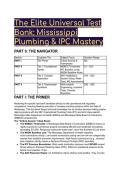
The Elite Universal Test
Bank: Mississippi
Plumbing & IPC Mastery
PART 0: THE NAVIGATOR
Section Cognitive Tier Subject Focus Question Range
PART I The Primer Critical Axioms & N/A
Frameworks
PART II Tier 1: Foundational MSBOC Thresholds, Q1 – Q15
Syntax IPC Baseline Limits,
MSDH Backflow Rules
PART II Tier 2: Complex AAV Installations, Q16 – Q35
Application System Sizing, Water
Tests, MS Amendments
PART II Tier 3: Grandmaster Multi-variable Q36 – Q60
Synthesis Engineering, Isometric
Traps, Disaster
Scenarios
PART I: THE PRIMER
Mastering this specific test bank translates directly to elite operational and regulatory
competence, ensuring flawless execution of complex plumbing systems within the State of
Mississippi. This document forges technical knowledge into an intuitive decision-making engine,
aligning practice with the 2021 International Plumbing Code (IPC) and strict state-specific
Mississippi State Department of Health (MSDH) and Mississippi State Board of Contractors
(MSBOC) amendments.
The "Critical Axioms" Cheat Sheet:
● The MSBOC Thresholds: A Mississippi State Board of Contractors (MSBOC) license is
rigidly required for commercial projects exceeding $50,000 and residential remodeling
exceeding $10,000. Reciprocity waives the trade exam, never the Business & Law exam.
● The MSDH Backflow Law: The Mississippi Department of Health classifies
cross-connections strictly. Low-hazard connections posing very low risk are categorically
exempt from backflow preventer requirements. High-hazard connections (e.g., chemical
lawn irrigation) strictly require a Reduced Pressure Principle (RPZ) assembly.
● The IPC Pressure Boundaries: Static water distribution pressure must NEVER exceed
80 psi without a Pressure-Reducing Valve (PRV). Minimum operational pressure at the
fixture must maintain 15 psi.
● The AAV Placement Rules: Air Admittance Valves (AAVs) must breathe. They must be
, installed a minimum of 4 inches above the horizontal branch/fixture drain, 6 inches above
any insulation, and remain permanently accessible.
● The DWV Sizing & Slope Mandate: Horizontal drainage piping 3 inches in diameter or
smaller must maintain a minimum slope of 1/4 inch per foot to achieve scouring velocity.
## PART II: THE ELITE TEST BANK
Q1: A municipal water supply is connected to a newly constructed commercial facility in
Jackson, Mississippi. The static water pressure at the service entrance is measured at 88 psi.
Based on the 2021 IPC, which action is IMMEDIATELY required? A) Install a water hammer
arrestor at the main line B) Install a pressure-reducing valve (PRV) C) Upsize the main
distribution line to reduce velocity D) Restrict all lavatory faucets to 1.0 gpm
● The Answer: B (Install a pressure-reducing valve (PRV))
● Distractor Analysis:
○ A is incorrect: Arrestors mitigate kinetic shock (water hammer) from quick-closing
valves, not static overpressure.
○ C is incorrect: Upsizing pipe reduces fluid velocity and friction loss but does not
lower static supply pressure.
○ D is incorrect: Flow restriction does not protect the internal piping network from
structural stress caused by static overpressure.
The Mentor's Analysis: The IPC draws a hard line at 80 psi for static pressure to protect
fixtures and joints from catastrophic failure. When facing high municipal supply pressure, the
immediate priority is establishing a pressure-reducing valve (PRV) at the service entrance. By
utilizing a PRV, the practitioner bypasses the common trap of allowing sustained overpressure
to degrade system integrity. Professional/Academic Intuition: Never expose a building's
internal potable network to static pressures exceeding 80 psi.
Q2: A contractor in Biloxi is submitting a bid for a residential bathroom remodel. The total cost of
labor and materials is $12,500. Under Mississippi State Board of Contractors (MSBOC)
regulations, which licensing requirement is MOST ACCURATE? A) The contractor requires a
Commercial Mechanical license. B) No state license is required because the project is under
$50,000. C) The contractor requires an MSBOC Residential Remodeling license. D) The
contractor only requires a local municipal permit.
● The Answer: C (The contractor requires an MSBOC Residential Remodeling license.)
● Distractor Analysis:
○ A is incorrect: This is a residential, not commercial, project.
○ B is incorrect: The $50,000 threshold applies to new residential construction and
commercial work, not residential remodeling.
○ D is incorrect: While local permits are necessary, the $10,000 threshold triggers the
state-level MSBOC requirement.
The Mentor's Analysis: Licensing thresholds in Mississippi dictate legal operational
boundaries. When facing residential renovations, the immediate priority is identifying the
$10,000 financial threshold. By utilizing the Residential Remodeling classification, the contractor
bypasses the common trap of operating illegally under the commercial $50k assumption.
Professional/Academic Intuition: Residential remodels trigger state licensing at $10k;
new builds and commercial work trigger at $50k.
Q3: The Mississippi State Department of Health (MSDH) has classified a residential property's
cross-connection as a "low-hazard posing a very low risk." What is the MOST ACCURATE
regulatory requirement for backflow prevention in this specific scenario? A) A Double Check
Valve Assembly must be installed and tested annually. B) The connection is entirely exempt and
a backflow preventer cannot be required. C) A Reduced Pressure Principle (RPZ) assembly is
, mandated. D) An atmospheric vacuum breaker is required at the meter.
● The Answer: B (The connection is entirely exempt and a backflow preventer cannot be
required.)
● Distractor Analysis:
○ A is incorrect: MSDH no longer requires annual testing for double check valves, and
low-hazard/low-risk connections do not require them at all.
○ C is incorrect: RPZ assemblies are reserved exclusively for high-hazard
environments.
○ D is incorrect: State law expressly exempts these specific low-hazard connections
from any backflow device requirements.
The Mentor's Analysis: Regulatory evolution (HB 692) fundamentally altered Mississippi's
backflow approach. When facing a low-hazard/low-risk cross-connection, the immediate priority
is acknowledging its exempt status. By utilizing the statutory exemption, the inspector bypasses
the common trap of over-engineering residential systems and violating current MSDH limits.
Professional/Academic Intuition: If MSDH designates a cross-connection as
low-hazard/very low risk, the state explicitly forbids mandating a backflow preventer.
Q4: A certified tester evaluates a Reduced Pressure Principle (RPZ) backflow prevention
assembly on a commercial property and determines it is non-functional. Under MSDH
regulations, what is the MAXIMUM timeframe allowed for the device to be repaired and
re-tested? A) 7 days B) 14 days C) 30 days D) 60 days
● The Answer: C (30 days)
● Distractor Analysis:
○ A is incorrect: 7 days is a common localized municipal timeframe, but the state
MSDH standard grants a wider window.
○ B is incorrect: 14 days is incorrect per the MSDH Cross Connection Control
manual.
○ D is incorrect: 60 days allows a severe high-hazard vulnerability to persist for too
long.
The Mentor's Analysis: A failed RPZ presents an active threat to the public water supply.
When facing a non-functional backflow assembly, the immediate priority is enforcing the
compliance window. By utilizing the 30-day mandated repair window, the operator bypasses the
common trap of indefinite deferral by property owners. Professional/Academic Intuition: A
failed RPZ starts a strict 30-day countdown to public safety compliance.
Q5: A horizontal sanitary drainage line is being roughed in using 3-inch PVC. According to the
IPC, what is the MINIMUM required slope for this pipe? A) 1/8 inch per foot B) 1/4 inch per foot
C) 1/2 inch per foot D) 1 inch per foot
● The Answer: B (1/4 inch per foot)
● Distractor Analysis:
○ A is incorrect: 1/8 inch per foot is the minimum slope permitted only for pipes 4
inches in diameter or larger.
○ C is incorrect: 1/2 inch is an overly aggressive slope that can cause liquids to
outpace solids, leading to blockages.
○ D is incorrect: 1 inch per foot is reserved for specific specialty offsets, not standard
horizontal drainage.
The Mentor's Analysis: Fluid dynamics within gravity DWV systems rely on precise angles.
When facing pipes 3 inches or smaller, the immediate priority is maintaining scouring velocity.
By utilizing a 1/4-inch per foot slope, the installer bypasses the common trap of solid-liquid
separation. Professional/Academic Intuition: Pipes 3 inches and smaller fall at 1/4 inch;
Bank: Mississippi
Plumbing & IPC Mastery
PART 0: THE NAVIGATOR
Section Cognitive Tier Subject Focus Question Range
PART I The Primer Critical Axioms & N/A
Frameworks
PART II Tier 1: Foundational MSBOC Thresholds, Q1 – Q15
Syntax IPC Baseline Limits,
MSDH Backflow Rules
PART II Tier 2: Complex AAV Installations, Q16 – Q35
Application System Sizing, Water
Tests, MS Amendments
PART II Tier 3: Grandmaster Multi-variable Q36 – Q60
Synthesis Engineering, Isometric
Traps, Disaster
Scenarios
PART I: THE PRIMER
Mastering this specific test bank translates directly to elite operational and regulatory
competence, ensuring flawless execution of complex plumbing systems within the State of
Mississippi. This document forges technical knowledge into an intuitive decision-making engine,
aligning practice with the 2021 International Plumbing Code (IPC) and strict state-specific
Mississippi State Department of Health (MSDH) and Mississippi State Board of Contractors
(MSBOC) amendments.
The "Critical Axioms" Cheat Sheet:
● The MSBOC Thresholds: A Mississippi State Board of Contractors (MSBOC) license is
rigidly required for commercial projects exceeding $50,000 and residential remodeling
exceeding $10,000. Reciprocity waives the trade exam, never the Business & Law exam.
● The MSDH Backflow Law: The Mississippi Department of Health classifies
cross-connections strictly. Low-hazard connections posing very low risk are categorically
exempt from backflow preventer requirements. High-hazard connections (e.g., chemical
lawn irrigation) strictly require a Reduced Pressure Principle (RPZ) assembly.
● The IPC Pressure Boundaries: Static water distribution pressure must NEVER exceed
80 psi without a Pressure-Reducing Valve (PRV). Minimum operational pressure at the
fixture must maintain 15 psi.
● The AAV Placement Rules: Air Admittance Valves (AAVs) must breathe. They must be
, installed a minimum of 4 inches above the horizontal branch/fixture drain, 6 inches above
any insulation, and remain permanently accessible.
● The DWV Sizing & Slope Mandate: Horizontal drainage piping 3 inches in diameter or
smaller must maintain a minimum slope of 1/4 inch per foot to achieve scouring velocity.
## PART II: THE ELITE TEST BANK
Q1: A municipal water supply is connected to a newly constructed commercial facility in
Jackson, Mississippi. The static water pressure at the service entrance is measured at 88 psi.
Based on the 2021 IPC, which action is IMMEDIATELY required? A) Install a water hammer
arrestor at the main line B) Install a pressure-reducing valve (PRV) C) Upsize the main
distribution line to reduce velocity D) Restrict all lavatory faucets to 1.0 gpm
● The Answer: B (Install a pressure-reducing valve (PRV))
● Distractor Analysis:
○ A is incorrect: Arrestors mitigate kinetic shock (water hammer) from quick-closing
valves, not static overpressure.
○ C is incorrect: Upsizing pipe reduces fluid velocity and friction loss but does not
lower static supply pressure.
○ D is incorrect: Flow restriction does not protect the internal piping network from
structural stress caused by static overpressure.
The Mentor's Analysis: The IPC draws a hard line at 80 psi for static pressure to protect
fixtures and joints from catastrophic failure. When facing high municipal supply pressure, the
immediate priority is establishing a pressure-reducing valve (PRV) at the service entrance. By
utilizing a PRV, the practitioner bypasses the common trap of allowing sustained overpressure
to degrade system integrity. Professional/Academic Intuition: Never expose a building's
internal potable network to static pressures exceeding 80 psi.
Q2: A contractor in Biloxi is submitting a bid for a residential bathroom remodel. The total cost of
labor and materials is $12,500. Under Mississippi State Board of Contractors (MSBOC)
regulations, which licensing requirement is MOST ACCURATE? A) The contractor requires a
Commercial Mechanical license. B) No state license is required because the project is under
$50,000. C) The contractor requires an MSBOC Residential Remodeling license. D) The
contractor only requires a local municipal permit.
● The Answer: C (The contractor requires an MSBOC Residential Remodeling license.)
● Distractor Analysis:
○ A is incorrect: This is a residential, not commercial, project.
○ B is incorrect: The $50,000 threshold applies to new residential construction and
commercial work, not residential remodeling.
○ D is incorrect: While local permits are necessary, the $10,000 threshold triggers the
state-level MSBOC requirement.
The Mentor's Analysis: Licensing thresholds in Mississippi dictate legal operational
boundaries. When facing residential renovations, the immediate priority is identifying the
$10,000 financial threshold. By utilizing the Residential Remodeling classification, the contractor
bypasses the common trap of operating illegally under the commercial $50k assumption.
Professional/Academic Intuition: Residential remodels trigger state licensing at $10k;
new builds and commercial work trigger at $50k.
Q3: The Mississippi State Department of Health (MSDH) has classified a residential property's
cross-connection as a "low-hazard posing a very low risk." What is the MOST ACCURATE
regulatory requirement for backflow prevention in this specific scenario? A) A Double Check
Valve Assembly must be installed and tested annually. B) The connection is entirely exempt and
a backflow preventer cannot be required. C) A Reduced Pressure Principle (RPZ) assembly is
, mandated. D) An atmospheric vacuum breaker is required at the meter.
● The Answer: B (The connection is entirely exempt and a backflow preventer cannot be
required.)
● Distractor Analysis:
○ A is incorrect: MSDH no longer requires annual testing for double check valves, and
low-hazard/low-risk connections do not require them at all.
○ C is incorrect: RPZ assemblies are reserved exclusively for high-hazard
environments.
○ D is incorrect: State law expressly exempts these specific low-hazard connections
from any backflow device requirements.
The Mentor's Analysis: Regulatory evolution (HB 692) fundamentally altered Mississippi's
backflow approach. When facing a low-hazard/low-risk cross-connection, the immediate priority
is acknowledging its exempt status. By utilizing the statutory exemption, the inspector bypasses
the common trap of over-engineering residential systems and violating current MSDH limits.
Professional/Academic Intuition: If MSDH designates a cross-connection as
low-hazard/very low risk, the state explicitly forbids mandating a backflow preventer.
Q4: A certified tester evaluates a Reduced Pressure Principle (RPZ) backflow prevention
assembly on a commercial property and determines it is non-functional. Under MSDH
regulations, what is the MAXIMUM timeframe allowed for the device to be repaired and
re-tested? A) 7 days B) 14 days C) 30 days D) 60 days
● The Answer: C (30 days)
● Distractor Analysis:
○ A is incorrect: 7 days is a common localized municipal timeframe, but the state
MSDH standard grants a wider window.
○ B is incorrect: 14 days is incorrect per the MSDH Cross Connection Control
manual.
○ D is incorrect: 60 days allows a severe high-hazard vulnerability to persist for too
long.
The Mentor's Analysis: A failed RPZ presents an active threat to the public water supply.
When facing a non-functional backflow assembly, the immediate priority is enforcing the
compliance window. By utilizing the 30-day mandated repair window, the operator bypasses the
common trap of indefinite deferral by property owners. Professional/Academic Intuition: A
failed RPZ starts a strict 30-day countdown to public safety compliance.
Q5: A horizontal sanitary drainage line is being roughed in using 3-inch PVC. According to the
IPC, what is the MINIMUM required slope for this pipe? A) 1/8 inch per foot B) 1/4 inch per foot
C) 1/2 inch per foot D) 1 inch per foot
● The Answer: B (1/4 inch per foot)
● Distractor Analysis:
○ A is incorrect: 1/8 inch per foot is the minimum slope permitted only for pipes 4
inches in diameter or larger.
○ C is incorrect: 1/2 inch is an overly aggressive slope that can cause liquids to
outpace solids, leading to blockages.
○ D is incorrect: 1 inch per foot is reserved for specific specialty offsets, not standard
horizontal drainage.
The Mentor's Analysis: Fluid dynamics within gravity DWV systems rely on precise angles.
When facing pipes 3 inches or smaller, the immediate priority is maintaining scouring velocity.
By utilizing a 1/4-inch per foot slope, the installer bypasses the common trap of solid-liquid
separation. Professional/Academic Intuition: Pipes 3 inches and smaller fall at 1/4 inch;


