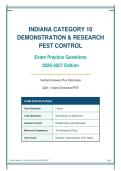
INDIANA CATEGORY 10
DEMONSTRATION & RESEARCH
PEST CONTROL
Exam Practice Questions
2026-2027 Edition
Verified Answers Plus Rationales
Q&A; | Instant Download PDF
EXAM SPECIFICATIONS
Time Allocation: 2 Hours
Total Questions: 50 Questions on State Exam
Question Format: Multiple Choice with Rationales
Minimum Competency: 70% Required to Pass
Core Focus: Research, Demonstration, EUP, Safety
Indiana Category 10 Pest Control Exam Prep 2026-2027 Page 1
, Exam Overview & Content Outline
EXAM PURPOSE
Indiana Category 10 certification is required for individuals who demonstrate restricted use pesticides
(RUPs) or conduct field research with pesticides. Covers experimental use permits (EUPs), research
protocols, demonstration safety, and FIFRA regulations per Indiana Pesticide Law and OISC
requirements.
CONTENT DISTRIBUTION
• Research & Experimental Use (30%) — EUPs, research protocols, data collection, efficacy trials,
plot design
• Demonstration Requirements (25%) — Public demonstrations, safety, notification, recordkeeping,
liability
• Federal & State Regulations (20%) — FIFRA, Indiana Pesticide Law, EUP compliance, reporting
requirements
• Safety & Environmental Protection (15%) — PPE, drift prevention, water protection, endangered
species, buffer zones
• Recordkeeping & Reporting (10%) — Research records, adverse effects reporting, EUP reports,
demonstration records
QUESTION FORMAT & SCORING
Each item presents four options. Correct answers are highlighted in green with checkmark (✓).
Every question includes detailed rationale with regulatory citations. Indiana requires 70% to pass
Category 10 exam.
STUDY STRATEGY
Master EUP requirements and research protocols. Know demonstration safety and notification rules.
Understand FIFRA Section 5 for experimental use. Review Indiana OISC rules for Category 10. Use
rationales for regulatory compliance.
CURRICULUM ALIGNMENT
Questions reflect 2026-2027 standards: FIFRA, 40 CFR Part 172 (EUP), Indiana Pesticide Law IC
15-16-5, OISC regulations, and EPA research guidelines for pesticide demonstrations and field trials.
Indiana Category 10 Pest Control Exam Prep 2026-2027 Page 2
, SECTION I: Research & Experimental Use Permits
1. An Experimental Use Permit (EUP) is required when:
A. Using registered pesticide according to label
✓ B. Testing unregistered pesticide or registered pesticide for unregistered use on >10 acres
C. Demonstrating any pesticide
D. Selling pesticides
Rationale: FIFRA Section 5: EUP required for testing unregistered pesticides or registered pesticides for
new uses if >10 acres land or >1 acre water. Allows data collection for registration. <10 acres may be
exempt but must notify EPA. Indiana OISC enforces.
2. EUP applications must include:
A. Marketing plan only
✓ B. Proposed program, objectives, experimental design, site info, safety precautions
C. Sales projections
D. Competitor analysis
Rationale: 40 CFR 172.4: EUP application requires proposed experimental program, objectives, design,
sites, crops/pests, application rates, safety precautions, disposal plans, qualifications. Not marketing or
sales data.
3. Research plot design best practice to ensure valid data:
A. Single large plot
✓ B. Randomized complete block design with replications and untreated checks
C. No untreated control
D. Adjacent treated plots only
Rationale: Experimental design: randomization, replication, blocking, untreated check/control. Prevents bias,
allows statistical analysis. Single plots or no controls invalidates efficacy data. Standard for EUP trials.
4. Adverse effects during EUP trial must be reported to EPA within:
A. 1 year
✓ B. 10 days of discovery
C. End of season
D. Never
Rationale: 40 CFR 172.8: Any adverse effect (human health, environmental) during EUP must be reported
to EPA within 10 days of discovery. Includes phytotoxicity, non-target effects. Failure to report violates
FIFRA.
5. EUP pesticide containers must be labeled with:
A. Commercial label only
✓ B. 'For Experimental Use Only' plus EUP number and required statements
C. No label needed
Indiana Category 10 Pest Control Exam Prep 2026-2027 Page 3
DEMONSTRATION & RESEARCH
PEST CONTROL
Exam Practice Questions
2026-2027 Edition
Verified Answers Plus Rationales
Q&A; | Instant Download PDF
EXAM SPECIFICATIONS
Time Allocation: 2 Hours
Total Questions: 50 Questions on State Exam
Question Format: Multiple Choice with Rationales
Minimum Competency: 70% Required to Pass
Core Focus: Research, Demonstration, EUP, Safety
Indiana Category 10 Pest Control Exam Prep 2026-2027 Page 1
, Exam Overview & Content Outline
EXAM PURPOSE
Indiana Category 10 certification is required for individuals who demonstrate restricted use pesticides
(RUPs) or conduct field research with pesticides. Covers experimental use permits (EUPs), research
protocols, demonstration safety, and FIFRA regulations per Indiana Pesticide Law and OISC
requirements.
CONTENT DISTRIBUTION
• Research & Experimental Use (30%) — EUPs, research protocols, data collection, efficacy trials,
plot design
• Demonstration Requirements (25%) — Public demonstrations, safety, notification, recordkeeping,
liability
• Federal & State Regulations (20%) — FIFRA, Indiana Pesticide Law, EUP compliance, reporting
requirements
• Safety & Environmental Protection (15%) — PPE, drift prevention, water protection, endangered
species, buffer zones
• Recordkeeping & Reporting (10%) — Research records, adverse effects reporting, EUP reports,
demonstration records
QUESTION FORMAT & SCORING
Each item presents four options. Correct answers are highlighted in green with checkmark (✓).
Every question includes detailed rationale with regulatory citations. Indiana requires 70% to pass
Category 10 exam.
STUDY STRATEGY
Master EUP requirements and research protocols. Know demonstration safety and notification rules.
Understand FIFRA Section 5 for experimental use. Review Indiana OISC rules for Category 10. Use
rationales for regulatory compliance.
CURRICULUM ALIGNMENT
Questions reflect 2026-2027 standards: FIFRA, 40 CFR Part 172 (EUP), Indiana Pesticide Law IC
15-16-5, OISC regulations, and EPA research guidelines for pesticide demonstrations and field trials.
Indiana Category 10 Pest Control Exam Prep 2026-2027 Page 2
, SECTION I: Research & Experimental Use Permits
1. An Experimental Use Permit (EUP) is required when:
A. Using registered pesticide according to label
✓ B. Testing unregistered pesticide or registered pesticide for unregistered use on >10 acres
C. Demonstrating any pesticide
D. Selling pesticides
Rationale: FIFRA Section 5: EUP required for testing unregistered pesticides or registered pesticides for
new uses if >10 acres land or >1 acre water. Allows data collection for registration. <10 acres may be
exempt but must notify EPA. Indiana OISC enforces.
2. EUP applications must include:
A. Marketing plan only
✓ B. Proposed program, objectives, experimental design, site info, safety precautions
C. Sales projections
D. Competitor analysis
Rationale: 40 CFR 172.4: EUP application requires proposed experimental program, objectives, design,
sites, crops/pests, application rates, safety precautions, disposal plans, qualifications. Not marketing or
sales data.
3. Research plot design best practice to ensure valid data:
A. Single large plot
✓ B. Randomized complete block design with replications and untreated checks
C. No untreated control
D. Adjacent treated plots only
Rationale: Experimental design: randomization, replication, blocking, untreated check/control. Prevents bias,
allows statistical analysis. Single plots or no controls invalidates efficacy data. Standard for EUP trials.
4. Adverse effects during EUP trial must be reported to EPA within:
A. 1 year
✓ B. 10 days of discovery
C. End of season
D. Never
Rationale: 40 CFR 172.8: Any adverse effect (human health, environmental) during EUP must be reported
to EPA within 10 days of discovery. Includes phytotoxicity, non-target effects. Failure to report violates
FIFRA.
5. EUP pesticide containers must be labeled with:
A. Commercial label only
✓ B. 'For Experimental Use Only' plus EUP number and required statements
C. No label needed
Indiana Category 10 Pest Control Exam Prep 2026-2027 Page 3