

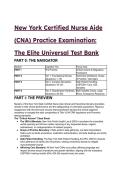
New York Certified Nurse Aide
(CNA) Practice Examination:
The Elite Universal Test Bank
PART 0: THE NAVIGATOR
Section Cognitive Tier Focus Area
PART I The Preview Critical Axioms & Regulatory
Framework
PART II Tier 1: Foundational Syntax Hard Deck Definitions, Scope
(Questions 1–15) of Practice, Vital Signs
PART II Tier 2: Complex Simulation Safe Patient Handling,
(Questions 16–35) LGBTQIA+ Care, ADL
Variables
PART II Tier 3: Grandmaster Synthesis Multi-Variable Crises, Legal
(Questions 36–60) Ethics, Emergency Response
PART I: THE PREVIEW
Mastery of the New York State Certified Nurse Aide clinical and theoretical domains translates
directly to elite clinical performance and the safeguarding of vulnerable populations. Rigorous
engagement with this test bank ensures that practitioners develop the clinical judgment
necessary to navigate the strict complexities of Title 10 NYCRR regulations and Prometric
testing standards.
The "Critical Axioms" Cheat Sheet
● The 2803-d Mandate: New York Public Health Law § 2803-d mandates the immediate
verbal reporting and 48-hour written reporting of any suspected abuse, neglect,
mistreatment, or misappropriation of resident property.
● Scope of Practice Boundary: CNAs perform data gathering, not data interpretation.
Tasks such as sterile procedures, medication administration, and tube feedings are strictly
prohibited.
● Safe Patient Handling: The New York Safe Patient Handling Act (PHL 2997-K) requires
strict adherence to facility zero-lift policies, utilizing mechanical assists to mitigate
musculoskeletal injuries.
● Affirming Care Standard: All New York CNAs must utilize affirming language and
respect diverse sexual orientations and gender identities, aligning with the mandatory
LGBTQIA+ training module (DAL #24-29) required every two years.
, ● Infection Control Absolute: Hand hygiene must be performed for a minimum of 20
seconds, representing the most critical, highly monitored failure point during the Prometric
clinical skills evaluation.
New York CNA Certification & Exam Blueprint
Requirement / Metric Regulatory Standard Clinical Implication
Training Hours Minimum 100 hours (70 Ensures baseline physical care
classroom, 30 clinical) competence prior to resident
contact.
Exam Structure 60 MCQs in 90 minutes Requires rapid, accurate
clinical judgment and
prioritization.
Recertification 7 hours of compensated work Prevents registry lapse and
every 24 months ensures active clinical
engagement.
Domain Weighting Physical Care Skills (~64%) ADLs and basic nursing skills
form the mathematical core of
the exam.
PART II: THE ELITE TEST BANK
Tier 1 - Foundational Syntax & Application
Q1: A New York State CNA observes a resident with a non-blanchable red area on the sacrum.
Based on integumentary assessment protocols, which action is the FIRST priority? A)
Vigorously massage the surrounding tissue to stimulate localized blood flow. B) Apply an
over-the-counter barrier cream to protect the compromised epidermis. C) Halt mechanical
pressure on the area and report the finding to the supervising nurse immediately. D) Document
the finding at the end of the shift to ensure the interdisciplinary team is notified.
● The Answer: C (Halt mechanical pressure on the area and report the finding to the
supervising nurse immediately.)
● Distractor Analysis:
○ A is incorrect: Massaging a non-blanchable red area causes deep tissue damage
and is clinically contraindicated.
○ B is incorrect: Applying unprescribed creams falls outside the unlicensed assistive
personnel scope of practice.
○ D is incorrect: Delayed reporting allows ischemia to progress rapidly, violating
immediate notification standards.
The Mentor's Analysis: Skin preservation requires immediate intervention upon identifying
suspected ischemia. When facing compromised integumentary tissue, the immediate priority is
halting mechanical damage and escalating to clinical leadership. By utilizing immediate
observation and reporting, the practitioner bypasses the common trap of exacerbating tissue
death through friction. Professional/Academic Intuition: Never massage a red bony
prominence; float the area and report it immediately.
Q2: Under New York Public Health Law § 2803-d, what is the mandatory timeline for submitting
a written report after a verbal report of suspected resident abuse has been made? A) Within 12
hours of the incident. B) Within 24 hours of the discovery. C) Within 48 hours to the Department
, of Health. D) Within 5 business days following an internal facility investigation.
● The Answer: C (Within 48 hours to the Department of Health.)
● Distractor Analysis:
○ A is incorrect: Verbal reports must be immediate; the written mandate is specifically
48 hours.
○ B is incorrect: 24 hours is the timeframe for a resident's right to access their medical
records. * D is incorrect: Facilities have 5 days to complete their internal
investigation, but the initial written report cannot wait for this conclusion.
The Mentor's Analysis: Statutory compliance in elder care admits no flexibility. When facing
suspected abuse, the immediate priority is securing the resident and triggering the legal
reporting sequence. By utilizing the immediate verbal/48-hour written protocol, the practitioner
bypasses the common trap of administrative delay leading to professional misconduct.
Professional/Academic Intuition: Verbalize abuse suspicions immediately; document
them within 48 hours.
Q3: During the Prometric clinical skills evaluation for hand hygiene, which oversight represents
an automatic failure regarding infection control? A) Using lukewarm water instead of hot water.
B) Failing to remove a plain wedding band before applying soap. C) Washing hands with friction
for only 15 seconds. D) Drying hands starting from the forearms down to the fingertips.
● The Answer: C (Washing hands with friction for only 15 seconds.)
● Distractor Analysis:
○ A is incorrect: Lukewarm or warm water is preferred; hot water damages the skin
barrier and is not a critical failure.
○ B is incorrect: Plain wedding bands are generally permissible to wear during
standard hand hygiene.
○ D is incorrect: Drying should occur from fingertips to wrists, but failing the
20-second friction rule is the primary automatic failure.
The Mentor's Analysis: Infection control is the mathematical foundation of clinical safety. When
performing medical asepsis, the immediate priority is sufficient mechanical friction to destroy
pathogens. By utilizing the 20-second minimum rule, the practitioner bypasses the common trap
of rushing under testing pressure. Professional/Academic Intuition: Friction is the mechanism
of asepsis; 20 seconds is the unyielding baseline.
Q4: A resident with a diagnosis of dysphagia requires assistance with feeding. The care plan
specifies a mechanical soft diet with nectar-thick liquids. The CNA notices a glass of thin water
on the resident's tray. What is the MOST APPROPRIATE action? A) Add a thickening packet to
the water to achieve a pudding-thick consistency. B) Remove the thin water immediately and
notify the charge nurse of the dietary error. C) Allow the resident to drink the water slowly using
a straw to prevent aspiration. D) Feed the resident the mechanical soft food first, reserving the
water for the end of the meal.
● The Answer: B (Remove the thin water immediately and notify the charge nurse of the
dietary error.)
● Distractor Analysis:
○ A is incorrect: Upgrading to pudding-thick violates the specific medical order for
nectar-thick liquids.
○ C is incorrect: Straws increase the velocity of fluid intake, severely exacerbating
aspiration risks in dysphagia.
○ D is incorrect: Thin liquids remain an aspiration hazard regardless of the sequence
of the meal.
The Mentor's Analysis: Aspiration pneumonia is a lethal, preventable complication. When
(CNA) Practice Examination:
The Elite Universal Test Bank
PART 0: THE NAVIGATOR
Section Cognitive Tier Focus Area
PART I The Preview Critical Axioms & Regulatory
Framework
PART II Tier 1: Foundational Syntax Hard Deck Definitions, Scope
(Questions 1–15) of Practice, Vital Signs
PART II Tier 2: Complex Simulation Safe Patient Handling,
(Questions 16–35) LGBTQIA+ Care, ADL
Variables
PART II Tier 3: Grandmaster Synthesis Multi-Variable Crises, Legal
(Questions 36–60) Ethics, Emergency Response
PART I: THE PREVIEW
Mastery of the New York State Certified Nurse Aide clinical and theoretical domains translates
directly to elite clinical performance and the safeguarding of vulnerable populations. Rigorous
engagement with this test bank ensures that practitioners develop the clinical judgment
necessary to navigate the strict complexities of Title 10 NYCRR regulations and Prometric
testing standards.
The "Critical Axioms" Cheat Sheet
● The 2803-d Mandate: New York Public Health Law § 2803-d mandates the immediate
verbal reporting and 48-hour written reporting of any suspected abuse, neglect,
mistreatment, or misappropriation of resident property.
● Scope of Practice Boundary: CNAs perform data gathering, not data interpretation.
Tasks such as sterile procedures, medication administration, and tube feedings are strictly
prohibited.
● Safe Patient Handling: The New York Safe Patient Handling Act (PHL 2997-K) requires
strict adherence to facility zero-lift policies, utilizing mechanical assists to mitigate
musculoskeletal injuries.
● Affirming Care Standard: All New York CNAs must utilize affirming language and
respect diverse sexual orientations and gender identities, aligning with the mandatory
LGBTQIA+ training module (DAL #24-29) required every two years.
, ● Infection Control Absolute: Hand hygiene must be performed for a minimum of 20
seconds, representing the most critical, highly monitored failure point during the Prometric
clinical skills evaluation.
New York CNA Certification & Exam Blueprint
Requirement / Metric Regulatory Standard Clinical Implication
Training Hours Minimum 100 hours (70 Ensures baseline physical care
classroom, 30 clinical) competence prior to resident
contact.
Exam Structure 60 MCQs in 90 minutes Requires rapid, accurate
clinical judgment and
prioritization.
Recertification 7 hours of compensated work Prevents registry lapse and
every 24 months ensures active clinical
engagement.
Domain Weighting Physical Care Skills (~64%) ADLs and basic nursing skills
form the mathematical core of
the exam.
PART II: THE ELITE TEST BANK
Tier 1 - Foundational Syntax & Application
Q1: A New York State CNA observes a resident with a non-blanchable red area on the sacrum.
Based on integumentary assessment protocols, which action is the FIRST priority? A)
Vigorously massage the surrounding tissue to stimulate localized blood flow. B) Apply an
over-the-counter barrier cream to protect the compromised epidermis. C) Halt mechanical
pressure on the area and report the finding to the supervising nurse immediately. D) Document
the finding at the end of the shift to ensure the interdisciplinary team is notified.
● The Answer: C (Halt mechanical pressure on the area and report the finding to the
supervising nurse immediately.)
● Distractor Analysis:
○ A is incorrect: Massaging a non-blanchable red area causes deep tissue damage
and is clinically contraindicated.
○ B is incorrect: Applying unprescribed creams falls outside the unlicensed assistive
personnel scope of practice.
○ D is incorrect: Delayed reporting allows ischemia to progress rapidly, violating
immediate notification standards.
The Mentor's Analysis: Skin preservation requires immediate intervention upon identifying
suspected ischemia. When facing compromised integumentary tissue, the immediate priority is
halting mechanical damage and escalating to clinical leadership. By utilizing immediate
observation and reporting, the practitioner bypasses the common trap of exacerbating tissue
death through friction. Professional/Academic Intuition: Never massage a red bony
prominence; float the area and report it immediately.
Q2: Under New York Public Health Law § 2803-d, what is the mandatory timeline for submitting
a written report after a verbal report of suspected resident abuse has been made? A) Within 12
hours of the incident. B) Within 24 hours of the discovery. C) Within 48 hours to the Department
, of Health. D) Within 5 business days following an internal facility investigation.
● The Answer: C (Within 48 hours to the Department of Health.)
● Distractor Analysis:
○ A is incorrect: Verbal reports must be immediate; the written mandate is specifically
48 hours.
○ B is incorrect: 24 hours is the timeframe for a resident's right to access their medical
records. * D is incorrect: Facilities have 5 days to complete their internal
investigation, but the initial written report cannot wait for this conclusion.
The Mentor's Analysis: Statutory compliance in elder care admits no flexibility. When facing
suspected abuse, the immediate priority is securing the resident and triggering the legal
reporting sequence. By utilizing the immediate verbal/48-hour written protocol, the practitioner
bypasses the common trap of administrative delay leading to professional misconduct.
Professional/Academic Intuition: Verbalize abuse suspicions immediately; document
them within 48 hours.
Q3: During the Prometric clinical skills evaluation for hand hygiene, which oversight represents
an automatic failure regarding infection control? A) Using lukewarm water instead of hot water.
B) Failing to remove a plain wedding band before applying soap. C) Washing hands with friction
for only 15 seconds. D) Drying hands starting from the forearms down to the fingertips.
● The Answer: C (Washing hands with friction for only 15 seconds.)
● Distractor Analysis:
○ A is incorrect: Lukewarm or warm water is preferred; hot water damages the skin
barrier and is not a critical failure.
○ B is incorrect: Plain wedding bands are generally permissible to wear during
standard hand hygiene.
○ D is incorrect: Drying should occur from fingertips to wrists, but failing the
20-second friction rule is the primary automatic failure.
The Mentor's Analysis: Infection control is the mathematical foundation of clinical safety. When
performing medical asepsis, the immediate priority is sufficient mechanical friction to destroy
pathogens. By utilizing the 20-second minimum rule, the practitioner bypasses the common trap
of rushing under testing pressure. Professional/Academic Intuition: Friction is the mechanism
of asepsis; 20 seconds is the unyielding baseline.
Q4: A resident with a diagnosis of dysphagia requires assistance with feeding. The care plan
specifies a mechanical soft diet with nectar-thick liquids. The CNA notices a glass of thin water
on the resident's tray. What is the MOST APPROPRIATE action? A) Add a thickening packet to
the water to achieve a pudding-thick consistency. B) Remove the thin water immediately and
notify the charge nurse of the dietary error. C) Allow the resident to drink the water slowly using
a straw to prevent aspiration. D) Feed the resident the mechanical soft food first, reserving the
water for the end of the meal.
● The Answer: B (Remove the thin water immediately and notify the charge nurse of the
dietary error.)
● Distractor Analysis:
○ A is incorrect: Upgrading to pudding-thick violates the specific medical order for
nectar-thick liquids.
○ C is incorrect: Straws increase the velocity of fluid intake, severely exacerbating
aspiration risks in dysphagia.
○ D is incorrect: Thin liquids remain an aspiration hazard regardless of the sequence
of the meal.
The Mentor's Analysis: Aspiration pneumonia is a lethal, preventable complication. When


