

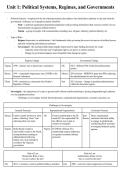
Unit 1: Political Systems, Regimes, and Governments
- Political Systems - comprised of the laws/ideas/procedures that address who should have authority to rule and what the
government’s influence on its people/economy should be
- State - a political organization (permanent population with governing institutions) that exercises control over an
internationally recognized, defined territory
- Nation - a group of people with commonalities including race, religion, ethnicity, political identity, etc.
- Type of Rule -
- Regime (democratic or authoritarian) - the fundamental rules governing the access to/exercise of political power,
typically outlasting individual governments
- Government - the institution/individuals legally empowered to make binding decisions for a state
- Authority stems from the state’s legitimate right to use power to enforce policies
- Change in government happens more frequently than change in regime
Regime Change Government Change
Nigeria 1999 - military rule to democratic constitution UK 2022 - different PMs within the parliamentary
system
Russia 1991 - communist singly-party state (USSR) to the Mexico 2018 election - MORENA party beat PRI, replacing
Russian Federation the administration but not the regime
China 1949 - transition to communist rule (People’s Iran 2021 election - change in president/administration
Republic of China) within the theocratic regime
- Sovereignty - the right/power of a state to govern itself without outside interference; having independent legal authority
over its population/territory
- Challenges to sovereignty include internal pressures, supranational organizations, economic sanctions, etc.
Challenges to Sovereignty
Internal Pressures Supranational Organizations Economic Pressure
Mexico Cartels control territory in some UK Former membership in the EU Iran/ Heavy international
states, collecting “taxes” and meant EU law superseded UK Russia sanctions limit their ability
enforcing their own rules law (Brexit was in part to to engage in global trade,
reclaim sovereignty) constraining their economic
sovereignty/domestic policy
Nigeria Boko Haram created a Nigeria ECOWAS (African EU) options
state-within-a-state in the North, membership requires adherence
seizing territory/creating an to regional economic/military
administration following protocols
Islamic law, in an attempt to
overthrow the Nigerian
government
Rule of Law Rule by Law
Democratic Rule of Law Authoritarian Abuse of Law
“no one is above the law” “law is a tool for the ruler”
UK 2013 - Commons voted to prohibit military airstrikes Iran 2009 - coercion/violent suppression of election
, against Syria, PM had to abandon military plans protests
Mexico 2018 - Nieto had to leave office due to constitutional Russia 2020 - Russian constitutional referendum was used
term limits to reset President Putin’s term limits
Nigeria 2006 - national legislature rejected an attempt to add a China 2018 - President Xi ended constitutional term
third term for the President limits with legislative support, extending his rule
past 10 years
- Control of Media - state influence on/control of what is said/published in the media, including on television, radio,
Internet, etc.
Democratic Media Authoritarian Media
UK Government runs some broadcast outlets Iran Government owns/controls most Blocks internet content of
Allows political dissent in privately broadcast media political dissent
controlled broadcast and print media
Mexico Russia Has rules regulating the
internet to diminish political
dissent
Nigeria China Blocks internet content of
political dissent with the
Great Firewall
- Free and Fair Elections - allows competition so that an opposition candidate/party can defeat the ruling candidate/party
Democratic Media Authoritarian Media
UK Government runs some broadcast outlets Iran Government owns/controls most Blocks internet content of
Allows political dissent in privately broadcast media political dissent
controlled broadcast and print media
Mexico Russia Has rules regulating the
internet to diminish political
dissent
Nigeria China Blocks internet content of
political dissent with the
Great Firewall
- Independence of Governmental Branches - serves to prevent any one branch from controlling all governmental power
Independent Branches
UK 2013 - Commons voted to prohibit Iran National legislature acts as a Expansion of the Supreme
military airstrikes against Syria, PM had rubber stamp Leader’s power
to abandon military plans
Mexico Supreme Court has judicial review Russia Expansion of executive
Constitutional amendments passed - made power (Federal Assembly
the judicial branch more independent represses opposition)
Nigeria 2006 - national legislature rejected an China Expansion of executive
attempt to add a third term for the power (2018 - ended term
President limits for President Xi)
, - Types of Democracies/Authoritarianism -
- Liberal democracy (UK) - free and fair elections; wide array of civil rights
- Illiberal/Hybrid democracy (Mexico/Nigeria) - elections exist with fraud; some rights protected and others
restricted
- Authoritarian forms (Iran/Russia/China) - one-party states/theocracies/military regimes/totalitarian government
(state controls all aspects of life)
- Democratization - the transition from an authoritarian to democratic regime
- Goals include increased competition, fairness, transparency, universal suffrage, equal treatment, etc.
- Democratic consolidation - the process of a democratic regime maturing (robust election rules, separation
of powers, etc.) to the point where reversion to authoritarianism in unlikely without an external shock
- Democratic Backsliding - decline in the quality of democracy (less participation/accountability, weaker rule of
law, etc.)
- Corruption - inhibits democratization, is reduced through the implementation of independent judiciaries
- Consensus - agreement among competing groups on policies creates sustainability
- Power/Authority/Legitimacy -
- Power - the ability to direct the behaviour of others through coercion/persuasion/leadership
- Capacity to act: “regime has the gun”
- Authority - the legal right to exercise power on behalf of the society/the government
- Right to act: “constitution says regime can use the gun”
- Legitimacy - the belief of the people that the government has the right to rule
- Acceptance of authority: “people accept the use of the gun”
- Grants authority and increases a regime/government’s power
- Gaining legitimacy - popular elections, constitutional provisions, nationalism, tradition, governmental
effectiveness, economic growth, ideology, religious heritage/organizations, endorsements, etc.
- Maintaining legitimacy - policy effectiveness, political efficacy, tradition, charismatic leadership,
institutionalized laws, etc.
- Reinforcing legitimacy - peaceful resolution of conflicts, peaceful transfer of power, reduced
governmental corruption, economic development, etc.
- Challenging legitimacy - increased corruption, reduced electoral competition, poor economy, social
conflicts, etc.
- Protests against electoral fraud Iran (2009) and Russia (2011-12)
- Terrorist violence (Nigeria 2015)
- Corruption/inadequacy causing a poor response to a natural disaster (Mexico 1985)
Sources of Power/Authority/Legitimacy
UK Constitutional reforms that devolved power Iran 1979 transition from dictatorial rule to theocracy
House of Commons/PM Islamic Sharia law
Legitimacy: tradition, stability Legitimacy: revolution, Islam
Mexico 2000 transition from PRI single-party rule Russia Political elite’s backing of Putin
Multi-party Republic Election rules favoring one party
Legitimacy: revolution, constitution Legitimacy: tradition, nationalism
Nigeria 1999 transition from military rule China CCP and their control over the military
1999 constitution Legitimacy: revolution, economic growth
Legitimacy: independence, constitution
- Regime change -
- Revolution - the overthrow of a regime based on widespread popular support
- Coup d’etat - the overthrow of the government by a small number of people, usually military leaders
- Can happen from external forces, not necessarily with the support of the people
- Political Systems - comprised of the laws/ideas/procedures that address who should have authority to rule and what the
government’s influence on its people/economy should be
- State - a political organization (permanent population with governing institutions) that exercises control over an
internationally recognized, defined territory
- Nation - a group of people with commonalities including race, religion, ethnicity, political identity, etc.
- Type of Rule -
- Regime (democratic or authoritarian) - the fundamental rules governing the access to/exercise of political power,
typically outlasting individual governments
- Government - the institution/individuals legally empowered to make binding decisions for a state
- Authority stems from the state’s legitimate right to use power to enforce policies
- Change in government happens more frequently than change in regime
Regime Change Government Change
Nigeria 1999 - military rule to democratic constitution UK 2022 - different PMs within the parliamentary
system
Russia 1991 - communist singly-party state (USSR) to the Mexico 2018 election - MORENA party beat PRI, replacing
Russian Federation the administration but not the regime
China 1949 - transition to communist rule (People’s Iran 2021 election - change in president/administration
Republic of China) within the theocratic regime
- Sovereignty - the right/power of a state to govern itself without outside interference; having independent legal authority
over its population/territory
- Challenges to sovereignty include internal pressures, supranational organizations, economic sanctions, etc.
Challenges to Sovereignty
Internal Pressures Supranational Organizations Economic Pressure
Mexico Cartels control territory in some UK Former membership in the EU Iran/ Heavy international
states, collecting “taxes” and meant EU law superseded UK Russia sanctions limit their ability
enforcing their own rules law (Brexit was in part to to engage in global trade,
reclaim sovereignty) constraining their economic
sovereignty/domestic policy
Nigeria Boko Haram created a Nigeria ECOWAS (African EU) options
state-within-a-state in the North, membership requires adherence
seizing territory/creating an to regional economic/military
administration following protocols
Islamic law, in an attempt to
overthrow the Nigerian
government
Rule of Law Rule by Law
Democratic Rule of Law Authoritarian Abuse of Law
“no one is above the law” “law is a tool for the ruler”
UK 2013 - Commons voted to prohibit military airstrikes Iran 2009 - coercion/violent suppression of election
, against Syria, PM had to abandon military plans protests
Mexico 2018 - Nieto had to leave office due to constitutional Russia 2020 - Russian constitutional referendum was used
term limits to reset President Putin’s term limits
Nigeria 2006 - national legislature rejected an attempt to add a China 2018 - President Xi ended constitutional term
third term for the President limits with legislative support, extending his rule
past 10 years
- Control of Media - state influence on/control of what is said/published in the media, including on television, radio,
Internet, etc.
Democratic Media Authoritarian Media
UK Government runs some broadcast outlets Iran Government owns/controls most Blocks internet content of
Allows political dissent in privately broadcast media political dissent
controlled broadcast and print media
Mexico Russia Has rules regulating the
internet to diminish political
dissent
Nigeria China Blocks internet content of
political dissent with the
Great Firewall
- Free and Fair Elections - allows competition so that an opposition candidate/party can defeat the ruling candidate/party
Democratic Media Authoritarian Media
UK Government runs some broadcast outlets Iran Government owns/controls most Blocks internet content of
Allows political dissent in privately broadcast media political dissent
controlled broadcast and print media
Mexico Russia Has rules regulating the
internet to diminish political
dissent
Nigeria China Blocks internet content of
political dissent with the
Great Firewall
- Independence of Governmental Branches - serves to prevent any one branch from controlling all governmental power
Independent Branches
UK 2013 - Commons voted to prohibit Iran National legislature acts as a Expansion of the Supreme
military airstrikes against Syria, PM had rubber stamp Leader’s power
to abandon military plans
Mexico Supreme Court has judicial review Russia Expansion of executive
Constitutional amendments passed - made power (Federal Assembly
the judicial branch more independent represses opposition)
Nigeria 2006 - national legislature rejected an China Expansion of executive
attempt to add a third term for the power (2018 - ended term
President limits for President Xi)
, - Types of Democracies/Authoritarianism -
- Liberal democracy (UK) - free and fair elections; wide array of civil rights
- Illiberal/Hybrid democracy (Mexico/Nigeria) - elections exist with fraud; some rights protected and others
restricted
- Authoritarian forms (Iran/Russia/China) - one-party states/theocracies/military regimes/totalitarian government
(state controls all aspects of life)
- Democratization - the transition from an authoritarian to democratic regime
- Goals include increased competition, fairness, transparency, universal suffrage, equal treatment, etc.
- Democratic consolidation - the process of a democratic regime maturing (robust election rules, separation
of powers, etc.) to the point where reversion to authoritarianism in unlikely without an external shock
- Democratic Backsliding - decline in the quality of democracy (less participation/accountability, weaker rule of
law, etc.)
- Corruption - inhibits democratization, is reduced through the implementation of independent judiciaries
- Consensus - agreement among competing groups on policies creates sustainability
- Power/Authority/Legitimacy -
- Power - the ability to direct the behaviour of others through coercion/persuasion/leadership
- Capacity to act: “regime has the gun”
- Authority - the legal right to exercise power on behalf of the society/the government
- Right to act: “constitution says regime can use the gun”
- Legitimacy - the belief of the people that the government has the right to rule
- Acceptance of authority: “people accept the use of the gun”
- Grants authority and increases a regime/government’s power
- Gaining legitimacy - popular elections, constitutional provisions, nationalism, tradition, governmental
effectiveness, economic growth, ideology, religious heritage/organizations, endorsements, etc.
- Maintaining legitimacy - policy effectiveness, political efficacy, tradition, charismatic leadership,
institutionalized laws, etc.
- Reinforcing legitimacy - peaceful resolution of conflicts, peaceful transfer of power, reduced
governmental corruption, economic development, etc.
- Challenging legitimacy - increased corruption, reduced electoral competition, poor economy, social
conflicts, etc.
- Protests against electoral fraud Iran (2009) and Russia (2011-12)
- Terrorist violence (Nigeria 2015)
- Corruption/inadequacy causing a poor response to a natural disaster (Mexico 1985)
Sources of Power/Authority/Legitimacy
UK Constitutional reforms that devolved power Iran 1979 transition from dictatorial rule to theocracy
House of Commons/PM Islamic Sharia law
Legitimacy: tradition, stability Legitimacy: revolution, Islam
Mexico 2000 transition from PRI single-party rule Russia Political elite’s backing of Putin
Multi-party Republic Election rules favoring one party
Legitimacy: revolution, constitution Legitimacy: tradition, nationalism
Nigeria 1999 transition from military rule China CCP and their control over the military
1999 constitution Legitimacy: revolution, economic growth
Legitimacy: independence, constitution
- Regime change -
- Revolution - the overthrow of a regime based on widespread popular support
- Coup d’etat - the overthrow of the government by a small number of people, usually military leaders
- Can happen from external forces, not necessarily with the support of the people


