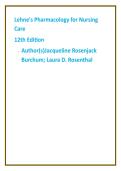
Lehne's Pharmacology for Nursing
Care
12th Edition
• Author(s)Jacqueline Rosenjack
Burchum; Laura D. Rosenthal
,TEST BANK
Question 1 (MCQ)
Clinical Scenario
A nurse administers an antihypertensive medication to a patient
with newly diagnosed hypertension. The patient asks, "How
does this medication know where to work in my body?"
Question Stem
Which pharmacologic concept best explains why a drug
produces its intended effect?
Options
A. Potency
B. Selectivity
C. Bioavailability
D. Half-life
Correct Answer
B. Selectivity
Detailed Rationale
Selectivity refers to a drug's ability to affect a particular tissue
or receptor more than others. Although no drug is completely
,selective, many medications act primarily at specific receptor
sites to achieve therapeutic effects while minimizing adverse
effects.
Incorrect Option Analysis
A. Potency
• Incorrect because potency refers to the amount of drug
needed to produce an effect.
• Misconception: Potent drugs are more selective.
• Safety Risk: May lead to inappropriate dose comparisons.
• Nursing Consideration: Evaluate therapeutic response, not
potency alone.
C. Bioavailability
• Refers to the fraction of administered drug reaching
systemic circulation.
• Does not explain target specificity.
• Safety Risk: Confusion regarding absorption versus action.
D. Half-life
• Refers to the time required for plasma drug concentration
to decrease by 50%.
• Does not determine receptor targeting.
• Safety Risk: Improper medication scheduling.
, Nursing Process Linkage
Assessment
NCJMM Competencies
• Recognize Cues
• Analyze Cues
Difficulty
Easy
Bloom's Level
Understand
NCLEX Category
Pharmacological and Parenteral Therapies
Key Learning Objective
Differentiate selectivity from other pharmacologic properties.
Question 2 (MCQ)
Clinical Scenario
A patient asks why the provider prescribed the lowest effective
dose of a medication rather than a larger dose.
Question Stem
Care
12th Edition
• Author(s)Jacqueline Rosenjack
Burchum; Laura D. Rosenthal
,TEST BANK
Question 1 (MCQ)
Clinical Scenario
A nurse administers an antihypertensive medication to a patient
with newly diagnosed hypertension. The patient asks, "How
does this medication know where to work in my body?"
Question Stem
Which pharmacologic concept best explains why a drug
produces its intended effect?
Options
A. Potency
B. Selectivity
C. Bioavailability
D. Half-life
Correct Answer
B. Selectivity
Detailed Rationale
Selectivity refers to a drug's ability to affect a particular tissue
or receptor more than others. Although no drug is completely
,selective, many medications act primarily at specific receptor
sites to achieve therapeutic effects while minimizing adverse
effects.
Incorrect Option Analysis
A. Potency
• Incorrect because potency refers to the amount of drug
needed to produce an effect.
• Misconception: Potent drugs are more selective.
• Safety Risk: May lead to inappropriate dose comparisons.
• Nursing Consideration: Evaluate therapeutic response, not
potency alone.
C. Bioavailability
• Refers to the fraction of administered drug reaching
systemic circulation.
• Does not explain target specificity.
• Safety Risk: Confusion regarding absorption versus action.
D. Half-life
• Refers to the time required for plasma drug concentration
to decrease by 50%.
• Does not determine receptor targeting.
• Safety Risk: Improper medication scheduling.
, Nursing Process Linkage
Assessment
NCJMM Competencies
• Recognize Cues
• Analyze Cues
Difficulty
Easy
Bloom's Level
Understand
NCLEX Category
Pharmacological and Parenteral Therapies
Key Learning Objective
Differentiate selectivity from other pharmacologic properties.
Question 2 (MCQ)
Clinical Scenario
A patient asks why the provider prescribed the lowest effective
dose of a medication rather than a larger dose.
Question Stem