

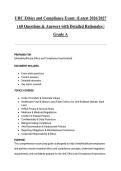
UHC Ethics and Compliance Exam: (Latest 2026/2027
) 60 Questions & Answers with Detailed Rationales |
Grade A
PREPARED FOR:
[UnitedHealthcare Ethics and Compliance Examination]
DOCUMENT INCLUDES:
● Exam-style questions
● Correct answers
● Detailed rationales
● Key topics covered
TOPICS COVERED:
● Code of Conduct & Corporate Values
● Healthcare Fraud & Abuse Laws (False Claims Act, Anti-Kickback Statute, Stark
Law)
● HIPAA Privacy & Security Rules
● Medicare & Medicaid Regulations
● Conflict of Interest Policies
● Confidentiality & Data Protection
● Billing & Coding Compliance
● Anti-Discrimination & Harassment Policies
● Reporting Obligations & Whistleblower Protections
● Corporate Responsibility & Ethics
PURPOSE:
This comprehensive exam prep guide is designed to help UnitedHealthcare employees
and partners master essential ethics and compliance concepts, understand regulatory
requirements, and confidently prepare for the UHC Ethics and Compliance Examination.
,SECTION 1: Code of Conduct & Corporate Values
Question 1
Which of the following best describes the primary purpose of UnitedHealthcare's Code
of Conduct?
A. To provide a comprehensive list of all federal healthcare regulations
B. To establish the ethical standards and expectations for all employees, officers, and
directors in their daily business activities
C. To outline the company's financial reporting procedures exclusively
D. To serve as a replacement for individual department policies and procedures
Correct Answer: B
Rationale: The Code of Conduct establishes the ethical standards, values, and
behavioral expectations that guide all employees, officers, and directors in their daily
business activities and decision-making. It serves as the foundation for ethical behavior
across the organization. Option A is incorrect because the Code of Conduct is broader
than just listing regulations—it provides guidance on how to apply ethical principles.
Option C is too narrow, as the Code covers far more than financial reporting. Option D is
incorrect because the Code of Conduct complements, rather than replaces,
departmental policies and procedures.
Question 2
A UnitedHealthcare employee is faced with a business decision that could benefit the
company financially but may not be in the best interest of a member. According to the
Code of Conduct, which principle should guide this decision?
A. Prioritize company profitability above all other considerations
B. Make decisions that balance company interests with member welfare, always acting
with integrity and putting members first
,C. Defer the decision to senior management without providing input
D. Follow the lowest-cost option regardless of member impact
Correct Answer: B
Rationale: UnitedHealthcare's Code of Conduct emphasizes integrity, member-focused
care, and ethical decision-making. Employees are expected to balance business
interests with the welfare of members, always acting in ways that uphold the company's
values and regulatory obligations. Prioritizing profitability above member welfare
(Option A) violates the ethical obligation to act in members' best interests. Deferring
without input (Option C) abdicates individual responsibility. Following the lowest-cost
option regardless of impact (Option D) could compromise quality of care and member
outcomes.
Question 3
Which of the following actions by a UnitedHealthcare employee would be considered a
violation of the Code of Conduct?
A. Reporting a suspected compliance issue through the anonymous hotline
B. Refusing to participate in an activity that violates federal healthcare laws
C. Accepting a $500 gift from a pharmaceutical representative without disclosing it
D. Attending a mandatory compliance training session
Correct Answer: C
Rationale: Accepting a $500 gift from a vendor or pharmaceutical representative
without disclosure violates conflict of interest and gift acceptance policies. Most
healthcare organizations, including UnitedHealthcare, have strict limits on gift values
and require disclosure of any gifts received. Reporting compliance issues (Option A) is
encouraged and protected. Refusing to participate in illegal activities (Option B) is
, required by the Code of Conduct. Attending mandatory training (Option D) is a
compliance obligation.
Question 4
According to corporate ethics principles, which of the following is an example of acting
with integrity?
A. Modifying documentation to support a denied claim after the fact
B. Admitting a billing error to a member and taking corrective action
C. Ignoring a colleague's request for assistance with a compliance question
D. Sharing member information with a family member without authorization
Correct Answer: B
Rationale: Acting with integrity means being honest, transparent, and accountable in all
business dealings. Admitting a billing error and taking corrective action demonstrates
integrity, accountability, and commitment to ethical standards. Modifying
documentation after the fact (Option A) constitutes fraud. Ignoring a compliance
question (Option C) violates the duty to support a culture of compliance. Sharing
protected information without authorization (Option D) violates HIPAA privacy rules.
Question 5
UnitedHealthcare's commitment to corporate social responsibility includes which of the
following?
A. Maximizing shareholder returns exclusively
B. Operating in ways that are ethical, transparent, and beneficial to communities,
members, and employees
C. Avoiding all community involvement to focus on core business
D. Prioritizing cost reduction over environmental sustainability
Correct Answer: B
) 60 Questions & Answers with Detailed Rationales |
Grade A
PREPARED FOR:
[UnitedHealthcare Ethics and Compliance Examination]
DOCUMENT INCLUDES:
● Exam-style questions
● Correct answers
● Detailed rationales
● Key topics covered
TOPICS COVERED:
● Code of Conduct & Corporate Values
● Healthcare Fraud & Abuse Laws (False Claims Act, Anti-Kickback Statute, Stark
Law)
● HIPAA Privacy & Security Rules
● Medicare & Medicaid Regulations
● Conflict of Interest Policies
● Confidentiality & Data Protection
● Billing & Coding Compliance
● Anti-Discrimination & Harassment Policies
● Reporting Obligations & Whistleblower Protections
● Corporate Responsibility & Ethics
PURPOSE:
This comprehensive exam prep guide is designed to help UnitedHealthcare employees
and partners master essential ethics and compliance concepts, understand regulatory
requirements, and confidently prepare for the UHC Ethics and Compliance Examination.
,SECTION 1: Code of Conduct & Corporate Values
Question 1
Which of the following best describes the primary purpose of UnitedHealthcare's Code
of Conduct?
A. To provide a comprehensive list of all federal healthcare regulations
B. To establish the ethical standards and expectations for all employees, officers, and
directors in their daily business activities
C. To outline the company's financial reporting procedures exclusively
D. To serve as a replacement for individual department policies and procedures
Correct Answer: B
Rationale: The Code of Conduct establishes the ethical standards, values, and
behavioral expectations that guide all employees, officers, and directors in their daily
business activities and decision-making. It serves as the foundation for ethical behavior
across the organization. Option A is incorrect because the Code of Conduct is broader
than just listing regulations—it provides guidance on how to apply ethical principles.
Option C is too narrow, as the Code covers far more than financial reporting. Option D is
incorrect because the Code of Conduct complements, rather than replaces,
departmental policies and procedures.
Question 2
A UnitedHealthcare employee is faced with a business decision that could benefit the
company financially but may not be in the best interest of a member. According to the
Code of Conduct, which principle should guide this decision?
A. Prioritize company profitability above all other considerations
B. Make decisions that balance company interests with member welfare, always acting
with integrity and putting members first
,C. Defer the decision to senior management without providing input
D. Follow the lowest-cost option regardless of member impact
Correct Answer: B
Rationale: UnitedHealthcare's Code of Conduct emphasizes integrity, member-focused
care, and ethical decision-making. Employees are expected to balance business
interests with the welfare of members, always acting in ways that uphold the company's
values and regulatory obligations. Prioritizing profitability above member welfare
(Option A) violates the ethical obligation to act in members' best interests. Deferring
without input (Option C) abdicates individual responsibility. Following the lowest-cost
option regardless of impact (Option D) could compromise quality of care and member
outcomes.
Question 3
Which of the following actions by a UnitedHealthcare employee would be considered a
violation of the Code of Conduct?
A. Reporting a suspected compliance issue through the anonymous hotline
B. Refusing to participate in an activity that violates federal healthcare laws
C. Accepting a $500 gift from a pharmaceutical representative without disclosing it
D. Attending a mandatory compliance training session
Correct Answer: C
Rationale: Accepting a $500 gift from a vendor or pharmaceutical representative
without disclosure violates conflict of interest and gift acceptance policies. Most
healthcare organizations, including UnitedHealthcare, have strict limits on gift values
and require disclosure of any gifts received. Reporting compliance issues (Option A) is
encouraged and protected. Refusing to participate in illegal activities (Option B) is
, required by the Code of Conduct. Attending mandatory training (Option D) is a
compliance obligation.
Question 4
According to corporate ethics principles, which of the following is an example of acting
with integrity?
A. Modifying documentation to support a denied claim after the fact
B. Admitting a billing error to a member and taking corrective action
C. Ignoring a colleague's request for assistance with a compliance question
D. Sharing member information with a family member without authorization
Correct Answer: B
Rationale: Acting with integrity means being honest, transparent, and accountable in all
business dealings. Admitting a billing error and taking corrective action demonstrates
integrity, accountability, and commitment to ethical standards. Modifying
documentation after the fact (Option A) constitutes fraud. Ignoring a compliance
question (Option C) violates the duty to support a culture of compliance. Sharing
protected information without authorization (Option D) violates HIPAA privacy rules.
Question 5
UnitedHealthcare's commitment to corporate social responsibility includes which of the
following?
A. Maximizing shareholder returns exclusively
B. Operating in ways that are ethical, transparent, and beneficial to communities,
members, and employees
C. Avoiding all community involvement to focus on core business
D. Prioritizing cost reduction over environmental sustainability
Correct Answer: B


