

Anatomy and Physiology Chapter 14
Study online at https://quizlet.com/_jpcgff
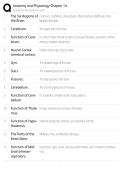
1. The Six Regions of Cerebrum, Cerebellum, Diencephalon, Mesencephalon (Midbrain), Pons,
the Brain. Medulla oblongata
2. Cerebrum. The largest part of the brain.
3. Function of Cere- It Controls higher mental functions (Conscious thoughts, sensations, intellect,
brum. memory, complex movements).
4. Neural Cortex Folded surface layer of gray matter.
(cerebral cortex).
5. Gyri. The elevated ridges of the brain.
6. Sulci. The shallow depressions of the brain.
7. Fissures. The deep grooves of the brain.
8. Cerebellum. The second largest part of the brain.
9. Function of Cere- It Coordinates complex somatic motor patterns.
bellum.
10. Function of Thala- It relays and processes sensory information.
mus.
11. Function of Hypo- hormone production, emotion, and autonomic function.
thalamus.
12. The Parts of the Midbrain, Pons, and Medulla oblongata.
Brain Stem.
13. Function of Mid- It processes sight, sound, and associated reflexes, and it maintains conscious-
brain (mesen- ness.
cephalon).
, Anatomy and Physiology Chapter 14
Study online at https://quizlet.com/_jpcgff
14. Function of Pons It connects cerebellum to brain stem, and it Is involved in somatic and visceral
motor control such as respiratory.
15. Function of Medul- Connects brain to spinal cord, relays information,and regulates autonomic
la Oblongata. functions (heart rate, blood pressure, respiratory and digestion).
16. Ventricles of the Lateral ventricles (First and Second), third ventricle, and fourth ventricle.
Brain.
17. Lateral Ventricles. Each cerebral hemisphere contains one large lateral chamber, and it is sepa-
rated by a thin medial partition (septum pellucidum).
18. Third Ventricle. It communicates with lateral ventricles via interventricular foramen (foramen of
Monro).
19. Cerebral Aque- It connects third ventricle to Fourth ventricle.
duct.
20. Fourth Ventricle. It extends into medulla oblongata and becomes continuous with central canal
of the spinal cord.
21. The Layers of Cra- Dura mater, arachnoid mater, and pia mater.
nial Meninges.
22. Dura Mater. This mater extends inward in several areas to form flat partitions that divide
cranial cavity
23. Function of Dura This mater acts to limit excessive movement of brain
Mater.
24. The Three Main Falx cerebri, falx cerebelli, and tentorium cerebelli.
Septa.
25. Arachnoid Mater. This mater covers the brain.
Study online at https://quizlet.com/_jpcgff
1. The Six Regions of Cerebrum, Cerebellum, Diencephalon, Mesencephalon (Midbrain), Pons,
the Brain. Medulla oblongata
2. Cerebrum. The largest part of the brain.
3. Function of Cere- It Controls higher mental functions (Conscious thoughts, sensations, intellect,
brum. memory, complex movements).
4. Neural Cortex Folded surface layer of gray matter.
(cerebral cortex).
5. Gyri. The elevated ridges of the brain.
6. Sulci. The shallow depressions of the brain.
7. Fissures. The deep grooves of the brain.
8. Cerebellum. The second largest part of the brain.
9. Function of Cere- It Coordinates complex somatic motor patterns.
bellum.
10. Function of Thala- It relays and processes sensory information.
mus.
11. Function of Hypo- hormone production, emotion, and autonomic function.
thalamus.
12. The Parts of the Midbrain, Pons, and Medulla oblongata.
Brain Stem.
13. Function of Mid- It processes sight, sound, and associated reflexes, and it maintains conscious-
brain (mesen- ness.
cephalon).
, Anatomy and Physiology Chapter 14
Study online at https://quizlet.com/_jpcgff
14. Function of Pons It connects cerebellum to brain stem, and it Is involved in somatic and visceral
motor control such as respiratory.
15. Function of Medul- Connects brain to spinal cord, relays information,and regulates autonomic
la Oblongata. functions (heart rate, blood pressure, respiratory and digestion).
16. Ventricles of the Lateral ventricles (First and Second), third ventricle, and fourth ventricle.
Brain.
17. Lateral Ventricles. Each cerebral hemisphere contains one large lateral chamber, and it is sepa-
rated by a thin medial partition (septum pellucidum).
18. Third Ventricle. It communicates with lateral ventricles via interventricular foramen (foramen of
Monro).
19. Cerebral Aque- It connects third ventricle to Fourth ventricle.
duct.
20. Fourth Ventricle. It extends into medulla oblongata and becomes continuous with central canal
of the spinal cord.
21. The Layers of Cra- Dura mater, arachnoid mater, and pia mater.
nial Meninges.
22. Dura Mater. This mater extends inward in several areas to form flat partitions that divide
cranial cavity
23. Function of Dura This mater acts to limit excessive movement of brain
Mater.
24. The Three Main Falx cerebri, falx cerebelli, and tentorium cerebelli.
Septa.
25. Arachnoid Mater. This mater covers the brain.


