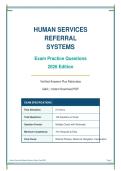
HUMAN SERVICES
REFERRAL
SYSTEMS
Exam Practice Questions
2026 Edition
Verified Answers Plus Rationales
Q&A; | Instant Download PDF
EXAM SPECIFICATIONS
Time Allocation: 2.5 Hours
Total Questions: 100 Questions on Exam
Question Format: Multiple Choice with Rationales
Minimum Competency: 70% Required to Pass
Core Focus: Referral Process, Resource Navigation, Coordination
Human Services Referral Systems Exam Prep 2026 Page 1
, Exam Overview & Content Outline
EXAM PURPOSE
This Human Services Referral Systems Exam Prep validates knowledge required for professionals
managing referral networks and connecting clients to services. Content covers referral processes,
resource navigation, interagency coordination, information systems, and follow-up per HS-BCP and
best practices.
CONTENT DISTRIBUTION
• Referral Process & Best Practices (25%) — Screening, assessment, referral types, warm
handoffs, documentation
• Resource Navigation & Mapping (25%) — Resource directories, eligibility, benefits, community
resources, 211 systems
• Interagency Coordination & MOUs (20%) — Collaboration, MOUs, confidentiality, data sharing,
coordinated entry
• Information Systems & Technology (15%) — HMIS, referral platforms, databases, data security,
interoperability
• Follow-up, Evaluation & Ethics (15%) — Tracking outcomes, closing loops, quality assurance,
ethical referral practices
QUESTION FORMAT & SCORING
Each item presents four options. Correct answers are highlighted in green with checkmark (✓).
Every question includes detailed rationale with referral system standards and best practices. Most
certifications require 70% to pass.
STUDY STRATEGY
Master referral workflow from intake to follow-up. Know resource eligibility criteria. Understand
confidentiality in referrals. Review HMIS and coordinated entry systems. Use rationales for referral
decision-making.
CURRICULUM ALIGNMENT
Questions reflect 2026 standards: HS-BCP referral competencies, coordinated entry standards,
HMIS data standards, 211 best practices, and interagency referral protocols.
Human Services Referral Systems Exam Prep 2026 Page 2
, SECTION I: Referral Process & Best Practices
1. A warm handoff in referral systems means:
A. Giving client a phone number only
✓ B. Direct introduction/transfer between providers with client present
C. Emailing referral form
D. Waiting for client to call
Rationale: Warm handoff: direct introduction between referring and receiving provider with client present
(in-person or three-way call). Increases engagement, reduces dropout. Cold handoff: give info and client
contacts alone.
2. First step in referral process after identifying need:
A. Make referral immediately
✓ B. Assess client eligibility and readiness
C. Close case
D. Bill insurance
Rationale: Referral process: 1) Assess need, 2) Assess eligibility/readiness, 3) Identify appropriate resource,
4) Obtain consent, 5) Make referral, 6) Follow-up. Must verify eligibility and client willingness before
referring.
3. Release of Information (ROI) for referrals must include:
A. Verbal permission only
✓ B. Specific info to be shared, purpose, expiration date, signature
C. Blanket authorization
D. No expiration needed
Rationale: Valid ROI: specific information to be disclosed, purpose, recipient, expiration date/event,
signature, date, right to revoke. HIPAA and 42 CFR Part 2 compliant. Blanket or verbal insufficient.
4. Coordinated entry system in homeless services is designed to:
A. Serve first-come first-served only
✓ B. Assess, prioritize, and match households to appropriate housing interventions
C. Deny services
D. Bypass assessment
Rationale: Coordinated Entry: standardized assessment, prioritization based on vulnerability, matching to
housing resources, referral. Ensures most vulnerable served first, not first-come. HUD requirement for
CoCs.
5. When client declines referral, best practice is to:
A. Close case immediately
✓ B. Explore barriers, provide info, respect choice, offer to revisit
C. Force referral
Human Services Referral Systems Exam Prep 2026 Page 3
REFERRAL
SYSTEMS
Exam Practice Questions
2026 Edition
Verified Answers Plus Rationales
Q&A; | Instant Download PDF
EXAM SPECIFICATIONS
Time Allocation: 2.5 Hours
Total Questions: 100 Questions on Exam
Question Format: Multiple Choice with Rationales
Minimum Competency: 70% Required to Pass
Core Focus: Referral Process, Resource Navigation, Coordination
Human Services Referral Systems Exam Prep 2026 Page 1
, Exam Overview & Content Outline
EXAM PURPOSE
This Human Services Referral Systems Exam Prep validates knowledge required for professionals
managing referral networks and connecting clients to services. Content covers referral processes,
resource navigation, interagency coordination, information systems, and follow-up per HS-BCP and
best practices.
CONTENT DISTRIBUTION
• Referral Process & Best Practices (25%) — Screening, assessment, referral types, warm
handoffs, documentation
• Resource Navigation & Mapping (25%) — Resource directories, eligibility, benefits, community
resources, 211 systems
• Interagency Coordination & MOUs (20%) — Collaboration, MOUs, confidentiality, data sharing,
coordinated entry
• Information Systems & Technology (15%) — HMIS, referral platforms, databases, data security,
interoperability
• Follow-up, Evaluation & Ethics (15%) — Tracking outcomes, closing loops, quality assurance,
ethical referral practices
QUESTION FORMAT & SCORING
Each item presents four options. Correct answers are highlighted in green with checkmark (✓).
Every question includes detailed rationale with referral system standards and best practices. Most
certifications require 70% to pass.
STUDY STRATEGY
Master referral workflow from intake to follow-up. Know resource eligibility criteria. Understand
confidentiality in referrals. Review HMIS and coordinated entry systems. Use rationales for referral
decision-making.
CURRICULUM ALIGNMENT
Questions reflect 2026 standards: HS-BCP referral competencies, coordinated entry standards,
HMIS data standards, 211 best practices, and interagency referral protocols.
Human Services Referral Systems Exam Prep 2026 Page 2
, SECTION I: Referral Process & Best Practices
1. A warm handoff in referral systems means:
A. Giving client a phone number only
✓ B. Direct introduction/transfer between providers with client present
C. Emailing referral form
D. Waiting for client to call
Rationale: Warm handoff: direct introduction between referring and receiving provider with client present
(in-person or three-way call). Increases engagement, reduces dropout. Cold handoff: give info and client
contacts alone.
2. First step in referral process after identifying need:
A. Make referral immediately
✓ B. Assess client eligibility and readiness
C. Close case
D. Bill insurance
Rationale: Referral process: 1) Assess need, 2) Assess eligibility/readiness, 3) Identify appropriate resource,
4) Obtain consent, 5) Make referral, 6) Follow-up. Must verify eligibility and client willingness before
referring.
3. Release of Information (ROI) for referrals must include:
A. Verbal permission only
✓ B. Specific info to be shared, purpose, expiration date, signature
C. Blanket authorization
D. No expiration needed
Rationale: Valid ROI: specific information to be disclosed, purpose, recipient, expiration date/event,
signature, date, right to revoke. HIPAA and 42 CFR Part 2 compliant. Blanket or verbal insufficient.
4. Coordinated entry system in homeless services is designed to:
A. Serve first-come first-served only
✓ B. Assess, prioritize, and match households to appropriate housing interventions
C. Deny services
D. Bypass assessment
Rationale: Coordinated Entry: standardized assessment, prioritization based on vulnerability, matching to
housing resources, referral. Ensures most vulnerable served first, not first-come. HUD requirement for
CoCs.
5. When client declines referral, best practice is to:
A. Close case immediately
✓ B. Explore barriers, provide info, respect choice, offer to revisit
C. Force referral
Human Services Referral Systems Exam Prep 2026 Page 3