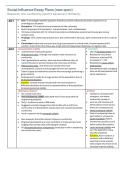
Social Influence Essay Plans (new spec)
Research into conformity (Asch’s baseline) (16 Marks)
AO1 • Aim: To investigate whether people’s Answers could be influence by others' opinions in an
unambiguous situation
• Procedure: 123 male American students at Yale university
• Split into groups of 6-8 people (1 real participant, rest confederates)
• 18 trials conducted with 12 critical trials where confederates would unanimously give wrong
answers only
• Findings: 75% conformed at least once, 5% conformed to all trials, 32% conformed on all 12 critical
trials
• Concluded conformity occurred due to group pressure in critical trials. As participants didn’t
conform most of the time there was a high level of independent behaviour in regular trials
AO3 -low population validity + controlled
• 123 American male participants • Use of lab experiment (uni)
• Androcentric bias, findings only explain male reactions to • Researcher has direct
conformity influence, reduces EVS,
• Can’t generalise to women, who may have different rates of increases IV -> DV
conformity due to women being more conscious of others • Establishes cause-effect
• Ethnocentric bias, only American sample who have relationship
individualistic culture so encouraged to form own opinion • Standardised task of judging
• Doesn’t apply to collectivist cultures who encourage prioritising a lines so all participants have
group opinion same experience
• Findings aren’t useful for a large portion of the population due to
limited generalisation
• Solution: sample should include both men and women of
different ethnicities to ensure its representative of the population.
Increasing external validity
-alternative research -artificial
• It’s a child of its time • Hosted in university with
• Perrin & Spencer (1980) replicated Asch’s line study with UK strangers, not where
engineering students conformity usually is
• Only 1 conform in total of 396 trials • such as with friends and
• Suggests societal changes from 50s to 80s with a shift from family about social issues,
community to individualistic values post-war caused decreased there are consequences
conformity • lacks ecological validity
• Asch’s research lacks temporal validity • Task of comparing lines to
each other is unusual so
• Also presents that other factors influence conformtiy lacks mundane realism
• Engineering students are more confident at measurement and • Conformity usually occurs
judging lines as they work with designs/ models within social discussions
• So dispostional factor of expertise could play a role in explaining • Lacks external validity and
low conformtiy rates can't be applied to many
real-life situations
• Solution: Asch conduct a
variation with a different
task that’s more realistic
with people who know e/o to
increase external validity
, Social Influence Essay Plans (new spec)
Explanations for conformity (16 Marks)
AO1 • Normative social influence is when someone agrees with the majority to be
liked and avoid rejection
• Leads to compliance- where public behaviour changes, but private opinion
remains the same
• Conforming for emotional reasons- temporary change in view/ behaviour
• Informative social influence is when someone agrees with the majority
though acceptance of new information, having a desire to be right
• Leading to internalisation, individual change their public and private belief,
private acceptance of the majority views
• Conforming for cognitive reasons- a permanent change in view behaviour
AO3 +supporting research (NSI) + Supporting Research (ISI)
• Asch interviewed participants after his experiment, said • Lucus et al. (2006) students
they only conformed to avoid being rejected had to give answers to easy
• In one variation (anonymity) Where participants answered and hard maths problems,
privately conformity dropped to 12.5% as there was no confederates told to give
group pressure wrong answers
• Supports that NSI is influential conformity as it will • Found conformity high for
increase with a large majority and decrease when people difficult problems and high
are alone as there’s no one to want to be liked by for those who rates maths
ability as poor
• Supports ISI as participants
didn’t want to be wrong so
higher conformity for hard
questions
-Individual differences -Counter: can’t separate NSI and
• Paul McGhee and Richard Teevan (1967) identified some ISI
people called nAffliatiors were more likely to conform • In real life its hard to
• Shows NSI explains conformity more for some people differentiate if behaviour is
than others due to NSI/ISI
• These individual differences between people can't be fully • In Asch’s unanimity variation
explained by situational pressure conformity reduced when
• Instead dispostional factors of personality come into play theres a dissenter
• Dissenter may reduce power
of NSI as they provide social
support
• Or reduce power of ISI as
they provide an alt. Source of
social information
• Hard to separate NSI and ISI
as both processes probably
operate together in most
real-world conformity
situations
Research into conformity (Asch’s baseline) (16 Marks)
AO1 • Aim: To investigate whether people’s Answers could be influence by others' opinions in an
unambiguous situation
• Procedure: 123 male American students at Yale university
• Split into groups of 6-8 people (1 real participant, rest confederates)
• 18 trials conducted with 12 critical trials where confederates would unanimously give wrong
answers only
• Findings: 75% conformed at least once, 5% conformed to all trials, 32% conformed on all 12 critical
trials
• Concluded conformity occurred due to group pressure in critical trials. As participants didn’t
conform most of the time there was a high level of independent behaviour in regular trials
AO3 -low population validity + controlled
• 123 American male participants • Use of lab experiment (uni)
• Androcentric bias, findings only explain male reactions to • Researcher has direct
conformity influence, reduces EVS,
• Can’t generalise to women, who may have different rates of increases IV -> DV
conformity due to women being more conscious of others • Establishes cause-effect
• Ethnocentric bias, only American sample who have relationship
individualistic culture so encouraged to form own opinion • Standardised task of judging
• Doesn’t apply to collectivist cultures who encourage prioritising a lines so all participants have
group opinion same experience
• Findings aren’t useful for a large portion of the population due to
limited generalisation
• Solution: sample should include both men and women of
different ethnicities to ensure its representative of the population.
Increasing external validity
-alternative research -artificial
• It’s a child of its time • Hosted in university with
• Perrin & Spencer (1980) replicated Asch’s line study with UK strangers, not where
engineering students conformity usually is
• Only 1 conform in total of 396 trials • such as with friends and
• Suggests societal changes from 50s to 80s with a shift from family about social issues,
community to individualistic values post-war caused decreased there are consequences
conformity • lacks ecological validity
• Asch’s research lacks temporal validity • Task of comparing lines to
each other is unusual so
• Also presents that other factors influence conformtiy lacks mundane realism
• Engineering students are more confident at measurement and • Conformity usually occurs
judging lines as they work with designs/ models within social discussions
• So dispostional factor of expertise could play a role in explaining • Lacks external validity and
low conformtiy rates can't be applied to many
real-life situations
• Solution: Asch conduct a
variation with a different
task that’s more realistic
with people who know e/o to
increase external validity
, Social Influence Essay Plans (new spec)
Explanations for conformity (16 Marks)
AO1 • Normative social influence is when someone agrees with the majority to be
liked and avoid rejection
• Leads to compliance- where public behaviour changes, but private opinion
remains the same
• Conforming for emotional reasons- temporary change in view/ behaviour
• Informative social influence is when someone agrees with the majority
though acceptance of new information, having a desire to be right
• Leading to internalisation, individual change their public and private belief,
private acceptance of the majority views
• Conforming for cognitive reasons- a permanent change in view behaviour
AO3 +supporting research (NSI) + Supporting Research (ISI)
• Asch interviewed participants after his experiment, said • Lucus et al. (2006) students
they only conformed to avoid being rejected had to give answers to easy
• In one variation (anonymity) Where participants answered and hard maths problems,
privately conformity dropped to 12.5% as there was no confederates told to give
group pressure wrong answers
• Supports that NSI is influential conformity as it will • Found conformity high for
increase with a large majority and decrease when people difficult problems and high
are alone as there’s no one to want to be liked by for those who rates maths
ability as poor
• Supports ISI as participants
didn’t want to be wrong so
higher conformity for hard
questions
-Individual differences -Counter: can’t separate NSI and
• Paul McGhee and Richard Teevan (1967) identified some ISI
people called nAffliatiors were more likely to conform • In real life its hard to
• Shows NSI explains conformity more for some people differentiate if behaviour is
than others due to NSI/ISI
• These individual differences between people can't be fully • In Asch’s unanimity variation
explained by situational pressure conformity reduced when
• Instead dispostional factors of personality come into play theres a dissenter
• Dissenter may reduce power
of NSI as they provide social
support
• Or reduce power of ISI as
they provide an alt. Source of
social information
• Hard to separate NSI and ISI
as both processes probably
operate together in most
real-world conformity
situations