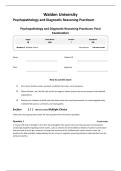
Walden University
Psychopathology and Diagnostic Reasoning Practicum
Psychopathology and Diagnostic Reasoning Practicum: Final
Examination
Name Student ID
Date Signature
How to use this exam
1 Set a timer. Practice under real exam conditions! No notes, no AI assistance.
2 When finished, scan the QR code on the last page to submit and see the correct answers with detailed
explanations.
3 Review your mistakes carefully and note down areas that need improvement. to create targeted study
materials like quizzes, summaries, and study guides.
Section 1/1 100 total marks Multiple Choice
Select the most appropriate answer for each question from the choices provided.
Question 1 2 total marks
A 72-year-old male is brought to the clinic by his daughter. She reports that over the past year, he has become
increasingly forgetful regarding recent events, such as what he ate for breakfast or details of a phone conversation
that occurred an hour ago. However, his long-term memory of his childhood and career remains intact. He
performs his daily activities independently, but his scores on cognitive screening indicate a subtle decline from his
previous baseline.
, A Based on the clinical presentation described, which mental function is most significantly affected in patients
experiencing mild cognitive impairment?
A Recent memory
B Executive function
C Language fluency D Remote memory
Question 2 2 marks
When assessing developmental delays in children, identify the most frequent cause of infant and childhood
intellectual disability that is attributed to a specific, single gene abnormality.
A Down syndrome
B Fragile X Syndrome
C Prader-Willi Syndrome
D Fetal Alcohol Syndrome
Question 3 2 marks
In the neurobiological understanding of Attention-Deficit/Hyperactivity Disorder (ADHD), which neurotransmitter
system is most strongly associated with the occurrence of symptoms and is the primary target for stimulant
medications?
A Serotonin
B Dopamine
C GABA
D Acetylcholine
Question 4 2 total marks
A 78-year-old female is currently hospitalized following a hip replacement surgery. On the second postoperative day,
she begins to experience a sudden onset of agitation, visual hallucinations of 'insects on the wall,' and confusion
regarding her location. She fluctuates between periods of lucidity and extreme disorientation.
A For the patient described who is experiencing acute psychosis and agitation within the context of delirium,
select the pharmacological drug of choice to manage the psychotic symptoms.
, A Haloperidol
B Lorazepam C Clozapine
D Quetiapine
Question 5 2 marks
When comparing the clinical characteristics of schizophrenia, which feature is significantly more prevalent in
childhood-onset cases than in adult-onset cases?
A Auditory hallucinations B
Violent behavior
C Organized delusions D
Social withdrawal
Question 6 2 marks
Which personality disorder is specifically characterized by patients who are perpetually in a state of crisis,
exhibiting highly unpredictable behavior and unstable interpersonal relationships?
A Dependent
B Schizotypal
C Narcissistic
D Borderline
Psychopathology and Diagnostic Reasoning Practicum
Psychopathology and Diagnostic Reasoning Practicum: Final
Examination
Name Student ID
Date Signature
How to use this exam
1 Set a timer. Practice under real exam conditions! No notes, no AI assistance.
2 When finished, scan the QR code on the last page to submit and see the correct answers with detailed
explanations.
3 Review your mistakes carefully and note down areas that need improvement. to create targeted study
materials like quizzes, summaries, and study guides.
Section 1/1 100 total marks Multiple Choice
Select the most appropriate answer for each question from the choices provided.
Question 1 2 total marks
A 72-year-old male is brought to the clinic by his daughter. She reports that over the past year, he has become
increasingly forgetful regarding recent events, such as what he ate for breakfast or details of a phone conversation
that occurred an hour ago. However, his long-term memory of his childhood and career remains intact. He
performs his daily activities independently, but his scores on cognitive screening indicate a subtle decline from his
previous baseline.
, A Based on the clinical presentation described, which mental function is most significantly affected in patients
experiencing mild cognitive impairment?
A Recent memory
B Executive function
C Language fluency D Remote memory
Question 2 2 marks
When assessing developmental delays in children, identify the most frequent cause of infant and childhood
intellectual disability that is attributed to a specific, single gene abnormality.
A Down syndrome
B Fragile X Syndrome
C Prader-Willi Syndrome
D Fetal Alcohol Syndrome
Question 3 2 marks
In the neurobiological understanding of Attention-Deficit/Hyperactivity Disorder (ADHD), which neurotransmitter
system is most strongly associated with the occurrence of symptoms and is the primary target for stimulant
medications?
A Serotonin
B Dopamine
C GABA
D Acetylcholine
Question 4 2 total marks
A 78-year-old female is currently hospitalized following a hip replacement surgery. On the second postoperative day,
she begins to experience a sudden onset of agitation, visual hallucinations of 'insects on the wall,' and confusion
regarding her location. She fluctuates between periods of lucidity and extreme disorientation.
A For the patient described who is experiencing acute psychosis and agitation within the context of delirium,
select the pharmacological drug of choice to manage the psychotic symptoms.
, A Haloperidol
B Lorazepam C Clozapine
D Quetiapine
Question 5 2 marks
When comparing the clinical characteristics of schizophrenia, which feature is significantly more prevalent in
childhood-onset cases than in adult-onset cases?
A Auditory hallucinations B
Violent behavior
C Organized delusions D
Social withdrawal
Question 6 2 marks
Which personality disorder is specifically characterized by patients who are perpetually in a state of crisis,
exhibiting highly unpredictable behavior and unstable interpersonal relationships?
A Dependent
B Schizotypal
C Narcissistic
D Borderline