

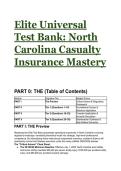
Elite Universal
Test Bank: North
Carolina Casualty
Insurance Mastery
PART 0: THE (Table of Contents)
Section Cognitive Tier Subject Focus
PART I The Preview Critical Axioms & Regulatory
Framework
PART II Tier 1 (Questions 1–15) Foundational Syntax &
Statutory Application
PART II Tier 2 (Questions 16–25) Complex Application &
Actuarial Simulation
PART II Tier 3 (Questions 26–30) Grandmaster Synthesis &
High-Stakes Scenarios
PART I: THE Preview
Mastering this Elite Test Bank guarantees operational superiority in North Carolina’s evolving
regulatory landscape, translating theoretical recall into strategic, high-level professional
competence. By internalizing these meticulously engineered scenarios, academic fluency will
seamlessly convert into flawless execution under the newly codified 2025/2026 statutes.
The "Critical Axioms" Cheat Sheet:
● The 50/100/50 Minimum Baseline: Effective July 1, 2025, North Carolina auto liability
minimums strictly mandate $50,000 per person bodily injury, $100,000 per accident bodily
injury, and $50,000 per accident property damage.
, ● The Zero-Setoff UIM Mandate: Underinsured Motorist (UIM) limits stack completely;
liability payouts no longer offset or reduce the UIM recovery.
● The 3-Employee NCIC Trap: The North Carolina Workers' Compensation Act triggers at
three regular employees; corporate officers absolutely count toward this threshold, even if
they explicitly opt out of personal coverage.
● The SDIP Escalation Matrix (Oct 2025): Property damage thresholds for at-fault
accidents dictate rate hikes. Minor is ≤$3,570; Intermediate is $3,571–$5,974; Major is
≥$5,975.
● The NCIGA Insolvency Caps: The North Carolina Insurance Guaranty Association
(NCIGA) caps standard claims at $300,000, unearned premium returns at $10,000, and
cybersecurity claims at an aggregate $500,000.
PART II: THE ELITE TEST BANK
Q1: A North Carolina driver applies for a new personal auto policy on August 15, 2025. Based
on the statutes codified by Session Law 2023-133 and Session Law 2024-29, which minimum
liability limit configuration is the ONLY legally compliant option for the insurance producer to
quote? A) $30,000 Bodily Injury Per Person / $60,000 Bodily Injury Per Accident / $25,000
Property Damage B) $50,000 Bodily Injury Per Person / $100,000 Bodily Injury Per Accident /
$25,000 Property Damage C) $50,000 Bodily Injury Per Person / $100,000 Bodily Injury Per
Accident / $50,000 Property Damage D) $100,000 Bodily Injury Per Person / $300,000 Bodily
Injury Per Accident / $50,000 Property Damage
● The Answer: C ($50,000 Bodily Injury Per Person / $100,000 Bodily Injury Per Accident /
$50,000 Property Damage)
● Distractor Analysis:
○ A is incorrect: This represents the outdated, legacy minimum limits (30/60/25) that
were entirely phased out for all new and renewing policies effective July 1, 2025.
○ B is incorrect: While the bodily injury limits are correct under the new law, this
option retains the archaic $25,000 property damage limit, which is non-compliant.
○ D is incorrect: These are enhanced, optional limits that a consumer may elect to
purchase or the NCRF may accept under specific federal requirements, but they
are not the statutory minimums required to operate a vehicle.
The Mentor's Analysis: Statutory minimums represent the unyielding hard deck of automotive
insurance compliance. When assessing any policy issued post-July 2025, the immediate priority
is verifying the 50/100/50 baseline. By utilizing the Updated Liability Mandate, you bypass the
common trap of quoting outdated legacy limits to modern clients. Professional/Academic
Intuition: Never issue a post-July 2025 auto policy below 50/100/50; the state has
permanently erased the 30/60/25 threshold to adjust for modern economic inflation.
Q2: A North Carolina roofing contractor operates as a small corporation. The business utilizes
two corporate owner-officers who never perform physical labor and one full-time field employee.
The officers formally elect to exclude themselves from workers' compensation coverage. Based
on the rules of the North Carolina Industrial Commission (NCIC), what is the MOST ACCURATE
legal requirement regarding this business? A) The business is exempt from securing workers'
compensation insurance because it only employs one active, non-exempt worker. B) The
business is exempt because corporate officers who opt out of coverage are legally removed
from the total employee headcount. C) The business must carry workers' compensation
insurance because corporate officers are strictly counted toward the three-employee threshold,
, regardless of their coverage opt-out status. D) The business must carry workers' compensation
insurance solely because roofing is classified as an inherently hazardous occupation.
● The Answer: C (The business must carry workers' compensation insurance because
corporate officers are strictly counted toward the three-employee threshold, regardless of
their coverage opt-out status.)
● Distractor Analysis:
○ A is incorrect: Physical labor or field presence is entirely irrelevant to the statutory
definition of an employee headcount for corporations.
○ B is incorrect: While officers may legally elect to exclude themselves from the
benefits of the policy, they are never excluded from the mathematical headcount
used to trigger the mandate.
○ D is incorrect: While roofing is hazardous, the NC Workers' Compensation Act does
not mandate coverage based solely on physical hazard level (except for radiation).
The mandate is triggered strictly by the headcount.
The Mentor's Analysis: Small business structures frequently attempt to circumvent premium
costs through technicalities and opt-outs. When calculating the NCIC mandate, the immediate
priority is universally counting the corporate officers. By utilizing the Officer Headcount Inclusion
Rule, you bypass the common trap of conflating a coverage opt-out with a headcount exclusion.
Professional/Academic Intuition: An officer's choice to refuse coverage does not erase
their existence; three humans equal a mandatory workers' compensation policy in the
state of North Carolina.
Q3: An admitted domestic property and casualty insurer in North Carolina becomes financially
insolvent and is placed into final liquidation. A consumer has a valid claim for a return of their
unearned premium. Based on the North Carolina Insurance Guaranty Association (NCIGA) Act,
what is the MAXIMUM amount the NCIGA is obligated to pay this specific consumer for their
unearned premium claim? A) $10,000 B) $50,000 C) $300,000 D) Full reimbursement of the
unearned premium with no statutory cap.
● The Answer: A ($10,000)
● Distractor Analysis:
○ B is incorrect: $50,000 is the new property damage liability minimum for auto
insurance, representing a completely unrelated statutory figure.
○ C is incorrect: $300,000 is the statutory maximum cap for standard, covered liability
or property damage claims under the NCIGA, not for the return of unearned
premium.
○ D is incorrect: While workers' compensation benefits are paid in full with no cap,
unearned premium returns are strictly capped by the statute to protect the solvency
of the guaranty fund.
The Mentor's Analysis: Guaranty associations operate as statutory safety nets, not bottomless
financial reservoirs. When handling carrier insolvency, the immediate priority is distinguishing
between an active liability claim and a premium refund request. By utilizing the NCIGA Statutory
Caps, you bypass the common trap of promising clients a full refund of massive commercial
premium deposits. Professional/Academic Intuition: The NCIGA limits its exposure
geometrically: $300,000 for standard claims, unlimited for workers' compensation, and a
strict $10,000 ceiling for unearned premiums.
Q4: An unlicensed car dealership employee refers a prospective car buyer to a licensed North
Carolina insurance producer to secure the auto policy needed to drive the vehicle off the lot. The
producer wishes to compensate the dealership employee for the referral. Based on G.S.
58-33-82, which action is the MOST APPROPRIATE? A) The producer may pay the employee a
Test Bank: North
Carolina Casualty
Insurance Mastery
PART 0: THE (Table of Contents)
Section Cognitive Tier Subject Focus
PART I The Preview Critical Axioms & Regulatory
Framework
PART II Tier 1 (Questions 1–15) Foundational Syntax &
Statutory Application
PART II Tier 2 (Questions 16–25) Complex Application &
Actuarial Simulation
PART II Tier 3 (Questions 26–30) Grandmaster Synthesis &
High-Stakes Scenarios
PART I: THE Preview
Mastering this Elite Test Bank guarantees operational superiority in North Carolina’s evolving
regulatory landscape, translating theoretical recall into strategic, high-level professional
competence. By internalizing these meticulously engineered scenarios, academic fluency will
seamlessly convert into flawless execution under the newly codified 2025/2026 statutes.
The "Critical Axioms" Cheat Sheet:
● The 50/100/50 Minimum Baseline: Effective July 1, 2025, North Carolina auto liability
minimums strictly mandate $50,000 per person bodily injury, $100,000 per accident bodily
injury, and $50,000 per accident property damage.
, ● The Zero-Setoff UIM Mandate: Underinsured Motorist (UIM) limits stack completely;
liability payouts no longer offset or reduce the UIM recovery.
● The 3-Employee NCIC Trap: The North Carolina Workers' Compensation Act triggers at
three regular employees; corporate officers absolutely count toward this threshold, even if
they explicitly opt out of personal coverage.
● The SDIP Escalation Matrix (Oct 2025): Property damage thresholds for at-fault
accidents dictate rate hikes. Minor is ≤$3,570; Intermediate is $3,571–$5,974; Major is
≥$5,975.
● The NCIGA Insolvency Caps: The North Carolina Insurance Guaranty Association
(NCIGA) caps standard claims at $300,000, unearned premium returns at $10,000, and
cybersecurity claims at an aggregate $500,000.
PART II: THE ELITE TEST BANK
Q1: A North Carolina driver applies for a new personal auto policy on August 15, 2025. Based
on the statutes codified by Session Law 2023-133 and Session Law 2024-29, which minimum
liability limit configuration is the ONLY legally compliant option for the insurance producer to
quote? A) $30,000 Bodily Injury Per Person / $60,000 Bodily Injury Per Accident / $25,000
Property Damage B) $50,000 Bodily Injury Per Person / $100,000 Bodily Injury Per Accident /
$25,000 Property Damage C) $50,000 Bodily Injury Per Person / $100,000 Bodily Injury Per
Accident / $50,000 Property Damage D) $100,000 Bodily Injury Per Person / $300,000 Bodily
Injury Per Accident / $50,000 Property Damage
● The Answer: C ($50,000 Bodily Injury Per Person / $100,000 Bodily Injury Per Accident /
$50,000 Property Damage)
● Distractor Analysis:
○ A is incorrect: This represents the outdated, legacy minimum limits (30/60/25) that
were entirely phased out for all new and renewing policies effective July 1, 2025.
○ B is incorrect: While the bodily injury limits are correct under the new law, this
option retains the archaic $25,000 property damage limit, which is non-compliant.
○ D is incorrect: These are enhanced, optional limits that a consumer may elect to
purchase or the NCRF may accept under specific federal requirements, but they
are not the statutory minimums required to operate a vehicle.
The Mentor's Analysis: Statutory minimums represent the unyielding hard deck of automotive
insurance compliance. When assessing any policy issued post-July 2025, the immediate priority
is verifying the 50/100/50 baseline. By utilizing the Updated Liability Mandate, you bypass the
common trap of quoting outdated legacy limits to modern clients. Professional/Academic
Intuition: Never issue a post-July 2025 auto policy below 50/100/50; the state has
permanently erased the 30/60/25 threshold to adjust for modern economic inflation.
Q2: A North Carolina roofing contractor operates as a small corporation. The business utilizes
two corporate owner-officers who never perform physical labor and one full-time field employee.
The officers formally elect to exclude themselves from workers' compensation coverage. Based
on the rules of the North Carolina Industrial Commission (NCIC), what is the MOST ACCURATE
legal requirement regarding this business? A) The business is exempt from securing workers'
compensation insurance because it only employs one active, non-exempt worker. B) The
business is exempt because corporate officers who opt out of coverage are legally removed
from the total employee headcount. C) The business must carry workers' compensation
insurance because corporate officers are strictly counted toward the three-employee threshold,
, regardless of their coverage opt-out status. D) The business must carry workers' compensation
insurance solely because roofing is classified as an inherently hazardous occupation.
● The Answer: C (The business must carry workers' compensation insurance because
corporate officers are strictly counted toward the three-employee threshold, regardless of
their coverage opt-out status.)
● Distractor Analysis:
○ A is incorrect: Physical labor or field presence is entirely irrelevant to the statutory
definition of an employee headcount for corporations.
○ B is incorrect: While officers may legally elect to exclude themselves from the
benefits of the policy, they are never excluded from the mathematical headcount
used to trigger the mandate.
○ D is incorrect: While roofing is hazardous, the NC Workers' Compensation Act does
not mandate coverage based solely on physical hazard level (except for radiation).
The mandate is triggered strictly by the headcount.
The Mentor's Analysis: Small business structures frequently attempt to circumvent premium
costs through technicalities and opt-outs. When calculating the NCIC mandate, the immediate
priority is universally counting the corporate officers. By utilizing the Officer Headcount Inclusion
Rule, you bypass the common trap of conflating a coverage opt-out with a headcount exclusion.
Professional/Academic Intuition: An officer's choice to refuse coverage does not erase
their existence; three humans equal a mandatory workers' compensation policy in the
state of North Carolina.
Q3: An admitted domestic property and casualty insurer in North Carolina becomes financially
insolvent and is placed into final liquidation. A consumer has a valid claim for a return of their
unearned premium. Based on the North Carolina Insurance Guaranty Association (NCIGA) Act,
what is the MAXIMUM amount the NCIGA is obligated to pay this specific consumer for their
unearned premium claim? A) $10,000 B) $50,000 C) $300,000 D) Full reimbursement of the
unearned premium with no statutory cap.
● The Answer: A ($10,000)
● Distractor Analysis:
○ B is incorrect: $50,000 is the new property damage liability minimum for auto
insurance, representing a completely unrelated statutory figure.
○ C is incorrect: $300,000 is the statutory maximum cap for standard, covered liability
or property damage claims under the NCIGA, not for the return of unearned
premium.
○ D is incorrect: While workers' compensation benefits are paid in full with no cap,
unearned premium returns are strictly capped by the statute to protect the solvency
of the guaranty fund.
The Mentor's Analysis: Guaranty associations operate as statutory safety nets, not bottomless
financial reservoirs. When handling carrier insolvency, the immediate priority is distinguishing
between an active liability claim and a premium refund request. By utilizing the NCIGA Statutory
Caps, you bypass the common trap of promising clients a full refund of massive commercial
premium deposits. Professional/Academic Intuition: The NCIGA limits its exposure
geometrically: $300,000 for standard claims, unlimited for workers' compensation, and a
strict $10,000 ceiling for unearned premiums.
Q4: An unlicensed car dealership employee refers a prospective car buyer to a licensed North
Carolina insurance producer to secure the auto policy needed to drive the vehicle off the lot. The
producer wishes to compensate the dealership employee for the referral. Based on G.S.
58-33-82, which action is the MOST APPROPRIATE? A) The producer may pay the employee a


