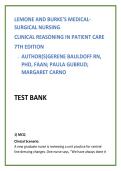
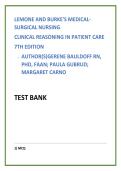
LEMONE AND BURKE'S MEDICAL-
SURGICAL NURSING
CLINICAL REASONING IN PATIENT CARE
7TH EDITION
AUTHOR(S)GERENE BAULDOFF RN,
PHD, FAAN; PAULA GUBRUD;
MARGARET CARNO
TEST BANK
1. Question type: MCQ
Clinical Scenario:
A nurse receives shift report on a postoperative patient. The
patient is drowsy, has a respiratory rate of 10/min, oxygen
,saturation of 90% on room air, and received IV morphine 30
minutes ago.
Question Stem:
Which action best demonstrates clinical reasoning in this
situation?
Answer Options:
A. Document the findings and reassess at the next routine vital
sign check.
B. Recognize the abnormal cues as urgent and begin focused
respiratory assessment immediately.
C. Ask the unlicensed assistive personnel (UAP) to encourage
the patient to deep breathe.
D. Administer the next scheduled opioid dose to maintain pain
control.
Correct Answer:
B
Detailed Rationale:
The nurse must recognize that a respiratory rate of 10/min, low
oxygen saturation, drowsiness, and recent opioid
administration may indicate opioid-related respiratory
depression. Clinical reasoning requires identifying the
significance of the cues and responding immediately with
focused assessment and escalation as needed. This reflects
safe, timely decision-making and supports patient safety.
Incorrect Option Analysis:
, A: Incorrect because delaying action risks worsening
hypoventilation and hypoxemia. This reflects under-
recognition of deterioration.
C: Incorrect because this does not address the urgent
cause of the problem. UAPs cannot independently assess
or interpret respiratory compromise.
D: Incorrect because another opioid dose could worsen
respiratory depression and place the patient at serious
risk.
Nursing Process Linkage:
Assessment
Clinical Judgment Competencies (NCJMM):
Recognize Cues; Analyze Cues
Clinical Reasoning Focus:
Cue Recognition
Difficulty Level:
Difficult
Bloom’s Cognitive Level:
Analyze
NCLEX Client Needs Category:
Physiological Adaptation
Key Learning Objective:
Identify urgent cues that require immediate nursing assessment
and escalation.
, 2. Question Type: SATA
Clinical Scenario:
A newly licensed nurse is reviewing safe practice behaviors on a
medical-surgical unit.
Question Stem:
Which actions reflect core competencies for safe and effective
healthcare? Select all that apply.
Answer Options:
A. Use two patient identifiers before administering medication.
B. Clarify an order that is incomplete or unclear before carrying
it out.
C. Leave a prepared syringe at the bedside so it is ready when
the patient returns.
D. Verify competency before delegating a sterile dressing
change.
E. Record vital signs for another nurse when the patient was
not assessed by you.
Correct Answers:
A, B, D
Detailed Rationale:
Safe care requires correct patient identification, clarification of
unclear orders, and delegation only after verifying that the
delegatee is competent for the task. These actions reduce
medication errors, procedural mistakes, and unsafe delegation.
SURGICAL NURSING
CLINICAL REASONING IN PATIENT CARE
7TH EDITION
AUTHOR(S)GERENE BAULDOFF RN,
PHD, FAAN; PAULA GUBRUD;
MARGARET CARNO
TEST BANK
1. Question type: MCQ
Clinical Scenario:
A nurse receives shift report on a postoperative patient. The
patient is drowsy, has a respiratory rate of 10/min, oxygen
,saturation of 90% on room air, and received IV morphine 30
minutes ago.
Question Stem:
Which action best demonstrates clinical reasoning in this
situation?
Answer Options:
A. Document the findings and reassess at the next routine vital
sign check.
B. Recognize the abnormal cues as urgent and begin focused
respiratory assessment immediately.
C. Ask the unlicensed assistive personnel (UAP) to encourage
the patient to deep breathe.
D. Administer the next scheduled opioid dose to maintain pain
control.
Correct Answer:
B
Detailed Rationale:
The nurse must recognize that a respiratory rate of 10/min, low
oxygen saturation, drowsiness, and recent opioid
administration may indicate opioid-related respiratory
depression. Clinical reasoning requires identifying the
significance of the cues and responding immediately with
focused assessment and escalation as needed. This reflects
safe, timely decision-making and supports patient safety.
Incorrect Option Analysis:
, A: Incorrect because delaying action risks worsening
hypoventilation and hypoxemia. This reflects under-
recognition of deterioration.
C: Incorrect because this does not address the urgent
cause of the problem. UAPs cannot independently assess
or interpret respiratory compromise.
D: Incorrect because another opioid dose could worsen
respiratory depression and place the patient at serious
risk.
Nursing Process Linkage:
Assessment
Clinical Judgment Competencies (NCJMM):
Recognize Cues; Analyze Cues
Clinical Reasoning Focus:
Cue Recognition
Difficulty Level:
Difficult
Bloom’s Cognitive Level:
Analyze
NCLEX Client Needs Category:
Physiological Adaptation
Key Learning Objective:
Identify urgent cues that require immediate nursing assessment
and escalation.
, 2. Question Type: SATA
Clinical Scenario:
A newly licensed nurse is reviewing safe practice behaviors on a
medical-surgical unit.
Question Stem:
Which actions reflect core competencies for safe and effective
healthcare? Select all that apply.
Answer Options:
A. Use two patient identifiers before administering medication.
B. Clarify an order that is incomplete or unclear before carrying
it out.
C. Leave a prepared syringe at the bedside so it is ready when
the patient returns.
D. Verify competency before delegating a sterile dressing
change.
E. Record vital signs for another nurse when the patient was
not assessed by you.
Correct Answers:
A, B, D
Detailed Rationale:
Safe care requires correct patient identification, clarification of
unclear orders, and delegation only after verifying that the
delegatee is competent for the task. These actions reduce
medication errors, procedural mistakes, and unsafe delegation.