

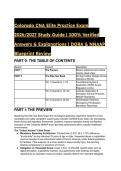
Colorado CNA Elite Practice Exam
2026/2027 Study Guide | 100% Verified
Answers & Explanations | DORA & NNAAP
Blueprint Review
PART 0: THE TABLE OF CONTENTS
Section Content Description
PART I The Preview Mission statement and Critical
Axioms cheat sheet.
PART II The Elite Test Bank 60 High-Caliber Multiple-Choice
Questions (MCQs).
Tier 1 (Questions 1–15) Foundational Syntax &
Application (DORA Scope,
Regulatory Limits).
Tier 2 (Questions 16–35) Complex Application &
Simulation (Clinical Protocols,
NNAAP Standards).
Tier 3 (Questions 36–60) Grandmaster Synthesis
(Emergency Prioritization,
Mandatory Reporting).
PART I: THE PREVIEW
Mastering this Elite Test Bank forges the neurological pathways required to transform novice
candidates into highly competent, board-ready Colorado Certified Nurse Aides. By internalizing
these clinical and regulatory frameworks, academic mastery translates directly into flawless
execution on the Credentia NNAAP exam and elite performance within complex healthcare
environments.
The "Critical Axioms" Cheat Sheet:
● Mandatory Reporting Architecture: Colorado law (C.R.S. 26-3.1-101) defines an
"at-risk elder" as any individual 70 years of age or older. Suspected abuse or exploitation
must be reported to law enforcement within 24 hours. However, under federal guidelines
for facilities, if the suspicion of a crime results in serious bodily injury, the reporting
timeline compresses to a maximum of 2 hours.
● Delegation vs. Expanded Scope: Under C.R.S. 12-255-206, specific tasks such as
digital stimulation, suppository insertion, and gastrostomy-tube feedings are legally
classified as an expanded scope of practice, explicitly distinct from standard delegated
, nursing tasks. A Registered Nurse (RN) must formally deem the CNA competent to
perform these actions.
● The CNA-Med Distinction: Standard CNAs are strictly prohibited from performing
invasive tasks like fingerstick blood glucose monitoring or medication administration.
These interventions require completion of an approved Medication Aide (CNA-Med)
training program under 3 CCR 716-1 Chapter 19.
● DORA Licensure Renewal: Certification is valid for 24 months. To maintain an active
license, a CNA must document a minimum of 8 hours of compensated nursing-related
employment supervised by a licensed nurse and remit a $25 fee via the DORA portal.
● Training and NNAAP Exam Parameters: Colorado exceeds federal training minimums,
mandating 100 total hours (60 hours classroom/lab, 40 hours clinical). The Credentia
written exam comprises 70 multiple-choice questions dominating in Physical Care Skills
(64%). The clinical skills evaluation mandates 5 tasks, universally requiring Hand Hygiene
and at least one Measurement skill.
PART II: THE ELITE TEST BANK
Tier 1: Foundational Syntax & Application
Q1: A Certified Nurse Aide (CNA) in Colorado is preparing to renew their certification online via
the Division of Professions and Occupations (DORA) portal. Based on the principles of the
Colorado Nurse Aide Practice Act, which action/conclusion is the MOST ACCURATE regarding
renewal requirements? A) The candidate must log a minimum of 16 hours of unpaid clinical
volunteering in a certified facility. B) The candidate must complete 24 hours of continuing
education units focusing on geriatric care. C) The candidate must document at least 8 hours of
compensated nursing-related employment within the past 24 months. D) The candidate must
retake the NNAAP written examination prior to submitting the renewal fee.
● The Answer: C (The candidate must document at least 8 hours of compensated
nursing-related employment within the past 24 months.)
● Distractor Analysis:
○ A is incorrect: Regulatory standards mandate that the employment must be
explicitly compensated (paid); volunteer hours do not legally satisfy the active
practice requirement.
○ B is incorrect: Standard CNAs are not universally required to submit CE units
unless specifically mandated by DORA as a disciplinary or conditional stipulation.
○ D is incorrect: Retesting is only legislatively required if the license has lapsed
beyond the two-year expiration window and the 60-day grace period.
The Mentor's Analysis: Certification renewal serves as a regulatory mechanism to validate
ongoing clinical competence and prevent skill degradation. When maintaining a Colorado CNA
license, the immediate priority is meeting the statutory work threshold established by the Board
of Nursing. By tracking compensated employment hours, the practitioner bypasses the
administrative trap of a lapsed license and the subsequent burden of competency re-evaluation.
Professional/Academic Intuition: Eight Hours of Paid Clinical Practice Every 24 Months
Secures Licensure.
Q2: A candidate is reviewing the structure of the Credentia certification exam. Based on the
principles of the National Nurse Aide Assessment Program (NNAAP) blueprint, which
conclusion is the MOST ACCURATE regarding exam architecture? A) The written exam
, consists of 100 essay-based scenarios evaluating complex clinical reasoning. B) The written
exam contains 70 multiple-choice items, heavily weighted toward Physical Care Skills. C) The
clinical exam requires the candidate to successfully perform 10 randomly selected restorative
skills. D) The exam is exclusively clinical and features no written component for candidates in
Colorado.
● The Answer: B (The written exam contains 70 multiple-choice items, heavily weighted
toward Physical Care Skills.)
● Distractor Analysis:
○ A is incorrect: The NNAAP does not utilize essay formats for baseline certification,
relying entirely on standardized objective testing.
○ C is incorrect: The clinical skills evaluation requires the demonstration of exactly 5
skills, not 10, to ensure a standardized assessment duration.
○ D is incorrect: Certification legally requires passing both a clinical skills test and a
written or oral knowledge-based examination.
The Mentor's Analysis: Familiarity with exam architecture prevents cognitive fatigue and
optimizes study prioritization. When preparing for the NNAAP, the immediate priority is allocating
study time according to the official blueprint, which allocates 64% of the exam to physical care
parameters. By focusing on Physical Care Skills, the candidate bypasses the trap of
over-studying low-yield psychosocial domains at the expense of core competencies.
Professional/Academic Intuition: Anticipate a 70-Question Gauntlet Dominating in
Physical Care and Activities of Daily Living.
Q3: A facility charge nurse asks a newly certified CNA to check a resident's blood glucose using
a fingerstick monitor. The CNA does not hold a Medication Aide (CNA-Med) authority. Based on
the principles of Colorado Board of Nursing Delegation Rules, which action is the MOST
APPROPRIATE? A) Perform the fingerstick, as this is a basic vital sign measurement routinely
delegated to unlicensed assistive personnel. B) Refuse the task, as standard CNAs are strictly
prohibited from performing fingerstick blood glucose testing. C) Perform the task only if the
supervising registered nurse directly observes the entire procedure. D) Perform the task after
obtaining written informed consent directly from the resident or their power of attorney.
● The Answer: B (Refuse the task, as standard CNAs are strictly prohibited from
performing fingerstick blood glucose testing.)
● Distractor Analysis:
○ A is incorrect: Fingerstick testing is an invasive procedure requiring capillary
puncture, necessitating advanced CNA-Med certification in Colorado.
○ C is incorrect: Direct supervision by a licensed professional does not legally
override state scope-of-practice limitations.
○ D is incorrect: Patient consent does not legitimize an inherently out-of-scope
procedure; scope is defined by statute, not patient preference.
The Mentor's Analysis: Scope of practice represents an impenetrable legal boundary designed
to ensure patient safety. When asked to perform invasive glucose monitoring, the immediate
priority is protecting the patient from unqualified interventions and protecting one's license from
disciplinary action. By utilizing scope refusal protocols, the practitioner bypasses the trap of
practicing nursing without advanced legislative authorization. Professional/Academic
Intuition: Standard CNAs Never Perform Fingersticks; Only CNA-Meds Possess This
Specific Authority.
Q4: A nursing home resident sustains a severe laceration resulting in extreme physical pain,
defined federally as "serious bodily injury." Based on the principles of Colorado Mandatory
Reporting rules and the Elder Justice Act, which action represents the FIRST legally required
2026/2027 Study Guide | 100% Verified
Answers & Explanations | DORA & NNAAP
Blueprint Review
PART 0: THE TABLE OF CONTENTS
Section Content Description
PART I The Preview Mission statement and Critical
Axioms cheat sheet.
PART II The Elite Test Bank 60 High-Caliber Multiple-Choice
Questions (MCQs).
Tier 1 (Questions 1–15) Foundational Syntax &
Application (DORA Scope,
Regulatory Limits).
Tier 2 (Questions 16–35) Complex Application &
Simulation (Clinical Protocols,
NNAAP Standards).
Tier 3 (Questions 36–60) Grandmaster Synthesis
(Emergency Prioritization,
Mandatory Reporting).
PART I: THE PREVIEW
Mastering this Elite Test Bank forges the neurological pathways required to transform novice
candidates into highly competent, board-ready Colorado Certified Nurse Aides. By internalizing
these clinical and regulatory frameworks, academic mastery translates directly into flawless
execution on the Credentia NNAAP exam and elite performance within complex healthcare
environments.
The "Critical Axioms" Cheat Sheet:
● Mandatory Reporting Architecture: Colorado law (C.R.S. 26-3.1-101) defines an
"at-risk elder" as any individual 70 years of age or older. Suspected abuse or exploitation
must be reported to law enforcement within 24 hours. However, under federal guidelines
for facilities, if the suspicion of a crime results in serious bodily injury, the reporting
timeline compresses to a maximum of 2 hours.
● Delegation vs. Expanded Scope: Under C.R.S. 12-255-206, specific tasks such as
digital stimulation, suppository insertion, and gastrostomy-tube feedings are legally
classified as an expanded scope of practice, explicitly distinct from standard delegated
, nursing tasks. A Registered Nurse (RN) must formally deem the CNA competent to
perform these actions.
● The CNA-Med Distinction: Standard CNAs are strictly prohibited from performing
invasive tasks like fingerstick blood glucose monitoring or medication administration.
These interventions require completion of an approved Medication Aide (CNA-Med)
training program under 3 CCR 716-1 Chapter 19.
● DORA Licensure Renewal: Certification is valid for 24 months. To maintain an active
license, a CNA must document a minimum of 8 hours of compensated nursing-related
employment supervised by a licensed nurse and remit a $25 fee via the DORA portal.
● Training and NNAAP Exam Parameters: Colorado exceeds federal training minimums,
mandating 100 total hours (60 hours classroom/lab, 40 hours clinical). The Credentia
written exam comprises 70 multiple-choice questions dominating in Physical Care Skills
(64%). The clinical skills evaluation mandates 5 tasks, universally requiring Hand Hygiene
and at least one Measurement skill.
PART II: THE ELITE TEST BANK
Tier 1: Foundational Syntax & Application
Q1: A Certified Nurse Aide (CNA) in Colorado is preparing to renew their certification online via
the Division of Professions and Occupations (DORA) portal. Based on the principles of the
Colorado Nurse Aide Practice Act, which action/conclusion is the MOST ACCURATE regarding
renewal requirements? A) The candidate must log a minimum of 16 hours of unpaid clinical
volunteering in a certified facility. B) The candidate must complete 24 hours of continuing
education units focusing on geriatric care. C) The candidate must document at least 8 hours of
compensated nursing-related employment within the past 24 months. D) The candidate must
retake the NNAAP written examination prior to submitting the renewal fee.
● The Answer: C (The candidate must document at least 8 hours of compensated
nursing-related employment within the past 24 months.)
● Distractor Analysis:
○ A is incorrect: Regulatory standards mandate that the employment must be
explicitly compensated (paid); volunteer hours do not legally satisfy the active
practice requirement.
○ B is incorrect: Standard CNAs are not universally required to submit CE units
unless specifically mandated by DORA as a disciplinary or conditional stipulation.
○ D is incorrect: Retesting is only legislatively required if the license has lapsed
beyond the two-year expiration window and the 60-day grace period.
The Mentor's Analysis: Certification renewal serves as a regulatory mechanism to validate
ongoing clinical competence and prevent skill degradation. When maintaining a Colorado CNA
license, the immediate priority is meeting the statutory work threshold established by the Board
of Nursing. By tracking compensated employment hours, the practitioner bypasses the
administrative trap of a lapsed license and the subsequent burden of competency re-evaluation.
Professional/Academic Intuition: Eight Hours of Paid Clinical Practice Every 24 Months
Secures Licensure.
Q2: A candidate is reviewing the structure of the Credentia certification exam. Based on the
principles of the National Nurse Aide Assessment Program (NNAAP) blueprint, which
conclusion is the MOST ACCURATE regarding exam architecture? A) The written exam
, consists of 100 essay-based scenarios evaluating complex clinical reasoning. B) The written
exam contains 70 multiple-choice items, heavily weighted toward Physical Care Skills. C) The
clinical exam requires the candidate to successfully perform 10 randomly selected restorative
skills. D) The exam is exclusively clinical and features no written component for candidates in
Colorado.
● The Answer: B (The written exam contains 70 multiple-choice items, heavily weighted
toward Physical Care Skills.)
● Distractor Analysis:
○ A is incorrect: The NNAAP does not utilize essay formats for baseline certification,
relying entirely on standardized objective testing.
○ C is incorrect: The clinical skills evaluation requires the demonstration of exactly 5
skills, not 10, to ensure a standardized assessment duration.
○ D is incorrect: Certification legally requires passing both a clinical skills test and a
written or oral knowledge-based examination.
The Mentor's Analysis: Familiarity with exam architecture prevents cognitive fatigue and
optimizes study prioritization. When preparing for the NNAAP, the immediate priority is allocating
study time according to the official blueprint, which allocates 64% of the exam to physical care
parameters. By focusing on Physical Care Skills, the candidate bypasses the trap of
over-studying low-yield psychosocial domains at the expense of core competencies.
Professional/Academic Intuition: Anticipate a 70-Question Gauntlet Dominating in
Physical Care and Activities of Daily Living.
Q3: A facility charge nurse asks a newly certified CNA to check a resident's blood glucose using
a fingerstick monitor. The CNA does not hold a Medication Aide (CNA-Med) authority. Based on
the principles of Colorado Board of Nursing Delegation Rules, which action is the MOST
APPROPRIATE? A) Perform the fingerstick, as this is a basic vital sign measurement routinely
delegated to unlicensed assistive personnel. B) Refuse the task, as standard CNAs are strictly
prohibited from performing fingerstick blood glucose testing. C) Perform the task only if the
supervising registered nurse directly observes the entire procedure. D) Perform the task after
obtaining written informed consent directly from the resident or their power of attorney.
● The Answer: B (Refuse the task, as standard CNAs are strictly prohibited from
performing fingerstick blood glucose testing.)
● Distractor Analysis:
○ A is incorrect: Fingerstick testing is an invasive procedure requiring capillary
puncture, necessitating advanced CNA-Med certification in Colorado.
○ C is incorrect: Direct supervision by a licensed professional does not legally
override state scope-of-practice limitations.
○ D is incorrect: Patient consent does not legitimize an inherently out-of-scope
procedure; scope is defined by statute, not patient preference.
The Mentor's Analysis: Scope of practice represents an impenetrable legal boundary designed
to ensure patient safety. When asked to perform invasive glucose monitoring, the immediate
priority is protecting the patient from unqualified interventions and protecting one's license from
disciplinary action. By utilizing scope refusal protocols, the practitioner bypasses the trap of
practicing nursing without advanced legislative authorization. Professional/Academic
Intuition: Standard CNAs Never Perform Fingersticks; Only CNA-Meds Possess This
Specific Authority.
Q4: A nursing home resident sustains a severe laceration resulting in extreme physical pain,
defined federally as "serious bodily injury." Based on the principles of Colorado Mandatory
Reporting rules and the Elder Justice Act, which action represents the FIRST legally required


